Workwear Manufacturers: A Global Comparison Guide for Buyers
Choosing between workwear manufacturers in different countries is one of the most important sourcing decisions a buyer makes. The wrong choice affects your cost, your compliance, your lead times, and ultimately your reputation with the clients you supply.
This guide compares the four countries that dominate global workwear manufacturing today: Bangladesh, China, Vietnam, and Turkey. For each country we cover the key factors that matter to B2B buyers: production cost, quality standards, compliance certifications, minimum order quantities, lead times, and the types of workwear each country does best.
If you are sourcing industrial workwear, safety garments, or uniforms for any sector, this comparison will help you make a more informed decision about where to place your next order.
Why the Country of Manufacture Matters More Than Most Buyers Realise
Most buyers focus on unit price when comparing workwear manufacturers. That is understandable, but it is only part of the picture. A lower unit price from a manufacturer with poor quality control can result in higher total costs once you factor in rejects, rework, delayed shipments, and customer returns.
The country of manufacture affects several things simultaneously: the labour cost base, the availability of specialist fabrics, the factory compliance standards that local law and export markets require, and the proximity to shipping routes that affect lead times and freight costs.
A well-matched sourcing decision considers all of these factors
together, not just the price per garment.
Bangladesh: The Strongest Case for Industrial and Safety Workwear
Bangladesh is the world’s second-largest apparel exporter and has built a specific strength in workwear and uniforms over the past decade. The country’s workwear manufacturers have invested heavily in technical fabric capabilities, safety compliance certifications, and quality management systems that meet the requirements of buyers in the USA, Europe, Middle East, and Australia.
Cost
Bangladesh consistently offers the lowest production costs among
major workwear manufacturing countries. Labour costs are
significantly lower than China, Vietnam, or Turkey. Combined with
competitive fabric sourcing and a large skilled workforce, this
makes Bangladesh the most cost-effective option for most workwear
categories, particularly for bulk orders above 500 pieces per style.
Quality and compliance
The leading workwear manufacturers in Bangladesh hold certifications including WRAP, BSCI, SEDEX, OEKO-TEX, and RSC. For specialist safety garments, factories produce to EN ISO 11612 (flame-resistant clothing), EN ISO 20471 (high-visibility clothing), and EN 1149-5 (antistatic properties). These are the same standards required by major oil and gas operators, construction contractors, and utility companies worldwide.
Best for
Industrial coveralls, flame-resistant garments, hi-vis workwear, Nomex and Kevlar coveralls for oil and gas, healthcare uniforms, hospitality uniforms, and outdoor clothing. Bangladesh workwear manufacturers cover the widest range of categories at the most competitive price point.
Typical MOQ and lead time
MOQ typically starts from 500 pieces per style and colour. Bulk production lead times run 45 to 90 days from sample approval depending on the garment type and order volume.
China: High Capacity but Rising Costs and Compliance Complexity
China remains the largest garment manufacturer in the world by volume. Chinese workwear manufacturers offer enormous production capacity, a vast fabric supply chain, and the ability to handle highly complex technical garments. However the competitive advantage China held for most of the 2000s and 2010s has narrowed significantly.
Cost
Labour costs in China have risen steadily for over a decade. For
most standard workwear categories, China is now 20 to 40 percent more expensive than Bangladesh on a unit cost basis. Freight costs from China to Europe and North America are also typically higher than from Bangladesh due to longer transit routes.
Quality and compliance
Chinese workwear manufacturers vary widely in quality. Top-tier
factories produce excellent technical garments. However the
sheer number of manufacturers makes it harder for buyers to identify and verify reliable partners without significant due diligence or on-the-ground sourcing support. Compliance documentation is available but requires careful verification.
Best for
High-complexity technical garments, very large volume orders above 10,000 pieces, and categories requiring specialist machinery that is not widely available elsewhere. China remains competitive for buyers who need extremely high volumes with tight technical specifications.
Typical MOQ and lead time
MOQ varies widely but typically starts from 500 to 1,000 pieces per style. Lead times are generally similar to Bangladesh at 45 to 90 days depending on complexity.
Vietnam: Strong for Outdoor and Performance Workwear
Vietnam has grown rapidly as a workwear and apparel manufacturing destination over the past decade, partly as buyers diversified away from China. Vietnamese workwear manufacturers have developed particular strength in performance fabrics, outdoor clothing, and technical sportswear-adjacent categories.
Cost
Vietnam sits between China and Bangladesh on cost. Labour costs
are higher than Bangladesh but lower than China for most categories. For standard industrial workwear, Bangladesh offers
better value. For performance outdoor garments with technical
fabric requirements, Vietnam is often more competitive due to stronger local fabric supply chains for those specific materials.
Quality and compliance
Vietnamese factories have invested significantly in quality management and compliance certifications. WRAP, BSCI, and OEKO-TEX certified factories are common among established manufacturers. However, specialist safety certifications for FR workwear and hi-vis clothing are less widely available than in Bangladesh, where demand from oil and gas buyers has driven greater investment in those specific standards.
Best for
Outdoor performance clothing, technical jackets, rainwear, fleece garments, and workwear categories that overlap with outdoor and activewear. Less competitive for specialist safety workwear such as FR coveralls and certified hi-vis garments.
Typical MOQ and lead time
MOQ typically starts from 500 pieces per style. Lead times are
generally 60 to 90 days from sample approval.
Turkey: Best for European Buyers Needing Short Lead Times
Turkey is the most expensive of the four countries for workwear
manufacturing. Unit costs are typically two to three times higher than Bangladesh for comparable garments. For buyers where lead time and proximity to market outweigh cost considerations, this premium is justified. For buyers focused primarily on cost efficiency, Turkey is rarely the right choice for large-volume workwear programs.
Quality and compliance
Turkish workwear manufacturers generally produce to high-quality standards with strong fabric availability and good compliance infrastructure. EU proximity means many factories are familiar with European compliance requirements. However, the same EN ISO certifications for specialist safety workwear are available from Bangladeshi manufacturers at a fraction of the cost.
Typical MOQ and lead time
MOQ typically starts from 300 to 500 pieces. Lead times to European markets are typically 20 to 35 days from order confirmation.
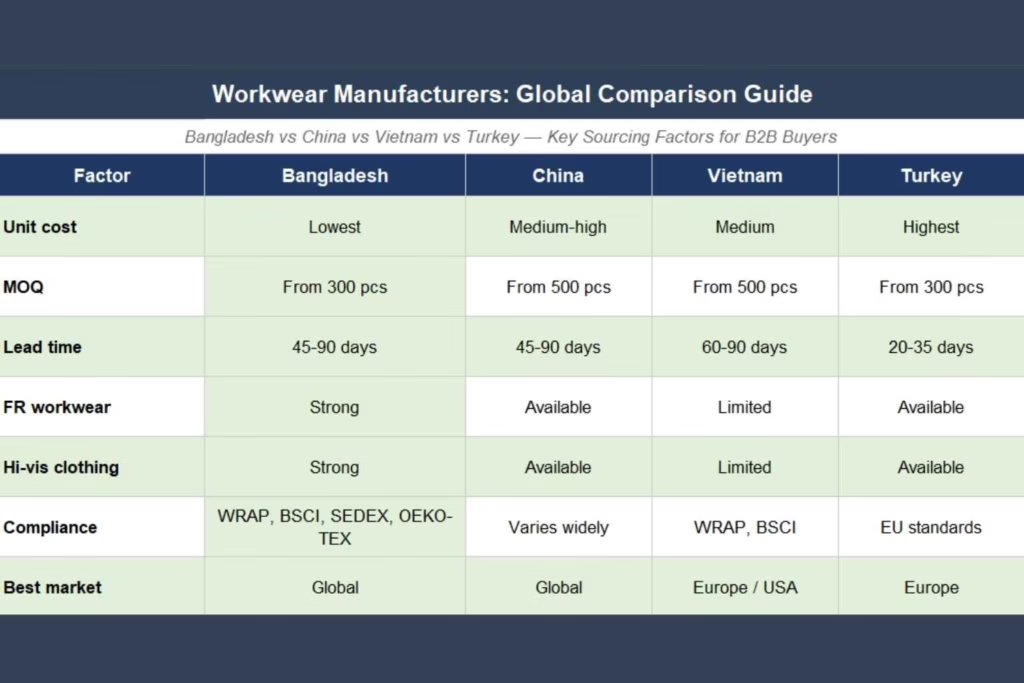
Side-by-Side Comparison of Workwear Manufacturers by Country
How to Choose the Right Workwear Manufacturer for Your Programme
The right choice depends on three questions.
– What is your priority: cost or speed? If cost efficiency on large volumes is your primary need, Bangladesh workwear manufacturers offer the strongest combination of price, compliance, and product range. If speed to market in Europe is your priority and cost is secondary, Turkey may suit certain programs.
– What type of workwear are you sourcing? For specialist safety garments, including FR coveralls, hi-vis clothing, and Nomex Kevlar garments, Bangladesh is the clear choice. The investment in safety certifications and technical fabric capabilities is deeper there than in any other low-cost manufacturing country.
– What compliance standards does your market require? If you are supplying into oil and gas, construction, or utilities in Europe
or the Middle East, you need EN ISO 11612 and EN ISO 20471
certified production. These standards are well established among
Bangladesh workwear manufacturers are less consistently available elsewhere at the same price point.
Why Bangladesh Workwear Manufacturers Are the Right Choice for Most Global Buyers
For the majority of B2B buyers sourcing industrial workwear, safety garments, healthcare uniforms, or hospitality uniforms
at scale, Bangladesh offers the most complete combination of
competitive pricing, compliance depth, product range, and
reliable supply infrastructure.
The country’s workwear manufacturers have spent the last decade building the factory certifications, technical fabric networks, and quality management systems that global buyers require. The result is a sourcing destination that competes on more than price alone.
Bengal Apparel BD works with importers, distributors, and
private-label brands across the USA, Europe, the Middle East, Canada, and Australia. We manage the full production process from fabric sourcing to export documentation, so you work with one contact regardless of how many garment categories your program includes.
If you are evaluating workwear manufacturers for your next production program, contact Bengal Apparel BD to discuss your specification, target volume, and destination market. We will
respond within one business day with pricing and a production timeline.