In oil and gas, petrochemical, and utility environments, a garment is not just a uniform. It is the last line of protection between a worker and a serious injury. For procurement managers and safety officers, understanding what a certified flame-resistant garment actually proves, and what it does not, is the foundation of a compliant PPE program.
This EN ISO 11612 guide covers what the standard tests for, how to read the performance codes on a certificate, how EN 1149-5 anti-static standards work alongside FR certification, and how to choose between inherent FR and treated FR fabric for your specific application.
What Is EN ISO 11612 and Why Does This Guide Matter for Buyers
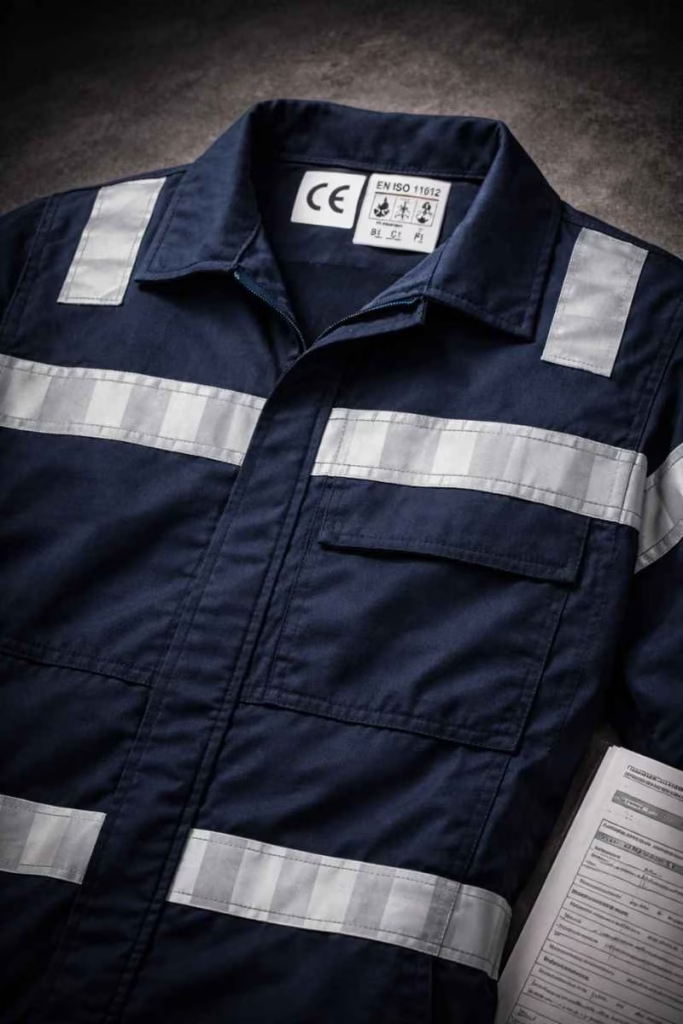
EN ISO 11612 is the international standard for protective clothing against heat and flame. It defines the tests a garment must pass to be considered protective against specific heat and flame hazards, and it assigns letter and number codes to the results of each test.
The standard matters because the phrase “flame-resistant” on its own proves nothing. A garment can carry FR branding without having been tested to any recognised standard. EN ISO 11612 certification, issued by an accredited Notified Body, is the document that proves the garment has been independently tested and meets defined performance levels.
For procurement teams buying FR workwear for oil and gas, petrochemical, refinery, utility, or metalwork applications, this EN ISO 11612 guide will help you specify correctly, verify documentation properly, and avoid the costly mistake of purchasing garments that look compliant but are not.
EN ISO 11612 Guide: The Six Performance Codes Explained
When a supplier provides an EN ISO 11612 certificate, it will include a set of letter and number codes. Each letter corresponds to a different hazard test. Each number indicates the performance level achieved in that test. A garment can pass some tests and not others, which is why reading the codes correctly is essential.
Code A: Limited Flame Spread
Code A is the foundation of EN ISO 11612 certification. There are two test methods: A1 and A2. Both test how a flame behaves when it contacts the fabric surface and whether the fabric continues to burn after the ignition source is removed.
A compliant garment must achieve either A1 or A2, or both. For most oil and gas and petrochemical applications, both A1 and A2 are specified. If a certificate shows only one, confirm with the supplier which test method applies to your end-use environment.
Code B: Convective Heat Protection
Code B measures how well the fabric protects against heat carried through the air, such as hot gases passing over a garment surface during a flash fire event. The result is expressed as a Heat Transfer Index (HTI) value.
B1 is the minimum performance level, B3 is the highest. For offshore oil and gas workers and refinery personnel with continuous exposure to heat hazards, B2 or B3 is worth specifying. B1 is acceptable for lower-risk industrial environments where heat exposure is intermittent.
Code C: Radiant Heat Protection
Code C measures protection against heat radiating from an external source, such as an open flame, furnace, or hot surface at a distance. C1 is the minimum, C4 is the highest.
For workers in steel, aluminium, and foundry environments or those working near open process flares in petrochemical plants, a higher C classification is relevant. For general industrial use, C1 or C2 is typically sufficient.
Code D: Molten Aluminium Splash
Code D tests protection against splashes of molten aluminium. This code is relevant to aluminium smelting, casting, and die-casting industries. It is not commonly required in oil and gas programs but may appear in multi-norm specifications for heavy industrial manufacturing.
Code E: Molten Iron Splash
Code E tests protection against splashes of molten iron or steel. It is required for foundry workers, steelmakers, and metal fabrication environments where molten metal contact is a real risk. E3 is a common requirement in comprehensive multi-norm programs covering both FR and metalwork hazards.
Code F: Contact Heat
Code F measures what happens when the fabric comes into direct contact with a hot surface. F1 is the minimum, F3 is the highest. This is relevant for workers who regularly handle hot pipes, valves, fittings, or equipment surfaces as part of their daily tasks.
Reading a Certificate: A Practical Example
A garment labelled EN ISO 11612 A1 A2 B1 C1 has been tested for flame spread (both methods), basic convective heat, and basic radiant heat. It provides a foundation level of protection suitable for many general industrial applications.
A garment labelled EN ISO 11612 A1 A2 B2 C2 E3 F1 has been tested across a wider range of hazards at higher performance levels. This is a more comprehensive specification suited to environments with multiple and overlapping heat and flame risks.
The codes are not marketing language. They are test results. A certificate without specific codes is not adequate documentation for a compliant FR procurement program.
EN ISO 11612 Guide: The Role of EN ISO 13688
No EN ISO 11612 guide is complete without covering EN ISO 13688, the base standard that underpins all protective clothing certification.
EN ISO 13688 sets the general requirements that every protective garment must meet before any hazard-specific standard applies. It covers ergonomics, material innocuousness, size designation, and labeling requirements. It also defines what information must appear in the garment’s care and user instructions.
A garment that holds an EN ISO 11612 performance certificate but cannot demonstrate EN ISO 13688 compliance is not fully certified as a finished protective garment. When reviewing supplier documentation, ask for evidence of both.
EN 1149-5 Anti-Static Standards: What Buyers Need to Know
EN 1149-5 is the standard governing electrostatic dissipative protective clothing. It works alongside EN ISO 11612 in environments where both flame hazard and static electricity risk are present simultaneously.
Why EN 1149-5 Anti-Static Standards Exist
In ATEX zones, which are classified areas where explosive or flammable atmospheres can form, static discharge from a worker’s clothing can be enough to ignite gases, vapours, or fine particles in the air. Refineries, petrochemical plants, gas processing facilities, and chemical storage areas all fall into this category.
Standard workwear, including standard FR workwear, does not dissipate electrostatic charge. A garment that passes EN ISO 11612 for flame and heat protection does not automatically meet EN 1149-5 anti-static standards. The two certifications address different hazards and must both be present on a garment specification for use in ATEX environments.
What EN 1149-5 Anti-Static Standards Test For
EN 1149-5 specifies requirements for the electrostatic properties of the fabric itself. The two key tests are surface resistivity, measured under EN 1149-1, and charge decay, measured under EN 1149-3. A fabric meeting EN 1149-5 is designed to dissipate static charge before it can build to a level capable of causing a discharge.
The most common method of achieving EN 1149-5 compliance in FR workwear fabrics is the integration of conductive carbon fibre yarns into the fabric structure. In a 93% Nomex and 5% Kevlar blend, for example, the remaining 2% is typically an antistatic carbon fibre component. This is the fabric construction behind most compliant FR anti-static garments used in oil and gas and petrochemical environments.
Important Restriction for EN 1149-5 Anti-Static Standards
EN 1149-5 compliant garments must be worn as a complete system. The standard only provides protection when the garment completely covers any non-antistatic clothing underneath. If any standard fabric is visible or exposed at the cuffs, collar, or hem, the electrostatic protection of the outer garment is compromised. This is a construction and wear-compliance detail that procurement teams should communicate clearly to end users.
Inherent FR Fabric Comparison: Inherent FR vs Treated FR
One of the most commercially significant decisions in any FR workwear procurement program is the choice between inherent FR and treated FR fabric. This section of the EN ISO 11612 guide provides a direct inherent FR fabric comparison to help procurement teams make the right call for their application.
Inherent FR Fabric: How It Works
In inherent FR fabrics, the flame resistance is a property of the fibre itself, built into the molecular structure during the manufacturing process. Nomex, Kevlar, modacrylic, and their blends are the most widely used inherent FR fibres. Because the protection is part of the fibre, it cannot be removed by washing, abrasion, or normal wear. The garment performs to the same EN ISO 11612 standard on the first day it is worn and on the last day of its service life.
For a concrete inherent FR fabric comparison, consider the Nomex and Kevlar blend used in high-risk oil and gas applications. The most common composition is 93% Nomex, 5% Kevlar, and 2% antistatic carbon fibre. This construction provides permanent flame resistance, cut and abrasion resistance from the Kevlar component, and EN 1149-5 anti-static compliance from the carbon fibre integration. All three properties are permanent.
Treated FR Fabric: How It Works
Treated FR fabrics begin as standard base fabrics, most commonly cotton, and receive a flame-resistant chemical finish applied during processing. The finish makes the fabric self-extinguishing under the conditions specified by EN ISO 11612. When tested as new, a treated FR fabric can achieve full EN ISO 11612 certification.
The important qualification is the phrase “when tested as new.” The chemical finish on treated FR fabrics degrades with repeated industrial laundering. Most treated FR fabric manufacturers specify a wash cycle limit, typically between 50 and 100 washes, after which the garment should be tested again before continued use in a high-risk environment. In practice, compliance cannot be guaranteed across the full working life of the garment without periodic retesting.
Inherent FR Fabric Comparison: Which to Choose
The inherent FR fabric comparison comes down to three factors: risk level, service life, and total cost.
For continuous high-risk exposure environments such as oil and gas fields, offshore platforms, refineries, and ATEX-classified petrochemical plants, inherent FR is the appropriate choice. The protection is permanent, the garment life is longer, and the compliance risk from protection degradation is eliminated. Major oil operators including Saudi Aramco and most GCC petrochemical companies specify inherent FR as their site minimum requirement.
For lower-risk or intermittent-exposure applications, such as maintenance teams that occasionally work near heat sources, treated FR provides adequate protection at a lower cost per garment. The trade-off is the need for a managed replacement and inspection cycle.
On total cost of ownership, the inherent FR fabric comparison often closes faster than buyers expect. Inherent FR garments typically last two to three times longer than treated FR equivalents, and they do not require periodic wash-cycle tracking or retesting. Over a two or three year supply program, the total cost difference between inherent and treated FR is frequently smaller than the per-unit price gap suggests.
Who Issues EN ISO 11612 Certifications
Certifications under this EN ISO 11612 guide are issued by Notified Bodies, which are independent third-party testing laboratories authorised by EU member states to certify compliance with European safety standards. The most commonly referenced Notified Bodies for FR workwear certification are BTTG, SGS, SATRA, Centexbel, and Bureau Veritas.
A valid EN ISO 11612 certificate will carry the Notified Body’s name and reference number. If a supplier provides a test report without a Notified Body reference, or issues a self-declaration of conformity without independent testing, that is not a compliant certificate for PPE Category III garments, which is the category that covers protection against life-threatening hazards including heat and flame.
FR workwear used in oil and gas, petrochemical, and utilities environments falls under PPE Category III. Category III garments require Module B (type examination) certification by a Notified Body and ongoing quality assurance under Module D or C2. A factory cannot self-certify Category III PPE.
Where Certification Responsibility Sits: Fabric Mill vs Factory
A point this EN ISO 11612 guide returns to repeatedly because it is the most misunderstood aspect of FR workwear sourcing: the performance codes on an EN ISO 11612 certificate come from the fabric mill, not the production factory.
The fabric mill tests the textile for flame spread, convective heat resistance, radiant heat resistance, and all other relevant codes. These tests are conducted on fabric samples, not finished garments, and the results are documented in fabric-level test reports issued by the Notified Body. The factory building the garment uses certified fabric as its raw material.
The factory’s responsibility is the finished garment certification: correct construction, sizing, labeling, seam strength, and compliance with EN ISO 13688. The factory holds the Declaration of Conformity and the CE Technical File. But it cannot produce those documents without valid fabric-level test reports from the mill.
When reviewing documentation from a supplier, ask for both levels. Fabric mill test reports for every EN ISO 11612 code listed, plus factory-level CE documentation. One without the other is an incomplete compliance picture.
ourcing EN ISO 11612 and EN 1149-5 Certified FR Workwear from Bangladesh
Bangladesh produces certified FR workwear to EN ISO 11612 and EN 1149-5 anti-static standards for buyers across Europe, North America, the GCC, and Australia. Fabric mills supplying certified inherent FR textiles to Bangladeshi production facilities hold Notified Body test documentation covering the full range of EN ISO 11612 performance codes.
Bengal Apparel BD is a B2B workwear sourcing company based in Bangladesh. Our flame-resistant workwear programs cover both inherent FR garments in 93/5/2 Nomex, Kevlar, and antistatic blends, and treated FR programs for lower-risk applications. Every order is supplied with complete documentation: fabric mill test reports, Technical Data Sheets, Declaration of Conformity, and care and user instructions meeting EN ISO 13688 requirements.
We are registered with the Government of Bangladesh Department of Textiles (Reg: L-2277) and operate with full banking compliance through BRAC Bank PLC. Our compliance documentation is audit-ready, which means your supply chain documentation is too.
For multi-norm programs that combine EN ISO 11612 with EN 1149-5, IEC 61482-2 arc flash, or EN ISO 20471 high-visibility requirements, visit our multi-norm workwear page for specifications and pricing.
Frequently Asked Questions on EN ISO 11612 and EN 1149-5
What is the EN ISO 11612 guide used for in procurement?
Procurement managers use the EN ISO 11612 standard to specify, verify, and audit flame-resistant garments for workers in heat and flame hazard environments. The performance codes on the certificate tell you exactly what was tested and to what level, allowing like-for-like comparison between suppliers.
What does each letter code on an EN ISO 11612 certificate mean?
A covers flame spread, B covers convective heat, C covers radiant heat, D covers molten aluminium splash, E covers molten iron splash, and F covers contact heat. The number after each letter is the performance level achieved, with higher numbers indicating better protection.
What are EN 1149-5 anti-static standards, and when are they required?
EN 1149-5 anti-static standards govern clothing worn in ATEX zones where flammable gases, vapours, or particles are present. The standard requires the fabric to dissipate electrostatic charge before it can build to a level capable of causing an ignition. It is required alongside EN ISO 11612 for most oil and gas, petrochemical, and chemical plant applications.
What is the inherent FR fabric comparison between Nomex and treated cotton?
Nomex and similar inherent FR fibres have flame resistance built into the molecular structure of the fibre. It is permanent and cannot wash out. Treated cotton starts as a standard fabric with a flame-resistant chemical finish applied. The finish can degrade over repeated industrial washing. For high-risk continuous exposure environments, inherent FR is the appropriate choice. For lower-risk intermittent applications, treated FR offers a cost-effective alternative with a managed replacement cycle.
Can a factory self-certify EN ISO 11612 workwear?
No. FR workwear used in oil and gas, petrochemical, and utilities falls under PPE Category III. Category III PPE requires independent type examination by an authorised Notified Body. Factories cannot self-certify Category III garments. Any supplier offering self-declared EN ISO 11612 compliance without a Notified Body certificate is not providing compliant documentation.
What documents should I request from an FR workwear supplier?
Request the fabric mill’s test reports for every EN ISO 11612 performance code listed, the fabric Technical Data Sheet, the factory’s Declaration of Conformity, the CE Technical File Notified Body reference, and the garment care and user instructions. For EN 1149-5 anti-static compliance, also request the fabric’s EN 1149-1 surface resistivity and EN 1149-3 charge decay test reports.