For procurement managers overseeing large-scale B2B uniform programmes, the appeal of low unit pricing is understandable. A workwear garment at $9 looks like a saving against one at $22 on a line-item budget. But when the $9 garment fails after 15 industrial wash cycles and the $22 garment is still performing at wash 55, the unit price comparison becomes meaningless. What matters is Total Cost of Ownership.
This post focuses on the financial risk and ROI case for durable, certified sustainable workwear manufacturing over fast fashion sourcing. While this guide focuses on the financial ROI of durability, you can learn more about the materials side of the equation in our guide to sustainable workwear in Bangladesh, which covers recycled polyester, organic cotton, and GRS-certified fabric sourcing in detail.
The procurement decision you make today about workwear quality will determine your replacement frequency, your compliance exposure, and increasingly, your regulatory standing under incoming supply chain legislation. All three of these factors carry a direct financial consequence.
The Real Cost of Fast Fashion in B2B Uniform Procurement
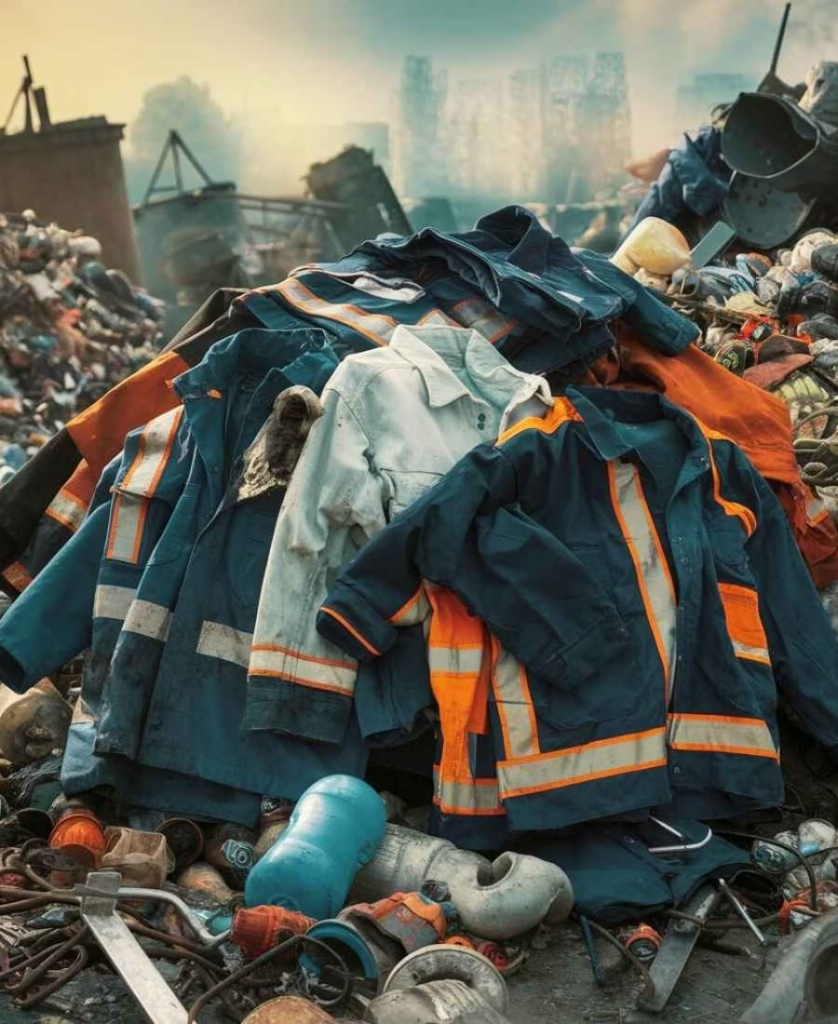
Fast fashion logic applied to industrial workwear procurement produces a predictable outcome: garments that look adequate on delivery and fail under operational conditions within months. The problem is not simply waste. It is a measurable financial loss that compounds across large programmes.
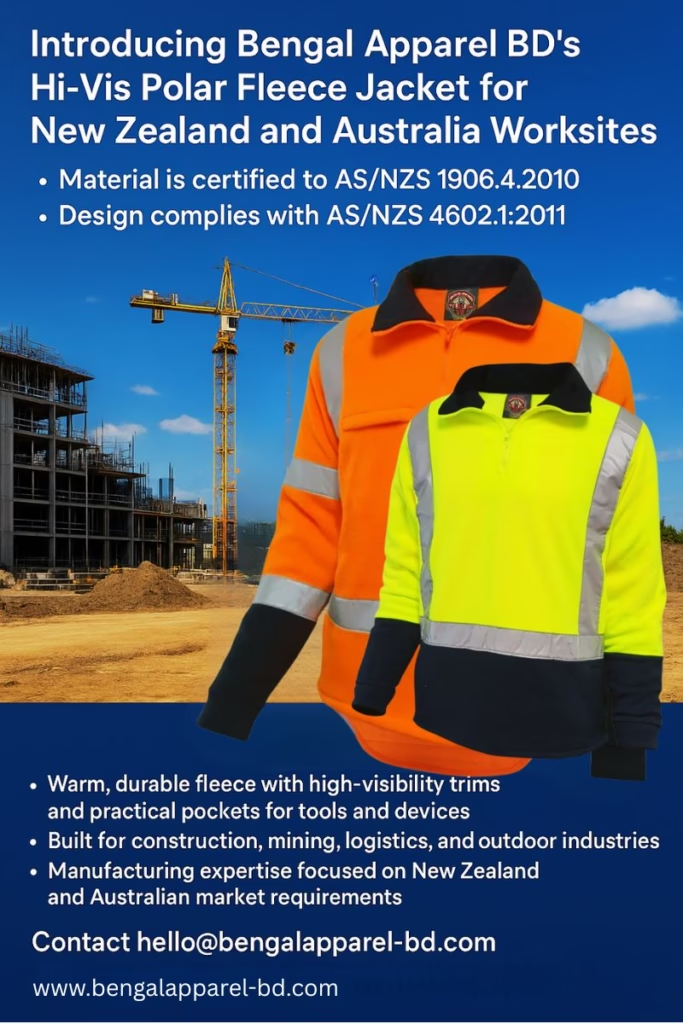
Consider a construction contractor outfitting 500 workers with hi-vis coveralls. At a fast fashion price point of $10 per unit, the initial outlay is $5,000. If those garments require replacement after 15 to 20 industrial wash cycles, which is a realistic failure point for low-specification workwear, the programme needs refreshing three times over a two-year period. Total spend: $15,000, plus the logistics, administration, and personnel downtime costs of three separate procurement and distribution cycles.
The same programme using professionally graded workwear at $22 per unit costs $11,000 at the outset and runs for the full two-year period without replacement. Total spend: $11,000. The premium product costs 27% less over the procurement cycle.
This is the cost-per-wear analysis that fast fashion suppliers do not want procurement managers to run.
Beyond the Unit Price: Maximizing ROI Through Industrial Durability
In high-volume B2B uniform procurement, the initial purchase price is a deceptive metric. A fast fashion approach to workwear, prioritising low unit costs over industrial durability, results in a significantly higher Total Cost of Ownership across any procurement cycle longer than twelve months.
When a garment fails after 15 washes, the costs of re-ordering, inbound logistics, internal distribution, and personnel downtime quickly erase the initial savings. For programmes covering hundreds or thousands of workers, these hidden costs are substantial.
At Bengal Apparel BD, our approach to certified industrial workwear manufacturing is built around a cost-per-wear strategy. By engineering uniforms that withstand 50 or more industrial launderings, we help procurement teams reduce their annual replacement frequency by up to 40%, lowering both direct procurement cost and the operational overhead of managing frequent uniform cycles.
Cost-Per-Wear Comparison: Fast Fashion vs. Professional Grade Workwear
| Feature | Fast Fashion Workwear | Bengal Apparel BD Professional Grade |
|---|---|---|
| Initial Unit Price | $8.00 to $12.00 | $18.00 to $25.00 |
| Wash Life (Industrial) | 15 to 20 cycles | 50 or more cycles |
| Compliance Retention | High risk of degradation | Certified integrity post-wash |
| Replacement Frequency | 3x per 24 months | 1x per 24 months |
| Total 2-Year Cost | $24.00 to $36.00 | $18.00 to $25.00 |
The table above illustrates a single-unit comparison. Across a programme of 500 workers, the total 2-year saving from professional grade sourcing ranges from $3,000 to $11,000 on garment cost alone, before accounting for logistics and administration.
The Safety Risk Hidden Inside Cheap Workwear
Beyond cost, fast fashion workwear carries a compliance and safety risk that procurement teams in regulated industries cannot afford to overlook.
For workers in environments requiring flame-resistant protection, the difference between a genuine certified garment and a cheaply produced imitation is a matter of physical safety. Inherent flame-resistant (FR) garments are engineered from fibres where flame resistance is a permanent property of the material. Treated FR garments start with a chemical coating that degrades with washing.
A fast fashion FR coverall may pass certification tests on day one. After 20 industrial wash cycles, the flame-resistant finish may have degraded to the point where it no longer meets the standard it was certified to. The garment still carries the label. The worker is no longer protected.
For procurement managers sourcing FR workwear for oil and gas, utilities, or construction programmes, specifying garments with documented post-wash compliance verification is not optional. It is a duty of care requirement. Our partner factories provide third-party test reports confirming certification compliance. You can review our full factory audit portfolio on our BSCI and WRAP certified production compliance page.
Sustainable Workwear Manufacturing: What It Looks Like in Practice
Sustainable workwear manufacturing is not a marketing category. It is a set of production decisions that result in garments with longer service lives, verifiable compliance across the garment’s working life, and supply chain documentation that holds up under audit.
The practical elements are as follows.
Fabric specification starts with the correct weight and construction for the intended end use, not the lightest fabric that passes initial certification testing. For a standard industrial coverall, this typically means a minimum of 240 to 300gsm for durability. For FR applications, it means specifying inherent FR fabric where the environment calls for it.
Seam construction is specified with reinforcement at stress points, using thread that matches the fabric’s performance specification. For FR garments, this means FR-rated thread. For anti-static garments, it means conductive thread that does not break the electrostatic dissipation path at the seam.
Certification documentation covers the full chain from fabric mill to finished garment, with test reports from accredited Notified Bodies rather than self-declarations.
Replacement cycle planning is built into the supply program from the start, based on realistic wash durability data rather than optimistic assumptions.
For buyers ready to move away from fast fashion workwear toward a sustainable workwear manufacturing program, the starting point is a clear specification. Share your garment requirements, required certifications, end-use environment, and target volume. We will provide indicative FOB pricing with a documentation list covering all certifications and factory compliance evidence.
MOQ: 3,000 pieces per style Lead time: 75 days from sample approval Incoterms: FOB Chittagong
The EU Regulatory Pressure That Is Changing B2B Procurement
For procurement managers sourcing into European markets, the financial case for durable sustainable workwear manufacturing is now reinforced by incoming regulatory requirements.
The EU Corporate Sustainability Due Diligence Directive (CSDDD) requires large companies operating in or supplying into the EU to identify, prevent, and address adverse human rights and environmental impacts across their supply chains. For buyers sourcing workwear from overseas manufacturers, this means documenting supplier compliance, factory conditions, and environmental standards to a level of detail that fast fashion supply chains simply cannot support.
A fast fashion supplier operating through informal intermediaries with undisclosed subcontracting cannot provide the supply chain documentation that CSDDD compliance requires. A manufacturer with WRAP, BSCI, and SEDEX certifications, documented factory audits, and chain-of-custody records can.
European procurement teams that continue to source on unit price alone are building a compliance liability into their supply chains that will become increasingly expensive to manage as CSDDD enforcement timelines approach.
What Sustainable Workwear Manufacturing Actually Means for B2B Buyers
Sustainability in industrial workwear procurement means different things depending on who you ask. For a materials specialist, it means recycled polyester and organic cotton. For a procurement manager, it means garments that last long enough to justify their cost. For a compliance officer, it means a supply chain that can be audited and documented. All three definitions point to the same sourcing decision.
Industrial Durability as Sustainable Practice
A garment that lasts three times as long as its fast fashion equivalent consumes roughly one third of the raw material, energy, and transport resources over the same procurement cycle. Industrial workwear durability is not just a cost argument. It is the most straightforward sustainability metric available to a procurement team.
Fabrics engineered for 50-plus industrial wash cycles use higher thread counts, tighter weave structures, and reinforced seam construction that significantly extend garment life without requiring premium exotic materials. This is the core of our manufacturing specification at Bengal Apparel BD.
GRS-Certified Recycled Content for ESG Programmes
For buyers with active ESG reporting requirements or sustainability procurement targets, we offer workwear produced from GRS-certified recycled polyester fabrics verified under the Global Recycled Standard. GRS certification provides chain-of-custody documentation confirming the recycled content claims throughout the production process, from raw material to finished garment.
This gives your sustainability team the documented evidence they need to report on procurement impact accurately, without relying on unverified supplier claims.
The Procurement Checklist for Sustainable Workwear Manufacturing
Use this checklist when evaluating any workwear supplier against a fast fashion alternative:
1. Wash Durability Documentation Does the supplier provide test data confirming garment performance after 50 or more industrial wash cycles? If the answer is verbal rather than documented, it is not verifiable.
2. Cost-Per-Wear Analysis Has a full TCO calculation been run across the programme’s expected replacement cycle? Unit price comparisons without wash life data are not valid procurement metrics.
3. FR Compliance Post-Wash For flame-resistant programmes, does the supplier provide post-wash certification test reports confirming EN ISO 11612 or NFPA 2112 compliance is maintained after industrial laundering?
4. Factory Certification Status Does the manufacturer hold current WRAP, BSCI, or SEDEX certifications from independent third-party auditors? Are these available before the order is placed?
5. CSDDD Supply Chain Documentation For European market buyers, can the supplier provide the factory audit reports, chain-of-custody records, and compliance documentation required to satisfy CSDDD due diligence requirements?
Why Fast Fashion Fails Industrial Workwear Programmes at Scale
The fast fashion model was designed for consumer markets where garments are worn occasionally, washed gently, and replaced seasonally. Applied to industrial workwear programmes where garments are worn daily, washed at 60 to 90 degrees Celsius in commercial laundry facilities, and expected to retain safety certifications across hundreds of wash cycles, the model fails structurally.
The fabric weights are too low. The seam construction is too light. The chemical finishes are not durable enough. The certification documentation is not deep enough to withstand a serious procurement audit. And the replacement frequency that results from these specification failures destroys whatever unit cost saving was achieved at the point of purchase.
Procurement managers who have run a genuine cost-per-wear analysis on their workwear programmes consistently reach the same conclusion: professional grade sourcing from a certified manufacturer is cheaper over any meaningful time horizon than fast fashion sourcing on unit price.
Partner with a Sustainable Workwear Manufacturing Specialist
Bengal Apparel BD produces industrial workwear for importers, distributors, and corporate procurement teams across the USA, Europe, Canada, the Middle East, and Australia. Our partner factories hold WRAP, Amfori BSCI, SEDEX, GRS, and ISO 9001:2015 certifications. Every order includes full compliance documentation and third-party test reports as standard.
If your current workwear programme is running higher replacement frequencies than expected, or if you are preparing your supply chain for CSDDD compliance requirements, contact our team to discuss how a cost-per-wear procurement strategy can reduce your total programme cost.
Request a Sourcing Consultation | View Our Manufacturing Capabilities | Download Our Compliance Documentation