The workwear sample approval checklist is one of the most important tools a procurement manager has in the entire sourcing process. It is the document that stands between a successful bulk order and an expensive production failure. Yet most buyers approach sample approval informally, relying on visual inspection and general feel rather than a structured verification process that covers every performance-critical element of the garment.
This guide provides a complete workwear sample approval checklist built specifically for B2B buyers sourcing technical safety apparel including flame-resistant workwear, high-visibility garments, and multinorm protective clothing. It also explains the most common defects found in FR and hi-vis fabrics at the sample stage, and what to do when a sample fails a check before bulk production begins.
Before using this checklist, review our standard ordering process which covers where sample approval sits within the full production timeline and what documentation should accompany each sample stage.
Why a Workwear Sample Approval Checklist Matters More Than You Think
For standard corporate uniforms, a visual inspection of a sample is often sufficient. The garment either looks right or it does not. For technical safety apparel, a visual inspection is not enough and in some cases is actively misleading.
A flame-resistant coverall can look identical to a non-FR garment. A high-visibility jacket with poorly bonded reflective tape will appear compliant on delivery and fail within ten industrial wash cycles. An FR fabric that has been incorrectly treated can pass a visual check and fail a vertical flame test.
The gap between a sample that looks correct and a sample that performs correctly is exactly where procurement risk lives. A structured workwear sample approval checklist closes that gap by requiring documented verification of performance rather than relying on appearance.
It also protects you commercially. A signed sample approval process creates a documented reference point that defines what the bulk production must match. Without it, disputes about quality between buyer and supplier have no objective baseline.
Stage 1: Pre-Production Sample Review
Before the garment sample arrives, your workwear sample approval checklist should include verification of the documentation that should accompany it. A sample without supporting documentation is incomplete regardless of how the garment looks.
Required documents at pre-production sample stage:
- Fabric specification sheet confirming composition, weight in gsm, weave structure, and finish type
- Mill certification confirming the fabric origin and any relevant compliance such as OEKO-TEX Standard 100
- FR performance data if applicable, confirming whether protection is inherent to the fiber or applied as a chemical treatment
- Colour standard reference using Pantone codes matched against the approved specification
- Trim and component specifications covering zippers, buttons, threads, reflective tape, and labels
If any of these documents are missing at the sample stage, request them before evaluating the physical garment. A supplier who cannot provide fabric documentation with a pre-production sample is unlikely to provide it with the bulk order.
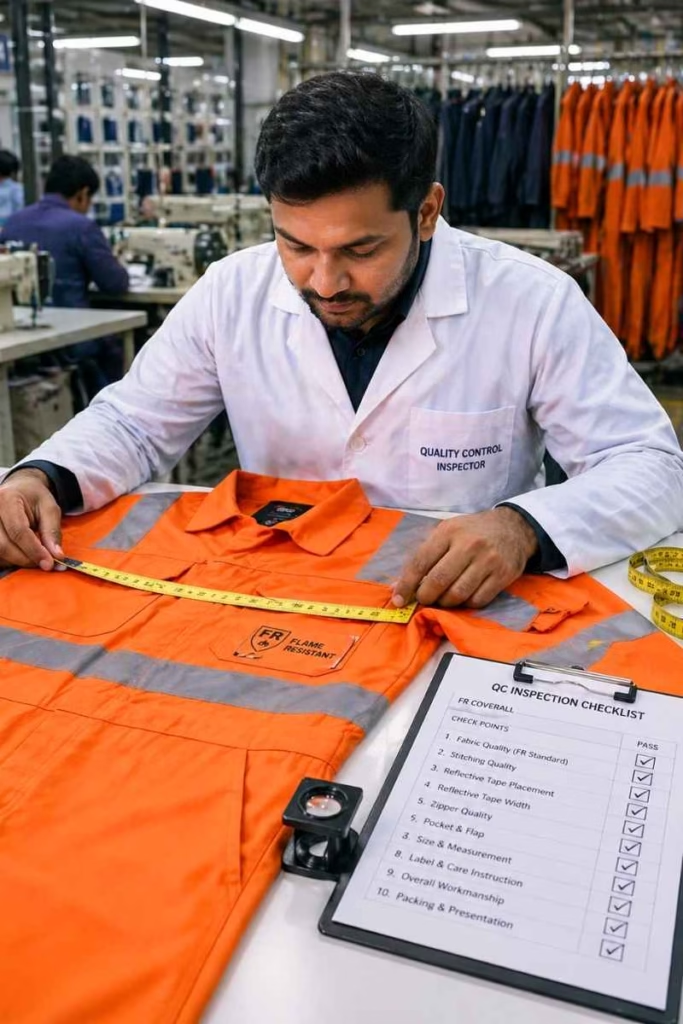
Stage 2: The Physical Workwear Sample Approval Checklist
Once the sample and its documentation arrive, work through the following checklist systematically. Do not approve a sample based on overall impression. Check each element independently.
Fabric and Construction
Fabric weight: Weigh a cut swatch and confirm it matches the specified gsm within an acceptable tolerance. A 240 gsm specification delivered at 210 gsm is a specification failure, not a minor variation.
Fabric composition: Request laboratory confirmation if there is any doubt about the fiber blend. Visual and tactile assessment cannot confirm whether a fabric is 65% polyester and 35% cotton or an inferior blend.
Colour accuracy: Compare the sample against your Pantone reference under a standard D65 light source. Checking colour under office lighting or natural daylight introduces variables that will cause batch-to-batch colour inconsistency in bulk production.
Shrinkage test: Wash the sample at the temperature specified in the care label and measure dimensional change before and after. Shrinkage above 3% in either direction should be raised with the supplier before bulk production begins.
Seam strength: Apply manual stress to all major seams including shoulder joins, side seams, and crotch seams on coveralls. Any seam that shows thread pullthrough or fabric distortion under moderate manual pressure will fail under operational conditions.
Stitching density: Count stitches per centimetre on a straight seam run. The industry standard for workwear is 4 to 5 stitches per centimetre. Lower density indicates a production shortcut that affects durability.
Pocket and fastener function: Open and close all zippers, buttons, and press studs a minimum of ten times. Confirm that all pockets are correctly bartacked at stress points. Bartacking failure is among the most common complaints in bulk workwear orders.
Label and branding placement: Confirm that all labels, including care labels, size labels, compliance labels, and brand labels, are correctly positioned, securely attached, and legible.
FR Fabric Specific Checks
For any sample containing flame-resistant fabric, extend your workwear sample approval checklist with the following verification steps. Our FR workwear manufacturing page covers the technical standards that each of these checks is designed to verify.
Inherent vs. treated FR confirmation: Confirm in writing from the supplier whether the FR protection is inherent to the fiber structure or applied as a surface chemical treatment. This distinction determines wash durability of the protective performance. Inherent FR fabrics retain their protection permanently. Treated FR fabrics degrade with washing. The sample cannot tell you this visually.
Colour and texture uniformity: Significant fading, uneven coloration, or unexpected variation in fabric surface texture in an FR sample can signal that the chemical finish has already begun to degrade before bulk production. This is a rejection criterion.
Chemical odour check: FR fabric that releases an unusual or strong chemical odour may have been over-treated or incorrectly processed. Raise this with the supplier and request a batch test report.
Thread specification: Confirm that the thread used in construction is FR-rated. A garment sewn with standard polyester thread has unprotected seam lines that will melt or burn under heat exposure even if the fabric is fully certified. This is a common and dangerous specification error.
Zipper and fastener material: Confirm that zippers, buckles, and any metal components are specified correctly for the end-use environment. Metal components can conduct heat. Plastic components can melt. The correct specification depends on the specific hazard profile.
Hi-Vis Garment Specific Checks
For high-visibility samples, your workwear sample approval checklist must include checks that go beyond what a visual inspection can confirm. Our high-visibility workwear range is produced to EN ISO 20471 and ANSI/ISEA 107, and these checks are built into our pre-production process as standard.
Reflective tape placement: Measure and confirm that tape is positioned according to the required pattern for your standard. EN ISO 20471 requires Hoop or Brace patterns. ANSI/ISEA 107 has its own placement requirements. Any deviation from the specified pattern is a compliance failure regardless of how much tape is present.
Tape width: Measure reflective tape width physically. The minimum is 50mm under both EN ISO 20471 and ANSI/ISEA 107. Tape that measures 47mm or 48mm is a non-compliant garment.
Tape bonding and edge stitching: Run your fingers across the full length of the tape edge on both sides. Any lifting, bubbling, or loose edge indicates inadequate bonding that will result in tape peeling after a small number of wash cycles. Tape edges should be stitched 2 to 3mm from the edge consistently around the full perimeter.
Retroreflection field test: In a dim environment, shine a directional light source at the sample from ten metres. The tape should return a sharp, even reflection directly back to the light source. A dull, patchy, or scattered reflection indicates degraded retroreflective performance. Request the supplier’s tape certification confirming the retro-reflection coefficient.
Fluorescent colour check: Compare the fluorescent fabric against your approved colour standard under a UV light source. Fluorescent fabrics that appear bright under standard office lighting can still fail the chromaticity coordinates required by your compliance standard under correct testing conditions.
Minimum fluorescent area measurement: For Class 2 and Class 3 garments, measure the fluorescent background area on both the front and back panel of the sample. EN ISO 20471 requires a minimum of 0.2 square metres per panel for Class 3. Confirm this across your full size range, not only the size of the submitted sample.
Stage 3: Compliance Documentation Verification
The final stage of your workwear sample approval checklist covers the compliance documentation that must be in place before bulk production is approved. Our compliance and certifications page details the full range of certifications available across our factory network.
For FR and multinorm garments: Request the current EN ISO 11612 garment test report from an accredited laboratory. Confirm the test report references the specific fabric used in your sample, not a generic fabric of the same type.
For hi-vis garments: Request the EN ISO 20471 or ANSI/ISEA 107 garment test report confirming the visibility class, fluorescent fabric certification, and reflective tape wash cycle rating.
For all garments: Confirm that factory social compliance certifications including WRAP, BSCI, or SEDEX are current and available. Expired certifications are non-compliant certifications regardless of when the audit was conducted.
Batch traceability: Confirm that the fabric lot used in the sample is documented and that the same lot or a certified equivalent will be used in bulk production. Fabric lot changes between sample and bulk production are a leading cause of colour and performance inconsistency.
What to Do When a Sample Fails a Check
Not every sample will pass every check on the first submission. A structured workwear sample approval checklist is not a rejection tool. It is a communication tool. When a check fails, document the specific failure clearly against the checklist item, reference the approved specification or standard that defines the correct requirement, request a corrective sample with a confirmed revision timeline, and re-run the full checklist on the corrected sample before approval.
Do not approve a sample with outstanding failures on the basis of verbal assurance that the bulk production will be different. The sample is the reference document for the bulk order. If the sample does not meet the specification, the bulk order has no verified baseline.
Download and Use This Checklist
Bengal Apparel BD provides a complete pre-production workwear sample approval checklist to all buyers as part of our standard onboarding process. The checklist covers all items in this guide in a structured sign-off format, with space for comments, photographs, and approval signatures from both buyer and supplier.
Contact us to receive the checklist and to discuss your next workwear sourcing programme. Our manufacturing capabilities cover the full range of technical workwear categories including FR, hi-vis, multinorm, healthcare, and hospitality uniforms.
Request the Sample Approval Checklist | View Our Ordering Process | Our Compliance Documentation
Lorem ipsum dolor sit amet, consectetur adipiscing elit. Ut elit tellus, luctus nec ullamcorper mattis, pulvinar dapibus leo.