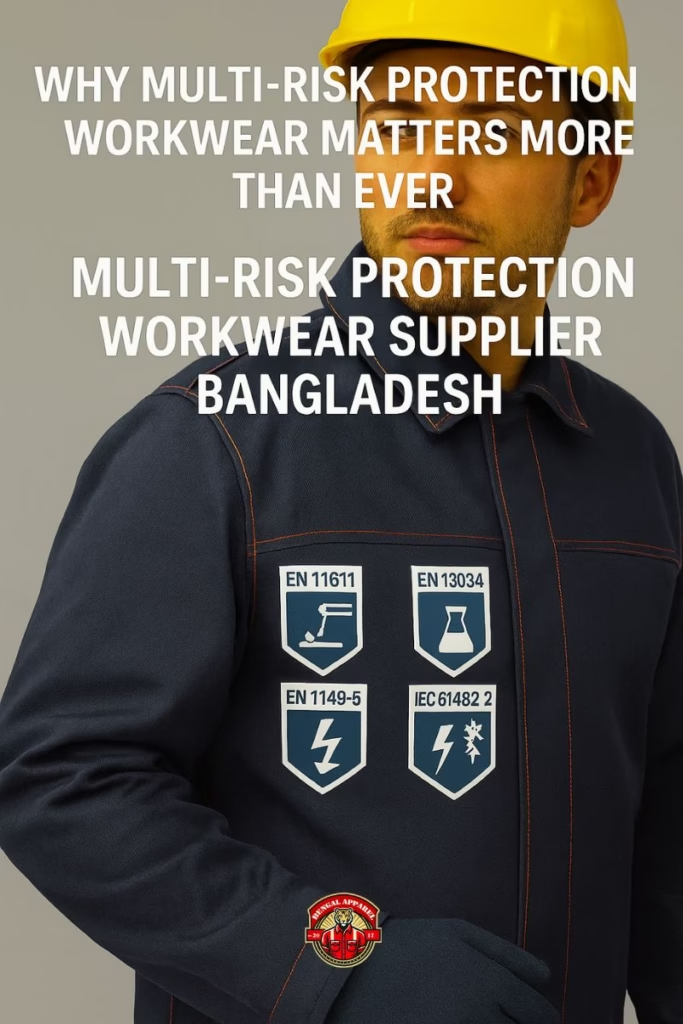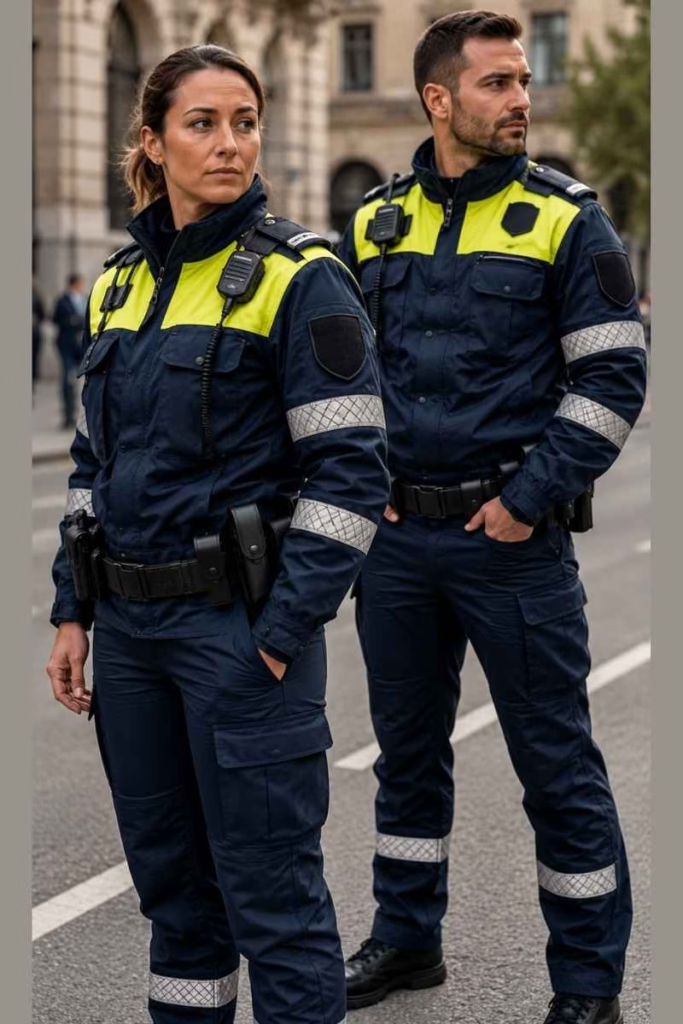
Procurement managers sourcing protective workwear for electrical maintenance, oil and gas, petrochemical, and utilities operations face a question that sounds simple but carries serious consequences: is this garment the right category of protection for this job?
CAT II PPE is the classification most commonly specified for industrial electrical work and multi-hazard environments. Getting it right means understanding what the category requires, how it aligns with EN ISO 11612 and related standards, and what construction details in the garment itself determine whether it genuinely meets the requirement under real working conditions.
This guide covers all of it, including one detail most procurement specifications miss: the front fastening.
What Is CAT II PPE and Why Does It Matter in 2026?
CAT II PPE, or Category II Personal Protective Equipment, covers protection against moderate risks that are serious but not immediately life-threatening. In the context of electrical safety and arc flash protection, CAT II PPE requires a minimum Arc Thermal Performance Value (ATPV) of 8 cal/cm².
This makes CAT II PPE the standard specification for most industrial electrical maintenance tasks, including switchgear operation, panel inspections, energised conductor work, and utility maintenance where calculated incident energy falls within the moderate range.
Is CAT II PPE Enough for Electrical Work?
For most industrial electrical maintenance and utility tasks where the calculated incident energy level sits at or below 8 cal/cm², CAT II PPE meets the requirement. It is the level specified in NFPA 70E for Hazard Risk Category 2 tasks in US markets, and it aligns with IEC 61482-2 APC Class 1 (4kA) in European and GCC markets.
CAT II PPE strikes the right balance for the majority of industrial applications: protection that is sufficient for the hazard without adding unnecessary bulk, weight, or heat stress for the worker wearing it. For environments where incident energy calculations consistently exceed this level, CAT III or CAT IV protection is required. But for the broad middle of industrial electrical work, CAT II PPE is both the regulatory minimum and the practical standard.
How CAT II PPE Fits into the Global Standards Landscape
In the USA, arc flash protection is governed by NFPA 70E, which aligns CAT II PPE with the 8 cal/cm² ATPV threshold. In European and GCC markets, the equivalent framework is IEC 61482-2, where APC Class 1 provides protection against arc flash at 4kA. Both reference the same fundamental requirement: a garment that limits the transfer of thermal energy to the wearer’s skin in an arc event.
For B2B buyers sourcing for multi-market programs, the practical approach is to specify a garment that meets both NFPA 70E CAT II and IEC 61482-2 APC 1 simultaneously. This is achievable with a correctly specified multi-norm coverall and simplifies procurement for programs supplying into the USA, Europe, and GCC markets from a single production run.
EN ISO 11612: The Heat and Flame Standard That Underpins CAT II PPE Coveralls
What EN ISO 11612 Adds to a CAT II PPE Specification
IEC 61482-2 covers arc flash specifically. EN ISO 11612 covers the broader range of heat and flame hazards that workers in the same environments also face: flash fire, convective heat, radiant heat, contact heat, and molten metal splash. A garment that only meets arc flash protection leaves a worker without certified protection against the other heat hazards present on the same site.
For oil and gas, petrochemical, utilities, and heavy industrial environments, a complete CAT II PPE specification combines both standards in a single garment. This is what the multi-norm approach delivers.
Reading the EN ISO 11612 Performance Codes on a CAT II PPE Certificate
When reviewing supplier documentation for a CAT II PPE multi-norm coverall, the EN ISO 11612 certificate should show specific letter and number codes. Each one is a separate test result.
A1 and A2: Limited Flame Spread. These two tests confirm the fabric stops burning when the ignition source is removed. Both A1 and A2 should be present on a CAT II PPE coverall intended for flash fire environments. A1 alone is insufficient for most oil and gas and petrochemical applications.
B1 to B3: Convective Heat Protection. This measures protection against hot gases and flame passing over the garment surface. B1 is the minimum level for most CAT II PPE programs. B2 or B3 is appropriate for higher-exposure environments.
C1 to C4: Radiant Heat Protection. This measures protection against heat radiating from an external source. C1 is the standard minimum for most CAT II PPE multi-norm coveralls. C2 or above is relevant for environments with significant continuous radiant heat sources.
E: Molten Iron Splash. Relevant for metalwork and foundry environments. E3 is a common requirement in comprehensive multi-norm programs.
F: Contact Heat. For workers who regularly handle hot pipes, valves, or equipment. F1 is the standard minimum.
A typical strong combination for a CAT II PPE multi-norm coverall targeting oil and gas, utilities, and electrical maintenance is EN ISO 11612 A1, A2, B1, and C1, combined with IEC 61482-2 APC 1 and EN 1149-5 anti-static. This combination delivers reliable performance across the full range of hazards present in these environments while remaining lightweight enough for use in tropical and high-heat climates.
EN ISO 13688: The Base Standard That Must Also Be Present
Every EN ISO 11612 certified CAT II PPE garment must also comply with EN ISO 13688, the base standard covering ergonomics, material safety, sizing, and labeling. A garment with an EN ISO 11612 performance certificate but no EN ISO 13688 compliance is not fully certified as a finished protective product. Always request both documents.
The Multi-Norm Shift: Why CAT II PPE Now Means More Than One Standard
What Multi-Norm CAT II PPE Actually Requires
Modern industrial sites are multi-hazard environments. A worker in an oil and gas facility or a petrochemical plant may face arc flash, flash fire, anti-static requirements, and in some locations additional hi-vis requirements, all on the same shift. Specifying separate garments for each hazard is impractical, uncomfortable for the worker, and increasingly non-compliant with site safety requirements that mandate a single outer garment carrying all relevant certifications.
A genuine multi-norm FR coverall for CAT II PPE applications combines the following in a single garment tested and certified as a complete assembly:
EN ISO 11612 (A1 A2 B1 C1 minimum) for heat and flame protection, IEC 61482-2 APC 1 for arc flash protection, EN 1149-5 for anti-static dissipation in ATEX zones, and optionally EN ISO 20471 for hi-vis integration where site conditions require it.
Each of these certifications must be demonstrated by the finished garment, not assumed from individual component tests. This is the critical point: a garment assembled from certified fabric does not automatically carry a garment-level certification. The complete assembly, including all closures and trims, must be tested.
The Fabric Behind CAT II PPE Multi-Norm Performance
The fabric construction that consistently achieves and maintains multi-norm CAT II PPE performance across 50 or more industrial wash cycles is an inherent FR blend. The most commonly specified construction for oil and gas and utilities programs is 93% meta-aramid, 5% para-aramid, and 2% antistatic carbon fibre.
In this construction, the meta-aramid component provides the fundamental flame resistance and thermal protection that underpins EN ISO 11612 compliance. The para-aramid component adds tensile strength and abrasion resistance. The 2% antistatic carbon fibre provides the electrostatic dissipation required for EN 1149-5 compliance in ATEX zones.
Because the flame resistance is inherent to the fibre structure, it cannot wash out or degrade with use. The garment performs to the same CAT II PPE standard on its fiftieth wash as on its first. This is the fundamental difference from treated FR fabrics and the reason inherent FR blends are mandated by most major oil and gas operators for permanent site workers.
At 150 GSM, this fabric construction delivers full CAT II PPE multi-norm performance in a lightweight garment suitable for tropical and high-heat climates, including GCC sites where standard European fabric weights cause significant heat stress.
The Detail Most CAT II PPE Specifications Miss: The Front Fastening
Why the Zipper Matters for CAT II PPE Compliance
The front closure of a CAT II PPE coverall is tested as part of the garment assembly. A standard metal zipper on a certified FR fabric does not produce a certified CAT II PPE garment. Metal components introduce three separate risks in the environments where CAT II PPE is required: electrical conductivity, spark generation from friction in flammable atmospheres, and heat transfer that can cause contact burns during an arc flash event.
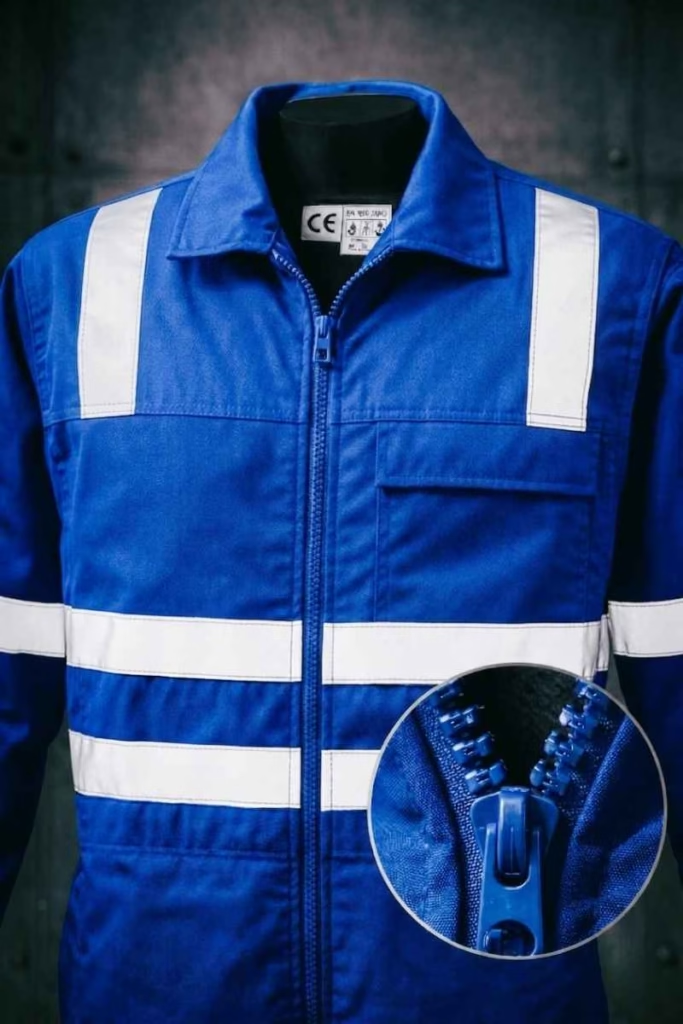
For this reason, premium CAT II PPE multi-norm coveralls use Heavy-Duty YKK Non-Spark Zipper (Nylon coil/ Vislon) with meta-aramid FR tape as the front closure system. No metal components in the fastening.
How the YKK Non-Spark Vislon Zipper System Works
The YKK Non-Spark Vislon zipper system used in CAT II PPE garments is engineered from the ground up for hazardous environments. Every element of the system is specified to eliminate the risks that make standard zippers unsuitable.
The teeth and slider are made from high-temperature moulded plastic using Vislon technology. This material is non-conductive, non-sparking, and heat-resistant. Under arc flash or flash fire conditions, the plastic elements resist melting and dripping, so the closure does not contribute to injury during an incident.
The tape bonding the zipper to the garment is made from inherent meta-aramid fibre, matching the 93% meta-aramid blend of the garment body. This tape withstands temperatures up to 750 degrees Fahrenheit without burning or degrading. Because the tape is made from the same inherent FR material as the shell fabric, the junction between zipper and garment does not create a weak point in the protection system.
The complete closure assembly adds inner protection with an FR aramid placket behind the zipper, made from the same inherent fabric as the garment body, and an outer storm flap with concealed FR hook-and-loop or snaps. This layered system ensures there is no exposed path through the front closure where arc energy or flame could reach the wearer directly.
The YKK Non-Spark Vislon zipper system offers durability that standard coil zippers cannot match: up to 15 times more abrasion-resistant, with reliable performance maintained across 50 or more industrial wash cycles. Two-way functionality is available for enhanced ventilation and access on long shifts without compromising the integrity of the closure or its CAT II PPE compliance.
Where YKK Non-Spark Zippers Are Specified
This closure system is specified across the most demanding CAT II PPE environments: arc flash protection under NFPA 70E and IEC 61482-2, oil and gas operations in the GCC and North Sea, chemical processing, petrochemical refining, mining, and welding fabrication. Any environment where standard metal zippers create electrical, sparking, or thermal risks is an application for the non-spark Vislon system.
CAT II PPE Sourcing: What Buyers Must Verify Before Placing an Order
A CAT II PPE specification is only as strong as the documentation behind it. These are the verification steps procurement teams should take before committing to any supplier.
Confirm the ATPV rating on the arc flash certificate. The certificate should show a minimum 8 cal/cm² ATPV for CAT II PPE equivalence, issued by an accredited Notified Body. A self-declared ATPV without third-party test documentation is not compliant for Category II protection.
Request garment-level test reports, not just fabric test reports. The EN ISO 11612, IEC 61482-2, and EN 1149-5 certificates must cover the finished garment assembly including the zipper system, placket, and storm flap. Fabric-level certification alone is insufficient.
Confirm the front fastening specification. Ask specifically whether the zipper system contains any metal components. Request confirmation that the zipper tape is meta-aramid and that the closure assembly was included in the garment certification test.
Verify wash durability data. Ask for test data confirming that the garment meets its EN ISO 11612 and IEC 61482-2 performance levels after 50 industrial wash cycles. This data should be available from the fabric mill as part of the Technical Data Sheet.
Check EN ISO 13688 compliance. Confirm that garment sizing, labeling, and care instructions meet the base standard requirements. This is a mandatory component of any complete CAT II PPE certification package.
Product Spotlight: Elite Series Multi-Norm Technical Coverall
Bengal Apparel BD produces the Elite Series Multi-Norm Technical Coverall for B2B buyers requiring full CAT II PPE compliance from a single garment.
Fabric: 93% Meta-Aramid / 5% Para-Aramid / 2% Antistatic Carbon Fibre, 200 GSM (recommended for confirmed CAT II ATPV compliance). 150 GSM constructions are available for lighter-weight programs where garment-level ATPV test documentation is provided by the fabric mill. Certifications: EN ISO 11612 (A1, A2, B1, C1), IEC 61482-2 APC 1, EN 1149-5, EN ISO 13688 Front Fastening: Heavy-Duty YKK Non-Spark Vislon plastic zipper with meta-aramid FR tape, inner aramid placket, and outer storm flap. Zero metal components in the closure system. Wash Durability: Performance maintained across 50 or more industrial wash cycles Optional: EN ISO 20471 hi-vis integration, full private labeling, custom pocket configurations, reinforced triple-needle stitching, FR thread throughout
The 200 GSM weight delivers full CAT II PPE multi-norm performance in a garment light enough for high-heat and tropical climates, including GCC sites where European fabric weights create unacceptable heat stress for workers on long shifts.
B2B advantages include optional hi-vis integration, full private labeling with FR thread, and customization for specific hazard profiles. MOQ from 1,000 pieces per style.
CAT II PPE Compliance Checklist for B2B Buyers
Before finalising a CAT II PPE coverall order, confirm the following:
Minimum 8 cal/cm² ATPV confirmed on the arc flash certificate from an accredited Notified Body. EN ISO 11612 garment-level test report showing A1, A2, B1, C1 codes as a minimum. IEC 61482-2 APC 1 certificate covering the complete garment assembly including closure system. EN 1149-5 compliance confirmed for ATEX-zone applications. Front fastening confirmed as Heavy-Duty YKK Non-Spark Vislon or Nylon coil zipper with meta-aramid tape and zero metal components. Inner FR placket and outer storm flap confirmed as part of the closure assembly. EN ISO 13688 compliance confirmed for sizing, labeling, and care instructions. Wash durability data available for 50-plus industrial cycles.
Confirm fabric weight is 200 GSM or above for reliable CAT II ATPV compliance, or request a specific garment-level ATPV test certificate if 150 GSM is specified.
Why Source CAT II PPE Multi-Norm Coveralls from Bangladesh
Bangladesh produces certified inherent FR workwear for buyers across the USA, Europe, the GCC, Canada, and Australia. Fabric mills supplying 93/5/2 meta-aramid blends to Bangladeshi production facilities hold Notified Body test documentation covering EN ISO 11612, IEC 61482-2, and EN 1149-5. Finished garments are certified at the garment level, including closure systems, and exported with full documentation packages.
Bengal Apparel BD manages production through nine certified partner factories in Dhaka. Factory certifications include WRAP, BSCI, SEDEX, OEKO-TEX, RSC, and C-TPAT. Every CAT II PPE order is supplied with complete documentation: fabric mill test reports, Technical Data Sheets, garment-level Declaration of Conformity, and care and user instructions meeting EN ISO 13688 requirements.
For buyers building multi-market programs, our garments are specified to meet both NFPA 70E CAT II and IEC 61482-2 APC 1 simultaneously, simplifying procurement for programs supplying the USA, European, and GCC markets from a single production run.
Request Samples, Technical Data Sheets, and a CAT II PPE Production Quote
Frequently Asked Questions on CAT II PPE
What is CAT II PPE?
CAT II PPE is Category II Personal Protective Equipment, designed for moderate-risk environments that require serious certified protection. In arc flash and electrical safety contexts, CAT II PPE requires a minimum Arc Thermal Performance Value (ATPV) of 8 cal/cm², making it the standard requirement for most industrial electrical maintenance and utility tasks.
What is the minimum ATPV for CAT II PPE?
The minimum ATPV for CAT II PPE is 8 cal/cm². This is the threshold defined by NFPA 70E for Hazard Risk Category 2 tasks. The IEC 61482-2 equivalent is APC Class 1, which provides protection against arc flash at 4kA.
Can a single garment meet both CAT II PPE and EN ISO 11612?
Yes. A correctly specified multi-norm coverall using an inherent FR fabric blend can simultaneously achieve IEC 61482-2 APC 1 (the standard equivalent to CAT II arc flash protection), EN ISO 11612 for heat and flame, and EN 1149-5 for anti-static properties. The garment must be tested and certified as a complete assembly, not just from fabric-level tests.
Why do CAT II PPE coveralls use plastic rather than metal zippers?
Metal zippers in a CAT II PPE garment create three risks: electrical conductivity, friction sparks in flammable atmospheres, and heat transfer contact burns during an arc event. Heavy-Duty YKK Non-Spark Vislon plastic zippers with meta-aramid FR tape eliminate all three risks. The plastic elements are non-conductive, non-sparking, and heat-resistant, and the meta-aramid tape matches the flame resistance of the garment body.
How many wash cycles should a CAT II PPE coverall withstand?
For programs using inherent FR fabric, performance should be maintained across 50 or more industrial wash cycles. Unlike treated FR fabrics where the flame-resistant finish degrades with washing, inherent FR fibres carry protection in the molecular structure of the fibre itself, so wash cycle count does not affect compliance.
Is EN ISO 11612 the same as CAT II PPE?
No, but they are complementary. EN ISO 11612 covers heat and flame protection across six hazard categories. CAT II PPE, defined by NFPA 70E, and its IEC equivalent IEC 61482-2 APC 1 cover arc flash thermal energy specifically. A complete CAT II PPE multi-norm specification combines both standards, along with EN 1149-5 anti-static for ATEX-zone applications.