NFPA 2112 Certified FR Coveralls: A Bangladesh Manufacturer's Guide for US and Canadian Buyers
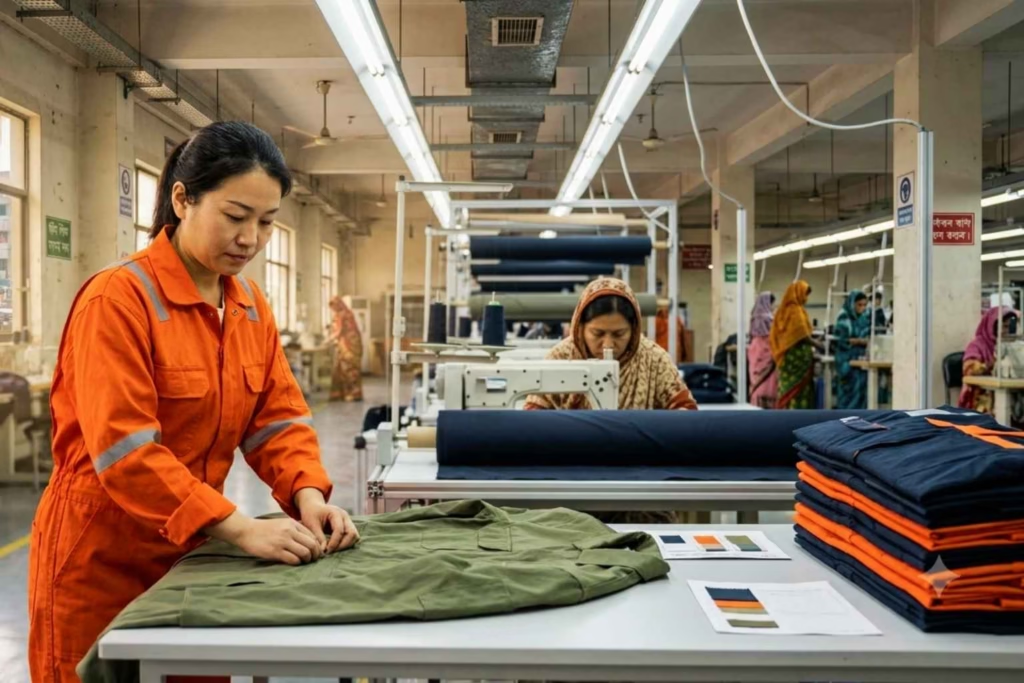
For US and Canadian buyers, NFPA 2112 certified FR coveralls are the baseline specification for any worker exposed to flash fire risk, not an optional upgrade. Oil and gas, petrochemical, and electrical maintenance programs across North America are built around this standard specifically, and procurement teams sourcing outside the US increasingly look to Bangladesh for certified production at competitive volume pricing. Bengal Apparel BD manufactures NFPA 2112 certified FR coveralls through a network of nine certified partner factories, with full third-party test documentation shipped on every order.
This guide covers what NFPA 2112 certification actually requires, how it differs from the European EN ISO 11612 standard your team may also see referenced, and what to confirm with a Bangladesh supplier before committing to bulk production.
What NFPA 2112 Certified FR Coveralls Actually Require
NFPA 2112 is the National Fire Protection Association’s standard governing flame-resistant clothing for industrial personnel against short-duration thermal exposure from fire, more commonly known as flash fire. It specifies minimum design, performance, certification, and testing requirements for both the fabric and the finished garment, and it is paired with NFPA 2113, which covers selection, care, use, and maintenance once the garment is in service.
NFPA 2112 certified FR coveralls must carry a permanent product label showing compliance, and the certifying body’s mark must appear on or directly adjacent to that label. This is not a self-declared standard. A third-party certifying agency tests and audits the garment before it can legally carry the NFPA 2112 designation, and certification must be renewed annually with ongoing factory quality audits.
The Manikin Test Behind Every NFPA 2112 Certified Garment
The defining requirement inside NFPA 2112 is the instrumented manikin flash-fire test, conducted under the ASTM F1930 method. A sensored test manikin wearing the garment is exposed to a three-second flash fire, and the test measures predicted body burn area across the wearer’s body. To pass, a garment must keep predicted second and third degree burn under 50 percent.
This single test is the reason NFPA 2112 certified FR coveralls are trusted differently than generic flame-retardant clothing. A garment can resist flame in isolation and still fail this test if heat transfer through the fabric is too high, which is why fabric weight, weave, and construction all factor into whether a finished coverall passes, not just the raw fiber content.
Beyond the manikin test, NFPA 2112 also requires flame resistance testing under ASTM D6413, thermal shrinkage testing, and heat transfer performance testing, with garments re-tested after 100 simulated industrial wash cycles to confirm performance holds up over the service life of the coverall, not just out of the box.
NFPA 2112 vs EN ISO 11612: Which Standard Your Program Needs
Buyers sourcing from a Bangladesh manufacturer often see both NFPA 2112 and EN ISO 11612 referenced on the same factory’s certification list, and the two are sometimes confused. They test for related hazards using different methods and different pass thresholds, and they are not interchangeable on a compliance document.
NFPA 2112 is the standard for the United States and Canada and is the one most US procurement teams, insurers, and safety auditors will specifically ask for by name. EN ISO 11612 is the equivalent European and internationally recognized standard, more commonly required for buyers in Europe, the Middle East, and Australia. We produce to both standards depending on destination market, and our Nomex and Kevlar coverall program covers the fabric and construction differences between the two in more depth.
If your buyer base spans both North America and Europe, it is worth specifying which markets each production run is destined for at the quoting stage, since labeling, test documentation, and in some cases fabric specification differ between the two standards.
Why North American Buyers Are Sourcing NFPA 2112 Certified FR Coveralls from Bangladesh
North American FR programs are increasingly evaluated on supplier reliability and documentation discipline, not fabric claims alone. Procurement teams want evidence of testing, traceable quality systems, and a supplier who understands both the product and the safety expectations behind it, which is exactly where a managed Bangladesh sourcing partner adds value over a single-factory relationship.
Bengal Apparel BD matches each NFPA 2112 order to the specific partner factory equipped for inherent FR fabric handling and the documentation history the order requires, the same process we use across our broader flame-resistant workwear program. MOQ typically starts from 500 to 1,200 pieces per style and color depending on fabric and construction, with standard lead times of 45 to 90 days from sample approval, FOB Chittagong.
Fire Safety Inside the Factory, Not Just the Fabric
A credible NFPA 2112 supplier claim extends beyond the garment itself into how the factory manages fire risk on its own floor. Combustible storage without fire-rated separation, inconsistent inspection routines, and inadequate means of egress have been identified as leading fire risk factors inside apparel manufacturing facilities, while fire-rated construction, standardized detection systems, and regular inspection and maintenance are the highest-priority mitigation measures.
This is part of why factory-level certification, not just garment-level testing, matters when evaluating a Bangladesh manufacturer. Our partner factories maintain WRAP, BSCI, SEDEX, and ISO 9001:2015 certification alongside garment-specific FR test documentation, and remediation and inspection activity across the wider Bangladesh export sector has shown sustained improvement over the past decade, even though compliance is not universal across every factory in the country. Buyers should request current audit reports directly rather than relying on country-level claims alone.
Construction and Fabric Options for NFPA 2112 Coveralls
NFPA 2112 certified coveralls can be produced in inherent or treated FR fabric, and the right choice depends on exposure frequency and program budget. Inherent FR fabrics, including Nomex and Kevlar blends, have flame resistance built into the fiber itself, so protection does not wash out over the life of the garment. Treated FR fabrics apply a flame-retardant finish to cotton or polyester base fabric, which costs less upfront but has a finite number of wash cycles before retesting is required to confirm continued compliance.
For continuous high-risk exposure, such as oil and gas drilling or refinery maintenance, inherent FR fabric is the standard specification. For lower-frequency or intermittent exposure roles, treated FR fabric is often an acceptable and more cost-effective choice. We can produce either depending on your risk assessment and program budget, and we are happy to walk through which option fits your specific use case.
What to Ask Before You Order
Before placing a bulk order, confirm three things directly with your supplier rather than assuming they are included. First, ask for the current NFPA 2112 certification documentation for the specific fabric and garment construction you are ordering, not a general factory certificate, since certification applies to a specific fabric and design combination. Second, confirm which third-party certifying agency issued the certification and that it remains current, since NFPA 2112 requires annual recertification. Third, ask whether the factory conducts its own ongoing quality assurance testing between annual recertification cycles, since this affects consistency across production batches.
FAQs
What does NFPA 2112 certification actually test?
NFPA 2112 tests flame resistance, heat and thermal shrinkage resistance, heat transfer performance, and predicted body burn area using an instrumented manikin exposed to a three-second flash fire. A garment must keep predicted burn under 50 percent to pass.
Is NFPA 2112 the same as EN ISO 11612?
No. NFPA 2112 is the North American standard primarily required in the US and Canada. EN ISO 11612 is the equivalent European and internationally recognized standard. They test similar hazards using different methods and thresholds, and are not directly interchangeable on compliance documentation.
Can Bangladesh factories produce NFPA 2112 certified coveralls?
Yes. Certified Bangladesh factories with the appropriate fabric handling capability and third-party test documentation can produce to NFPA 2112. Not every factory in Bangladesh is equipped for this level of compliance, so supplier verification matters.
What is the minimum order quantity for NFPA 2112 coveralls?
MOQ typically starts from 500 to 1,200 pieces per style and color, depending on fabric type and construction. Contact us with your specification and we will confirm what is achievable, including options for smaller test orders.
How long does NFPA 2112 certification last?
Certification requires annual recertification with ongoing factory quality audits, typically up to four times per year, to confirm production continues to meet the standard.