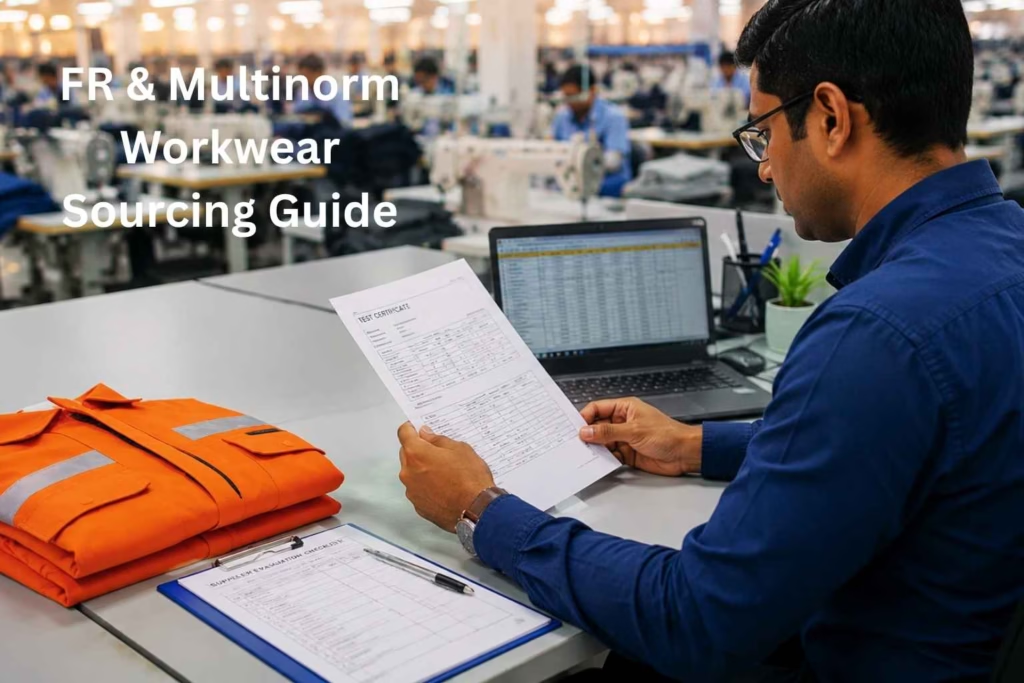
How to Choose a Reliable FR and Multinorm Workwear Supplier: A B2B Buyer's Guide
Knowing how to choose FR multinorm workwear supplier correctly is one of the most consequential procurement decisions a B2B importer or distributor makes. Get it right and you build a supply relationship that holds up under regulatory scrutiny, client expectations, and real-world hazard conditions. Get it wrong and the cost is not just a failed order. It is reorders, compliance liability, and in the worst cases, a garment worn in a hazardous environment that should never have left the factory.
Here is a situation that happens more often than most procurement teams will admit.
You send requests for quotes to five suppliers. All five respond with competitive pricing. All five say they manufacture EN ISO 11612 and EN 1149-5 certified garments. Two of them have professional-looking websites. One has pricing 35 percent lower than the others. Another says they can deliver in 30 days. You have a shortlist. But you have no solid basis for telling which one is actually capable of delivering what they claim.
This is where most buyers who are evaluating FR multinorm workwear suppliers run into serious trouble. The challenge in flame-resistant garment sourcing is not a shortage of options. There are hundreds of manufacturers across Bangladesh, Pakistan, China, and Eastern Europe all claiming FR and multinorm capability. The difficulty is separating those who genuinely understand the standards, the fabric science, and the compliance documentation from those who are repeating phrases copied from someone else’s product page.
The stakes in this category are higher than in most workwear. FR and multinorm garments are specified for workers in oil and gas extraction, electrical utilities, petrochemical plants, and welding operations. These are environments where a garment that passes on paper but fails under real hazard conditions is not a product defect. It is a safety failure with direct legal consequences for the importer, distributor, and end client who specified and deployed it.
At Bengal Apparel BD, we have been manufacturing FR and multinorm workwear from Bangladesh since 2017, supported by 25 years of prior garment production and merchandising experience. Procurement teams across North America, Europe, the Middle East, and Australia have put us through this evaluation. We have also spent years applying the same supplier qualification process to our own fabric mills, trim vendors, and test laboratories. That combined experience is the foundation of this guide.
This is a practical framework for every stage of the FR multinorm supplier selection decision. Use it to assess any manufacturer, including us.
Six Red Flags That Should Disqualify a Supplier Immediately
The fastest way to reduce your shortlist is to eliminate suppliers who fail basic transparency tests early. Below are the six most common disqualifiers that experienced importers and distributors encounter when selecting a reliable FR workwear manufacturer.
Red Flag 1: "We Are EN ISO 11612 Certified" Without Batch-Specific Test Documents
This is the most common source of confusion in industrial workwear compliance, and it is worth being precise about what certification actually means before you engage any supplier.
When a factory says it is certified, it almost always means the factory holds an ISO 9001 quality management system certificate. ISO 9001 confirms the factory has documented management processes. It does not confirm that the specific garment you are ordering has been independently tested and verified to meet the protection standard you have specified.
What B2B procurement for protective clothing actually requires is a batch-specific third-party test report. This is a document issued by an independent testing laboratory such as SGS, TUV Rheinland, or Bureau Veritas confirming that your specific garment style, made from the specific fabric in your production batch, was tested against the full requirements of the named standard and passed each parameter. The document must show the test date, the batch reference number, the exact designation of the standard tested (for example EN ISO 11612:2015), and the individual numeric result for every parameter. A summary conclusion is not sufficient.
Without this document you are relying on a claim. With it you have verifiable, batch-level proof of compliance. From a procurement due diligence standpoint these are fundamentally different positions.
Ask every potential supplier the same direct question: “Do you provide a third-party batch test certificate for every production order I place, automatically, as a standard part of your service?” If they hesitate, suggest certificates are only issued on request, or respond with general reassurances about their quality systems, that is a disqualifying response. Manufacturers with genuine compliance culture test every batch because it is how they operate, not because a buyer has asked for a special effort.
Red Flag 2: MOQ Impossibly Low at Prices That Do Not Reflect Real Production Costs
If a supplier offers 200 pieces at USD 10 per piece for a certified FR coverall, pause before responding. That price does not reflect the real cost structure of legitimate FR workwear production.
FR workwear production has cost floors determined by real inputs. The fabric alone for a compliant Nomex blend or a tested treated cotton FR garment runs between USD 5 and 9 per piece at the material stage, before any conversion costs are applied. Add cutting room waste, sewing labour, quality inspection, labels and trims, third-party laboratory testing, and export packaging, and a genuinely certified FR garment produced at small quantities will rarely come in below USD 14 to 18 per piece when all costs are accounted for honestly.
A quote that sits well below this floor at low volumes points to one of three situations. The supplier is using untested or non-compliant fabric. The price presented is an opening figure that will be revised upward once you have committed. Or the third-party testing step is simply not happening, which means the certifications being quoted cannot be verified at the batch level regardless of what the supplier claims.
Ask any supplier whose quote looks unusually low: “Can you walk me through the cost breakdown for this garment? What fabric are you using, which mill supplies it, and how does the cost of third-party laboratory testing appear in this price?” A supplier who understands their own operations will answer this clearly. A supplier who deflects or becomes evasive is showing you something important about how their supply chain reliability actually works.
Red Flag 3: Unrealistically Short Lead Times With No Process to Support Them
A 30-day lead time for a full certified FR garment production run from order confirmation to factory shipment is not achievable within a legitimate process. A supplier who promises it is either misrepresenting their capabilities or preparing to cut corners in a phase that directly affects the safety performance of the finished garment.
The actual timeline for a credible FR multinorm production process breaks down as follows: two to three weeks for sampling and approval if a new style is being introduced, two weeks for fabric procurement if the specific material is not already in the supplier’s confirmed inventory, four weeks for the production run, two to three weeks for third-party laboratory testing by an accredited test body, one week for final quality inspection and export packing. When these are added up honestly, ten to twelve weeks from order confirmation to factory shipment is the realistic minimum before goods are ready to move.
Some suppliers with pre-approved styles, confirmed fabric inventory, and available production capacity can compress this to seven or eight weeks for a specific order. These situations do exist and legitimate express options are available in the right circumstances. But any supplier routinely offering under five weeks for a first-production certified style with full independent batch testing built in should be required to explain precisely which phase they are shortening, and to provide a reference from a previous client who received delivery on that timeline and can speak to the quality of what arrived.
You can review a full breakdown of what a realistic ordering and production schedule looks like in practice before you send your first request for quote.
Red Flag 4: Cannot Name Their Fabric Mills or Explain Their Sourcing Strategy
FR fabric is not a commodity that can be swapped between suppliers without consequence. It is the single variable most directly responsible for the safety performance of the finished garment, and understanding exactly where a supplier sources it is a non-negotiable part of responsible factory quality assurance in this category.
The distinction between inherent FR fabrics and treated FR fabrics carries significant practical implications for garment defect tolerance, service life, and ongoing compliance. Inherent fabrics, such as those built from Nomex or Lenzing FR fibres, have flame resistance integrated into the chemical structure of the fibre itself at the point of manufacture. This protection cannot degrade through washing because it is not a surface treatment. Treated FR fabrics achieve their flame resistance through chemical coatings applied after the base fabric is woven. These coatings degrade over time with industrial laundering, which affects the garment’s ongoing compliance performance during its service life. These two categories carry different durability profiles, different cost structures, and different suitability for different end-use environments and certification requirements.
A supplier who cannot identify their fabric mills by name is either sourcing opportunistically from whichever supplier offers the best price on a given order, or they do not have sufficient visibility into their own supply chain to confirm what you are actually buying. Neither is acceptable in a procurement program for certified industrial workwear compliance.
The conversation you want to have sounds like this: “Which mills supply your FR fabrics, and is it possible to see the mill certifications and test data?” A qualified supplier responds with specific names, describes the fabric type and construction they use for different application requirements, for example Nomex for oil and gas programmes in North America and a TUV-audited treated cotton for standard EN ISO 11612 programmes in Europe, and provides the relevant documentation directly or offers to share it under a signed non-disclosure agreement where the supplier relationships are commercially sensitive.
A response along the lines of “we use quality certified FR fabrics from our trusted network” is not an answer. If specifics are not available after you have asked clearly, remove that supplier from consideration.
Red Flag 5: Will Not Allow Independent Factory Audits
A supplier who blocks, discourages, delays, or levies unreasonable charges for third-party factory audits is a supplier with something to conceal. This applies regardless of how strong their other responses may appear.
Qualified manufacturers operating at a serious level in the B2B workwear industry are accustomed to audits. They have procedures in place for hosting them. They hold and can immediately produce current certificates covering ISO 9001, OEKO-TEX, WRAP, and BSCI requirements. When you ask about audit rights, the response from a qualified supplier is something like: “Yes, you or a third party you appoint may audit our facilities. We ask for five working days notice as standard. Here are our current compliance certificates and our most recent third-party audit summary.”
Factory audit rights matter for reasons that extend beyond production quality management. Importer and distributor guidelines in North America, Europe, and Australia increasingly require demonstrable supply chain due diligence covering labour practices, environmental compliance, chemical handling, and physical safety infrastructure. A supplier who cannot be audited is a supplier who may expose your company to compliance liability that has nothing to do with whether the garments themselves meet their technical specifications.
Red Flag 6: Dramatic Price Reductions at Higher Volumes Without a Coherent Explanation
Economies of scale exist in garment manufacturing. A reasonable price reduction moving from 1,000 to 10,000 pieces of a consistent style, made from the same fabric and processed through the same production line, is typically in the range of 15 to 25 percent. The drivers are identifiable: fabric is sourced in larger batch quantities at better mill pricing, production setup costs are spread across more units, and logistics efficiency improves with volume.
A supplier who quotes USD 22 per piece at 1,000 pieces and USD 9 per piece at 10,000 pieces is presenting a 59 percent reduction that does not correspond to any realistic cost saving of that magnitude from volume alone. Gaps of this size usually indicate that different quality inputs are being used at different volume tiers, that large-volume orders are being fulfilled through different factories with different certification and quality control profiles, or that the pricing was constructed without grounding in actual production economics.
Ask the supplier to walk through their cost structure at each volume point. What specific input or process cost changes and by how much? A supplier who runs a stable, well-managed production operation will answer this with specifics. A supplier who cannot explain their own pricing is not a supplier positioned to deliver reliably to a specification across an ongoing program.
How to Choose FR Multinorm Workwear Supplier: Six Green Flags That Confirm You Have Found the Right One
After eliminating suppliers who fail the red flag tests above, the task shifts to positively confirming capability. Here is what selecting a reliable FR workwear manufacturer looks like in practice across six key dimensions.
Green Flag 1: Batch-Specific Test Certificates Are Offered Without Prompting
When you raise the subject of documentation with a capable supplier, they do not treat it as an unusual or burdensome request. They proactively tell you that every production batch ships with a third-party test certificate, and they can show you examples from previous orders so you understand exactly what the document contains.
A certificate from a credible accredited laboratory will show the batch lot number, the date of testing, the full title and version year of the standard tested, and the individual numeric result for every parameter within that standard. The laboratory will hold ISO/IEC 17025 accreditation, the international benchmark for the technical competence of testing and calibration organisations. This accreditation number appears on the certificate itself and can be verified independently through the accreditation body’s public register.
Batch-level third-party documentation is not an enhanced service offered by premium suppliers. It is the minimum standard that any serious B2B buyer has a right to expect. A supplier who positions it as exceptional is revealing the actual standard they apply to orders from buyers who do not ask.
Green Flag 2: MOQ and Pricing Structure That Can Be Explained in Detail
A qualified supplier can account for the costs that build their price at each volume level. They provide a clear price break structure and can explain the logic behind the movement between tiers. When you request a cost breakdown, they provide it with enough specificity to be useful: fabric cost per unit at the applicable batch size, labour cost, trim and accessories, the cost of third-party laboratory testing amortised across the production batch, overhead allocation, and margin.
They do not need to expose their exact profit percentage. But they should be able to explain the structure of their pricing without resorting to generalities. A supplier who falls back on “that is market pricing” without any further content is not a supplier with sufficient command of their own operations to be a reliable long-term procurement partner. You can review realistic MOQ levels and production cost ranges for workwear sourcing from Bangladesh before assessing any quotes.
Green Flag 3: A Documented Lead Time With a Phase-by-Phase Breakdown
A qualified supplier does not give you a single lead time figure. They give you a timeline that accounts for each stage of production, identifies when third-party testing occurs and how long it takes, and names the laboratory partner responsible. When you ask whether they have met specific timelines on previous orders, they can describe examples and offer reference contacts at the clients involved.
Realistic lead times are not a sign of an inefficient operation. They are a sign of a supplier who understands their own production workflow well enough to commit to a schedule they can actually meet. A supplier who consistently delivers against realistic timelines is of more commercial value than a supplier who quotes short timelines and then manages delays after you have already committed your inventory program.
Green Flag 4: Named Fabric Mills With Verifiable Certifications
A qualified supplier names their FR fabric sources immediately and can distinguish what they use for different applications and markets. They understand the durability and compliance implications of the difference between inherent and treated FR fabrics and can point you toward the appropriate option for your specific end-use and compliance geography.
A supplier who mentions Nomex or Lenzing FR by name, who can explain the difference in EN ISO 11612 performance levels between different fabric constructions, and who can describe the washing durability of treated fabrics alongside the test data that supports that description is a supplier with genuine technical grounding in their product category. That level of knowledge does not exist in a supplier who is assembling orders opportunistically.
A qualified supplier has also considered supply chain reliability for your benefit. They hold buffer inventory for their primary fabric lines or maintain pre-qualified backup mills capable of supplying equivalent certified materials if a primary source encounters disruption. That kind of planning is what sustains a long-term B2B supply program through the disruptions that affect any manufacturing supply chain over time.
Green Flag 5: Current Certifications in Hand and Audit Access Confirmed
A qualified supplier shares their current certification documents without delay when asked, and ideally before you ask. You should see active ISO 9001, OEKO-TEX, WRAP, and BSCI certification documents as a baseline. The certificates should be current and the supplier should be able to tell you when each is due for renewal.
When you raise the question of audit rights, a qualified supplier confirms them without qualifying conditions. They describe the process: how much notice is required, who at the factory is the correct contact, and what areas of the facility are accessible. They have hosted audits from other international buyers and can provide that as a reference if you want to validate their comfort with the process. A supplier who is unguarded about scrutiny operates consistently regardless of whether they are being observed.
Green Flag 6: A Written, Specific Policy Governing Defects and Test Failures
No production operation achieves zero defects across all orders at all times. The measure of a reliable supplier is not a defect-free guarantee but a documented, specific process for managing the quality failures that will occur over the life of a supply relationship.
A credible quality commitment sets a defined defect tolerance (two percent is the accepted norm for technical workwear), a stated response process and timeline for batches that fail third-party testing, a root cause investigation requirement to prevent the same failure recurring on subsequent orders, and a clear statement of the buyer’s recourse if commitments are not met.
When you are seriously evaluating any supplier, ask them: “If a production batch fails third-party testing, walk me through exactly what happens from the moment the failure result is received.” The specificity of their answer, and how readily it comes, tells you a great deal about whether their quality management process is documented and practised or whether it exists only on paper.
The Supplier Scoring Matrix for FR Multinorm Workwear Selection
Subjective assessments of supplier capability are a starting point, not a conclusion. When you are vetting FR and multinorm garment suppliers for a significant procurement program, you need a framework that makes the comparison between suppliers objective, repeatable, and visible to your team and any stakeholders who will review your decision.
A formal scoring process removes personal bias and creates an auditable record of your reasoning that finance, compliance, and senior management can review if questions arise later.
Score each supplier from 0 to 10 on every criterion below. Multiply each raw score by the criterion weight to produce the weighted contribution. Add all weighted contributions to reach a total out of 10.
Scoring guide: 0 to 3 indicates the supplier fails this criterion or declines to address it. 4 to 6 indicates partial compliance with follow-up questions needed before proceeding. 7 to 9 indicates the supplier clearly meets your expectations. 10 indicates they exceed expectations and have provided documentation to support that assessment.
Evaluation Criterion | Weight | Supplier A | Supplier B | Supplier C |
Batch test certificates provided automatically | 15% | /10 | /10 | /10 |
Test lab holds ISO/IEC 17025 accreditation | 10% | /10 | /10 | /10 |
Clear and justified MOQ and pricing structure | 12% | /10 | /10 | /10 |
Realistic lead time with documented breakdown | 12% | /10 | /10 | /10 |
Named fabric suppliers with supporting documents | 10% | /10 | /10 | /10 |
ISO 9001 certificate current and shareable | 8% | /10 | /10 | /10 |
OEKO-TEX certification current and shareable | 8% | /10 | /10 | /10 |
Third-party audit allowed at your request | 7% | /10 | /10 | /10 |
Documented defect policy and response process | 6% | /10 | /10 | /10 |
References available from comparable orders | 6% | /10 | /10 | /10 |
Willingness to discuss problems openly | 6% | /10 | /10 | /10 |
Total weighted score | 100% |
Decision thresholds: A total score below 60 means the supplier should not be selected for a live production program. A score between 60 and 75 allows the supplier to proceed to sampling but requires additional due diligence before a trial order is placed. A score of 76 or above confirms the supplier as a qualified candidate for the next stage.
The weights shown are calibrated for a general B2B importer or distributor serving multiple markets. You should adjust them to reflect your specific compliance priorities.
If your primary market is Europe, where chemical substance compliance creates direct regulatory risk, increase the OEKO-TEX weight to 12 percent and reduce the MOQ pricing weight to 9 percent. If you are serving the Middle East oil and gas sector, where certified batch documentation is the non-negotiable first requirement, increase the batch testing weight to 18 percent and reduce the references weight to 4 percent. If you are procuring for Australia or New Zealand, where NATA-accredited testing is the accepted standard, add a dedicated row for NATA laboratory accreditation at an 8 percent weight and adjust the ISO/IEC 17025 row accordingly.
The scoring matrix is not a mechanism for avoiding accountability in a close decision. It is a tool for making FR multinorm supplier selection criteria explicit before you are under time pressure, so your reasoning survives scrutiny from anyone who reviews it afterwards.
The Six-Step FR Multinorm Supplier Qualification Process
Understanding the selection criteria is one challenge. Running the actual qualification process from initial contact to a confirmed ongoing production program is another. Below is the six-step procurement process applied by experienced B2B importers and distributors when they are bringing a new FR or multinorm workwear manufacturer into their supply chain.
Step 1: Initial Screening Through a Structured RFQ (Week One)
Send a detailed request for quote to five to seven potential suppliers. A well-constructed RFQ does far more than collect pricing. It asks the specific questions that let you apply the red flag tests from Section 1 before you commit time and money to physical samples.
Your RFQ should put the following questions directly to every supplier: Can you manufacture this specific garment style to these specific certification requirements (list them in full, for example EN ISO 11612:2015 Level A1B1C1 and EN 1149-5:2018)? What is your minimum order quantity for this style? Do you provide a third-party batch test certificate from an ISO/IEC 17025 accredited laboratory for every production batch, as a standard part of your service? What is your lead time from order confirmation to factory shipment for this type of product? Which test laboratory do you use and what is their accreditation reference number? Can you provide contact details for two or three previous clients whose orders were comparable in product type and volume?
When responses arrive, apply the disqualifiers from Section 1 consistently. Suppliers who give vague answers, who cannot confirm their testing process specifically, or who promise timelines that cannot be supported by a realistic production schedule should be removed from consideration at this point. Advance the top two or three who have demonstrated the capacity to respond to basic qualification questions with specificity.
Step 2: Quote Analysis and Shortlisting (Week Two)
Build a structured comparison table covering MOQ, price per piece at your target volume, confirmed lead time, named test laboratory, the specific certifications claimed, and the preliminary score each supplier has earned from your evaluation matrix in Section 3.
Review the table for anything that falls outside the range of the group. A quote significantly below the others at the same volume should prompt a request for the full cost breakdown. A lead time notably longer than competitors deserves an explanation of which production phase creates the difference. Any divergence in the certifications that different suppliers claim should trigger a request for the supporting documentation for each claim.
By the end of this step you should have two suppliers who have passed the red flag screening, provided consistent responses under questioning, and demonstrated enough operational transparency to justify the investment of a formal sampling process.
Step 3: Sample Ordering and Internal Physical Testing (Weeks Three and Four)
Order five to ten pieces from each of your two remaining suppliers. When submitting the sample request, provide the full specification in writing: the exact garment measurements for each size in your required range, the colour with a specific reference standard, the width and placement of reflective tape if applicable, the seam construction type, the label content and positioning, and any additional detail that will govern the production order. Request physical samples together with a technical specification sheet and a sample-level test report from an accredited laboratory.
When samples arrive, run them through a practical physical evaluation before reviewing any documentation. Wash each sample five times under industrial laundering conditions that approximate what your end clients will apply. After washing, measure shrinkage in both the length and width directions. A result below three percent in either axis is the acceptable standard for most industrial workwear applications. Apply firm manual pressure to all principal seams and stress points to assess seam integrity. Evaluate colour fastness visually. Fit the samples against your target sizing standard.
Record your assessment for each supplier against each test parameter with clear pass or fail findings, not summary impressions. This documentation is your objective record for comparing suppliers and for evidencing your quality process if questions arise later.
Step 4: Sample Approval and Full Documentation Review (Week Five)
When a supplier’s samples pass your physical evaluation, move to a systematic review of the compliance documentation. Request the complete third-party test certificate issued for the specific samples you received.
Review the certificate against the following checklist. The test date should be within the past six months; test reports older than this may not accurately represent current production materials. The standard designation on the certificate should match your requirement exactly, including the year of the applicable version. The laboratory should hold ISO/IEC 17025 accreditation and the accreditation reference number should be visible on the document so you can verify it against the accreditation body’s public register. The certificate should show individual numeric results for every parameter within the standard, not a single overall pass or fail determination.
After your review, put two direct questions to the supplier: “Will every bulk production batch I order be tested by this same laboratory? Will I receive the full certificate with each shipment delivery automatically?” The answer to both must be yes without conditions. If the response introduces caveats, whether volume thresholds, additional cost, or buyer-initiated requests, that is a procurement due diligence issue that needs to be resolved in writing before any order is placed.
Suppliers whose samples pass your physical tests and whose documentation meets the review criteria above are ready to proceed to a trial order. Suppliers whose samples fail on quality should be given a clearly defined deadline and a specific list of what must change before revised samples are provided. Suppliers whose documentation fails should be disqualified unless the deficiency can be fully resolved and confirmed in writing.
Step 5: Trial Production Order and Written Quality Agreement (Weeks Six Through Eight)
Place a small trial production order to validate the supplier’s capability under real production conditions. Five hundred to one thousand pieces is the typical volume range, though the appropriate quantity will depend on your market requirements, your storage capacity, and the supplier’s confirmed minimum for the specific style.
Before the purchase order is issued, document in writing the terms that will govern this trial and carry forward into the supply relationship. At minimum this written agreement should cover: the complete garment specification by reference to the approved sample and written spec sheet, the confirmed lead time with a specific factory shipment date, the testing requirement specifying that every production batch must be tested by the named accredited laboratory with the full certificate delivered as part of the shipment documentation, the defect tolerance applicable to this supply program (two percent is the accepted industry standard for technical workwear), the exact procedure and timeline for addressing any batch that fails testing or arrives with defect rates above the agreed tolerance, your right to commission an independent pre-shipment inspection at the factory, and the payment terms.
This agreement does not need to be a complex legal document at the trial stage. A detailed purchase order that references a short written quality schedule countersigned by the supplier is adequate for most B2B supply relationships while trust and track record are being established.
When the trial shipment arrives, inspect twenty to thirty pieces across size and colour variants systematically. Check for visual defects, measurement conformance against the approved specification, seam integrity, and reflective tape adhesion and placement if applicable. Confirm that the third-party test certificate is present and that the batch reference number on the certificate matches the reference on the shipping documents. If quality is confirmed across all checks, the supplier is ready for a full ongoing production program. If issues are found, raise them formally and document both the problem and the supplier’s response before making any decision on whether to proceed.
Step 6: Full Production Program and Active Supplier Management (Week Nine Onwards)
With a confirmed trial order and quality evidence behind you, you can place your ongoing production program from a position grounded in verified performance.
Establish a production schedule that reflects your inventory requirements and the supplier’s forward capacity. Do not relax the quality requirements that governed the trial order because the relationship feels established. Build an annual third-party audit of the supplier’s production facilities into your supply management calendar. Hold a quarterly review call with your main contact at the supplier to work through quality data from the preceding period, any material cost changes on the horizon, updates to the relevant standards that may require specification adjustments, and any constraints on the supplier’s capacity that could affect your planning.
Maintain complete organised records of every batch test certificate received, every quality agreement executed, every defect record and its associated corrective action response, and every audit report. If your client, a regulatory body, or a customs authority raises a compliance question at any point in the life of this supply program, these records are the evidence that your procurement was diligent and that the basis for your compliance claims is documented at every stage. They are not administrative overhead. They are the foundation of your supply chain integrity.
How FR Multinorm Supplier Selection Criteria Differ by Market
The supplier qualification framework above is designed to apply across markets, but buyers in different regions face specific compliance requirements that should shape how you weight the scoring matrix and which questions you lead with during supplier evaluation.
North America, USA and Canada: The primary governing standard for industrial FR workwear in North America is NFPA 2112, which covers workwear sourcing for oil and gas, utilities, and power generation. Test laboratories must be recognised under the NFPA certification framework. SGS, TUV, and UL are among those commonly accepted. Suppliers must have hands-on experience shipping to US and Canadian importers and distributors, including understanding of customs documentation and country-of-origin marking obligations. Ask specifically for references from clients in North America. You can review how Bengal Apparel BD’s manufacturing capabilities serve North American buyers as one practical reference point in your evaluation.
Europe: The EU PPE Regulation 2016/425 is the binding legal framework for all personal protective equipment placed on the European market. Testing must be conducted by designated EU Notified Bodies. CE technical files must be prepared, maintained, and held available for regulatory inspection for every garment category. OEKO-TEX Standard 100 certification is now routinely required by European buyers and distributors, driven by EU regulations on restricted substances in textiles that are among the most demanding chemical compliance frameworks in any market. If you are sourcing for Europe, increase the OEKO-TEX weight in your scoring matrix to 12 percent. Chemical substance compliance creates direct legal liability for the importer, not just a preference question.
Middle East and GCC: Middle East oil and gas workwear demand is governed by both NFPA 2112 and IEC 61482-2 for arc flash protection, and suppliers must be familiar with both. Suppliers serving the Saudi market must also understand Saudi Aramco’s own procurement requirements, which operate separately from and in addition to the international standards. Logistics to GCC destinations require specific documentation sets, freight lead times longer than those applicable to Europe or North America, and in some cases additional inspection requirements upon arrival. Ask explicitly whether the supplier has completed production orders for GCC-based clients and whether those clients are available as references.
Australia and New Zealand: Industrial workwear compliance in Australia and New Zealand operates under AS/NZS standards. Test laboratories must hold accreditation from NATA, the National Association of Testing Authorities Australia. Ocean freight from Bangladesh to Australian ports adds four to six weeks to the total supply chain timeline, and this must be incorporated into your lead time planning from the very beginning of the procurement process rather than treated as a calculation to be made after production has already been scheduled.
Conclusion: How to Qualify an FR Workwear Supplier Comes Down to One Question
Looking back at every element of this guide, one pattern runs through the entire process. Every green flag identified in Section 2 is a version of the same behaviour: the supplier is genuinely willing to show you what they are doing, in detail, at every stage.
They provide batch test certificates before you ask. They explain their pricing against real costs when you request a breakdown. They confirm audit rights without qualification. They give you the names and direct contact details of previous clients so you can verify their claims independently. They have a specific written process for the quality failures that will occur over the course of a supply relationship, rather than a culture of information management when something goes wrong.
Every red flag identified in Section 1 is a version of the opposite: evasion. Certification claims that dissolve when you ask for batch-level documentation. Pricing that has no cost basis when you ask for an explanation. Lead time promises that hold up only until you press for specifics. Fabric sources that cannot be identified by name.
The price differential between a supplier who passes these tests and one who does not is usually ten to twenty percent per piece at the order stage. The cost of selecting a supplier who fails after your program is committed, or who delivers garments that fail compliance verification after your clients have deployed them in the field, is measured in full reorder costs, regulatory liability, commercial relationship damage, and in some circumstances worker safety failures that this procurement process could have prevented.
FR multinorm supplier selection criteria matter more than price benchmarking in this product category. Apply the scoring matrix from Section 3 to every supplier on your shortlist. Follow the six-step qualification process in Section 4 without shortcutting any stage. Ask the specific questions this guide identifies at every point. A supplier who genuinely meets the standard of a reliable FR multinorm workwear manufacturer will not find any of these questions difficult to answer. The one who qualifies is the one who welcomes the scrutiny.
About Bengal Apparel BD
Bengal Apparel BD has been manufacturing FR and multinorm workwear from Bangladesh since 2017, supported by 25 years of prior production and merchandising experience across the garment industry. We work with certified partner factories, hold active relationships with accredited third-party test laboratories, and provide full batch-level test documentation with every production order as standard operating practice. We supply importers, distributors, and private-label brands in North America, Europe, the Middle East, and Australia.
Our compliance and certifications page provides current documentation for review at any stage of your evaluation. Our protective clothing certifications guide explains the standards framework that governs the products we manufacture.
If you are currently assessing FR and multinorm workwear suppliers for your procurement program, apply this guide directly to us. Request our cost breakdowns, the names of our fabric mills, our audit access policy, examples of batch test certificates from recent production, and reference contacts from comparable orders. We expect exactly these questions from serious buyers and are prepared to answer every one of them without qualification.
View our manufacturing capabilities or request a quote to begin the evaluation.