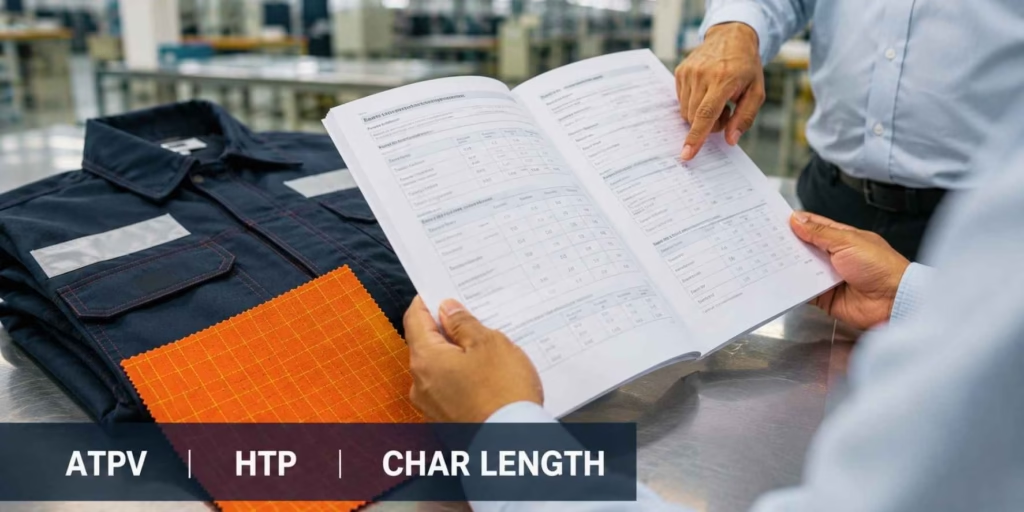
Reading an FR Workwear Test Report: What ATPV, HTP, and Char Length Actually Mean
A certification label on an FR garment tells you a standard has been met. A test report tells you by how much, under what conditions, and whether that performance holds after the garment has been washed one hundred times. For procurement managers sourcing flame-resistant coveralls, understanding the key metrics inside an FR workwear test report is not a technical exercise. It is the practical skill that separates a compliant program from one that looks compliant on paper but fails in the field.
This guide explains what ATPV, HTP, and char length actually measure, how they relate to each other, what minimum thresholds apply under NFPA 2112 and ASTM F1506, and what a credible test report should contain before you approve bulk production. For buyers who want to understand the specific certification standards these tests support before reading further, our guide on NFPA 2112 certified FR coveralls for US and Canadian buyers covers the standard’s full requirements in depth.
Why Your FR Workwear Test Report Matters More Than the Certification Label
A certification label on an FR garment is a summary. The test report is the evidence behind it. Two garments can both carry an EN ISO 11612 or NFPA 2112 certification label and perform very differently in a real thermal event, because the label only confirms a standard has been met, not the margin by which it was met, not which fabric batch was tested, and not whether performance holds after repeated industrial washing.
Procurement managers who rely only on certification labels are making sourcing decisions on a summary document rather than the underlying evidence. Buyers who request and review full test reports know the exact ATPV value, the HTP figures for both spaced and contact conditions, the char length before and after laundering, and the predicted body burn percentage from the manikin flash fire test. These numbers are what determine whether your workforce is adequately protected for the specific hazard exposure your program covers.
A credible FR supplier provides these documents as a standard part of the quoting and sample approval process, not only on request after an order is placed. If a supplier cannot produce a current, third-party-verified test report for the specific fabric and garment construction you are ordering, that is a quality signal, not a paperwork inconvenience.
ATPV: Arc Thermal Performance Value in an FR Workwear Test Report
ATPV stands for Arc Thermal Performance Value. It measures a fabric’s ability to protect against electric arc flash thermal energy and is expressed in cal/cm² (calories per square centimeter). It is determined by the ASTM F1959/F1959M test method, which exposes fabric samples to increasing levels of arc energy while sensors behind the fabric measure transmitted heat.
The ATPV value is defined as the incident energy level at which there is a 50 percent probability that sufficient heat transfer through the fabric will cause the onset of a second-degree burn, modeled using the Stoll Curve, which is the standard human skin burn injury model used across FR testing. A higher ATPV means the fabric can absorb more arc energy before that threshold is reached, which means greater protection for the wearer.
A closely related value called EBT, or Energy Breakopen Threshold, appears on some reports instead of ATPV. EBT measures the energy level at which there is a 50 percent probability of the fabric breaking open with a hole larger than 1.6 cm². When a garment carries an arc rating on its label, that rating is always the lower of the ATPV or EBT value, not both. ATPV-rated fabrics tend to be stronger but less insulative. EBT-rated fabrics are more insulative but may break open before a second-degree burn threshold is reached.
In practice, the arc rating categories most commonly referenced in procurement are those set by NFPA 70E and ASTM F1506: a minimum of 4 cal/cm² for Category 1 electrical hazards, 8 cal/cm² for Category 2, 25 cal/cm² for Category 3, and 40 cal/cm² or above for Category 4. A garment rated at 8 to 12 cal/cm² provides moderate arc flash protection and covers most general electrical maintenance exposure. Garments rated above 40 cal/cm² are specified for very high-hazard environments such as switchgear and transformer work.
ATPV applies specifically to arc flash hazards. It is not a measure of flash fire protection. Both values can appear in the same test report if the garment is tested for both hazard types, but they must be read separately and matched to the correct hazard in your risk assessment.
HTP: Heat Transfer Performance and What the Numbers Tell You
HTP stands for Heat Transfer Performance. It quantifies a fabric’s ability to resist heat transfer from combined convective and radiant sources, the conditions that occur in an industrial flash fire rather than an electric arc. It is tested per ASTM F2700 and is also expressed in cal/cm².
The test exposes fabric to a controlled heat source delivering approximately 2 cal/cm²/s combining flame and radiant heat, simulating flash fire conditions. Sensors behind the fabric measure the heat passing through. Critically, the test is run in two configurations that produce two separate values in the report.
The spaced configuration places an air gap between the fabric and the sensor, simulating the looser fit typical of a coverall worn over base layers. The contact configuration places the fabric directly against the sensor, simulating what happens where the garment sits tightly against the body, particularly at elbows, knees, and shoulders. Both values appear in the test report, and NFPA 2112 sets a minimum threshold of 6 cal/cm² for the spaced result and 3 cal/cm² for the contact result.
A higher HTP value in either configuration means the fabric transfers less heat to the wearer per unit of time under flash fire conditions. Fabrics that substantially exceed the minimum thresholds provide a meaningful safety margin. When comparing FR fabric options for a sourcing program, comparing HTP values across fabrics is a more precise indicator of real-world thermal protection than fabric weight or fiber brand alone.
Char Length: The Vertical Flame Test Explained
Char length is measured through the Vertical Flammability Test under ASTM D6413. It assesses how far flame damage extends along a fabric after a controlled exposure, and it is one of the most straightforward metrics in an FR workwear test report to interpret: a lower number is always better.
The test procedure holds a fabric strip vertically, exposes the bottom edge to a standardized flame for twelve seconds, then removes the flame source and records how long the fabric continues to burn on its own, called afterflame time. The charred fabric strip is then torn along the damaged area, and the distance from the original flame edge to the end of the tear is recorded as the char length.
NFPA 2112 requires an average char length of no more than 4 inches (100 mm) across test specimens, with an afterflame time of no more than 2 seconds after the flame source is removed. ASTM F1506, the arc-rated clothing standard, allows a slightly less stringent limit of 6 inches (150 mm) char length. Any fabric that melts, drips, or burns through completely during the test fails regardless of the measured char length.
Char length is a useful baseline measure of whether a fabric is genuinely self-extinguishing, but it does not by itself predict overall thermal protection performance in a full garment test. A fabric can achieve a low char length and still perform poorly in the manikin flash fire test if the garment construction allows heat transfer through seams, openings, or fitted areas. Char length is one data point in the full test report, not a standalone pass or fail for garment performance.
The Manikin Flash Fire Test: Where ATPV, HTP, and Char Length Come Together
The instrumented manikin flash fire test under ASTM F1930 is the single most comprehensive performance test in an FR workwear test report. It tests a complete finished garment rather than fabric swatches, which means it captures the effect of garment construction, fit, seam placement, openings, and fabric behavior all at once.
A sensor-equipped test manikin is dressed in the finished coverall and exposed to a propane-fueled flash fire simulation delivering approximately 84 kW/m² of heat flux for a standard three-second exposure, the duration used for NFPA 2112 certification. Sensors across the manikin’s body measure heat transfer during and after the exposure, and burn prediction software calculates predicted second- and third-degree burn injury at each sensor location. The primary result is the predicted total body burn percentage.
NFPA 2112 requires that the average predicted body burn across test specimens does not exceed 50 percent. High-performing FR garments from certified manufacturers typically achieve 10 to 30 percent predicted body burn at the three-second exposure, well below the standard’s maximum. Garments approaching the 50 percent threshold have passed the standard but carry no additional protective margin. The lower the predicted body burn percentage, the higher the likelihood of survival and recovery in a real flash fire event.
A garment can pass char length and HTP bench tests and still perform poorly in the manikin test if seam construction, collar design, or closure configuration allows heat to reach the body. This is why procurement managers who only review fabric-level test data without requesting manikin test results are missing the most important performance indicator in the document set. For a full explanation of how NFPA 2112 uses the manikin test as its central certification requirement, our NFPA 2112 certified FR coveralls guide covers this in detail.
How to Read an FR Workwear Test Report: A Section-by-Section Guide
A complete FR workwear test report typically contains the following sections. Knowing what to look for in each saves time and prevents compliance gaps.
Test method references: The report should explicitly state which ASTM methods were used, including ASTM D6413 for vertical flame and char length, ASTM F2700 for HTP, ASTM F1959 for ATPV if arc flash protection is claimed, and ASTM F1930 for manikin testing. If a method is not listed, that test was not conducted.
Specimen identification: Confirms the exact fabric, construction, and garment style that was tested. This is critical. If the fabric lot or garment style in your production order differs from what appears on this line, the test report does not cover your actual product.
Test results table: Should contain individual specimen results and averages for each metric, not just a single number. Averages drawn from a small number of specimens with high variance are less reliable than averages from five or more specimens with consistent results.
Compliance statement: A clear statement confirming whether the tested garment meets or exceeds the threshold for each relevant standard, NFPA 2112, ASTM F1506, EN ISO 11612, or others as applicable.
Laundering condition: Confirms whether the test was conducted on new fabric, after a defined number of wash cycles, or both. This is covered in more depth in the next section.
Pre- and Post-Laundering Results: The Test Most Buyers Miss
FR performance can degrade with washing, particularly in treated FR fabrics where the flame-retardant finish is applied to the fiber surface rather than being inherent to the fiber chemistry. A test report that only shows results for new, unwashed fabric is not sufficient evidence that the garment will maintain its protective properties through its service life.
NFPA 2112 requires that certified garments be tested after 100 simulated industrial wash cycles, not just on new fabric. A complete test report for NFPA 2112 certified production should therefore show char length, HTP, and manikin test results both before and after laundering, and both sets of results should meet the standard’s minimum thresholds. If your supplier can only provide pre-wash test data, that is a gap worth raising before bulk production is approved.
For inherent FR fabrics such as Nomex and Kevlar blends, flame resistance is built into the fiber structure itself and cannot wash out, which is one of the practical reasons inherent FR fabrics maintain their certification through a garment’s full service life. Our guide on flame-resistant workwear manufacturing covers the performance and cost differences between inherent and treated FR fabrics in detail, which is directly relevant to how you interpret laundering results across different fabric types.
What to Request from Your Bangladesh FR Manufacturer
Before approving a sample or committing to bulk production, request the following documents directly from your supplier and verify them against the information in this guide.
First, the full test report for the specific fabric and garment construction you are ordering, referencing the exact ASTM methods used and the specific garment style number tested. Second, both pre-wash and post-wash results for all bench tests, confirming the garment meets minimum thresholds after laundering, not only on new material. Third, the manikin flash fire test report under ASTM F1930, showing predicted total body burn percentage and the exposure duration used. Fourth, the accredited laboratory name and certification status, since test reports from non-accredited labs are not accepted by most procurement compliance frameworks. Fifth, the garment compliance statement explicitly referencing the relevant standard edition, such as NFPA 2112-2018 or EN ISO 11612:2015, and confirming pass or fail against each metric.
Bengal Apparel BD provides all of these documents as part of the standard sample approval package for FR coveralls produced for oil and gas environments, since that buyer base consistently requires full test documentation before approving bulk production. For buyers sourcing multi-norm garments combining FR with anti-static or hi-vis certification, the same documentation standard applies across all certifications in the garment, not only the FR component.
FAQs
What is ATPV and what does it measure?
ATPV, or Arc Thermal Performance Value, measures a fabric’s resistance to heat transfer from electric arc flash energy. It is expressed in cal/cm² and represents the energy level at which there is a 50 percent probability that the fabric will allow enough heat transfer to cause a second-degree burn. A higher ATPV means greater arc flash protection.
What is the difference between ATPV and HTP?
ATPV measures protection against electric arc flash, tested per ASTM F1959. HTP measures protection against convective and radiant heat from flash fire conditions, tested per ASTM F2700. Both are expressed in cal/cm² but apply to different hazard types and different test methods. Both can appear in the same FR workwear test report if the garment is certified for both hazards.
What is a good char length result for FR workwear?
NFPA 2112 requires an average char length of no more than 4 inches (100 mm) with afterflame of no more than 2 seconds. ASTM F1506 allows up to 6 inches (150 mm). Lower results indicate better self-extinguishing behavior, but char length alone does not predict full garment performance in a flash fire.
Why does the manikin test matter more than fabric bench tests?
The manikin test under ASTM F1930 tests the complete finished garment in a simulated flash fire, capturing the effect of construction, fit, seam placement, and closures. A fabric can pass bench tests for char length and HTP and still allow significant heat transfer through seam gaps or fitted areas in a full garment test. NFPA 2112 requires predicted body burn below 50 percent in the manikin test as its primary pass criterion.
Should I request post-wash test results from my supplier?
Yes, always. NFPA 2112 requires testing after 100 simulated wash cycles. A test report showing only new-fabric results does not confirm that protective performance holds through the garment’s service life, particularly for treated FR fabrics where the flame-retardant finish can degrade with repeated washing.