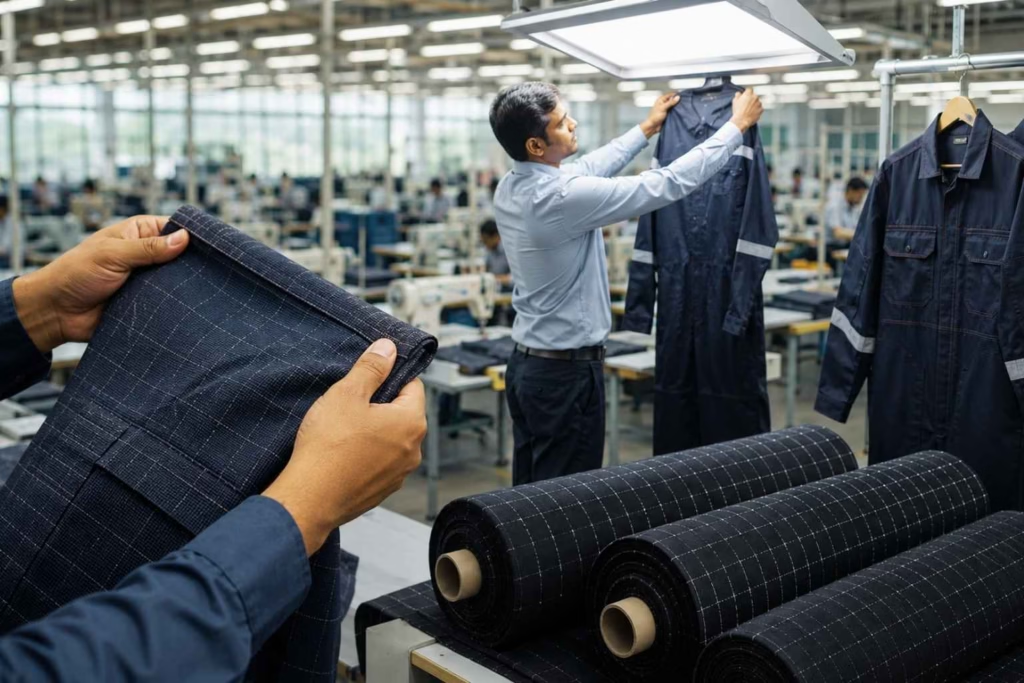
Anti-Static and ESD Protective Clothing Manufacturer, Bangladesh
Static electricity creates two very different risks depending on the environment. In a fuel depot or chemical plant, a static spark can ignite a flammable atmosphere. In an electronics cleanroom, the same static discharge can destroy a microchip worth far more than the garment protecting it. As an anti-static and ESD protective clothing manufacturer, Bengal Apparel BD produces certified garments for both situations, built to EN 1149-5 for worker safety in hazardous atmospheres and to IEC 61340-5-1 for ESD protection in electronics manufacturing environments.
These two garment types are often confused with each other because both use conductive fibers, but they are built to different standards, tested to different thresholds, and serve different purposes. Getting the specification right matters, both for compliance and for the safety of your workforce or your product line.
Anti-Static and ESD Protective Clothing Manufacturer: Two Different Hazards, Two Different Garments
Anti-static clothing exists to protect people. It dissipates static charge gradually so a spark never forms, which matters in environments handling flammable gases, vapors, or fine combustible dust, including petrochemical, oil and gas, mining, and powder-handling operations.
ESD clothing exists to protect products. It controls how static discharges to ground in a precise, repeatable way, which matters when handling components that can be damaged by even a small electrostatic event, including semiconductor assembly, PCB handling, and cleanroom electronics manufacturing.
The garments can look almost identical from a distance. The difference is in the certification, the resistance range they are built and tested to, and how they integrate into the rest of your safety or production system.
Anti-Static Workwear: EN 1149-5 Certified Production
Anti-static garments are produced and certified to the EN 1149 series published by CEN, the European Committee for Standardization, the primary European framework governing electrostatic properties in protective clothing.
- EN 1149-1 covers surface resistivity testing
- EN 1149-3 covers charge decay performance
- EN 1149-5 sets the overall performance and design requirements, with surface resistance required at or below 2.5 × 10⁹ ohms
Anti-static garments are classified as PPE and are almost never specified on their own. EN 1149-5 protection is required to be combined with thermal protection, typically EN ISO 11612 for flame resistance, since the standard exists specifically to prevent ignition in atmospheres where a spark could also trigger a fire. We produce anti-static garments built on this combined basis as standard, not as an add-on feature, in the same way we approach our flame-resistant coverall programs.
Construction requires full-body coverage, continuous skin contact with the conductive fabric, and conductive thread woven through the garment in a grid or stripe pattern to allow gradual charge dissipation. The system only works when paired with conductive footwear that completes the path to ground, which is worth confirming with your safety team before finalizing a program.
ESD Garments: IEC 61340-5-1 and ANSI/ESD S20.20 Production
ESD garments are produced to a different standard entirely. IEC 61340-5-1, published by the International Electrotechnical Commission, is the core international standard governing ESD protection across personnel, clothing, flooring, and workstations inside an ESD Protected Area. In North America, ANSI/ESD S20.20 covers the equivalent program requirements.
ESD garments are not classified as PPE in the same way anti-static garments are, because their primary function is protecting the product rather than the wearer. The performance threshold is also tighter and more specific, typically requiring point-to-point resistance below 10¹² ohms, with denser conductive fiber grids than anti-static garments use.
Construction is snug rather than loose, particularly at the sleeves, to minimize movement-generated charging. The conductive grid is denser, often woven at intervals as tight as 5mm by 5mm, functioning similarly to a partial Faraday cage around the wearer. Grounding is achieved through wrist straps, footwear-to-floor systems, or direct connection points built into the workstation, and garments in this category typically need replacing or retesting every 12 to 18 months as conductive performance degrades with washing and wear.
Anti-Static vs ESD: Which Certification Does Your Program Need
| Factor | Anti-Static (EN 1149-5) | ESD (IEC 61340-5-1) |
|---|---|---|
| Protects | The worker, against spark and ignition risk | The product, against electrostatic damage |
| Typical resistance range | Up to approximately 10⁹ ohms | Tighter range, often below 10¹² ohms point-to-point |
| PPE classification | Yes, classified as PPE | Generally not classified as PPE |
| Coverage | Full body required | Often upper body focused, snug fit |
| Grounding method | Natural dissipation, paired with conductive footwear | Integrated grounded system, wrist straps or floor connection |
| Typical industries | Oil and gas, petrochemical, mining, powder handling | Electronics manufacturing, semiconductor assembly, cleanrooms |
| Re-certification | Initial certification, periodic inspection | Ongoing resistance testing through service life |
A garment built for one purpose does not automatically satisfy the other. ESD clothing is usually anti-static by default, but anti-static clothing does not necessarily meet the tighter, more specific ESD threshold. If your operation runs both hazard types in different areas, this is worth specifying separately rather than assuming one garment covers both.
Fabric and Construction
Both garment types rely on conductive fiber woven or blended into the base fabric, typically carbon-based fiber, fine metal fiber such as stainless steel, silver, or copper, or a metal-salt dissipative additive. These are blended into polyester, cotton, or a polycotton base, commonly at a ratio of around 96 to 98 percent base fiber to 2 to 4 percent conductive fiber.
Many of our anti-static and ESD orders are produced as combination garments, built on the same inherent FR Nomex and Kevlar fabric used across our oil and gas product lines, with the conductive grid integrated at the mill stage rather than added afterward. This keeps the flame-resistant and anti-static performance consistent across the life of the garment rather than relying on a surface treatment that can wear off.
Combining Anti-Static with FR and Hi-Vis Requirements
Most of our anti-static orders are not standalone garments. Oil and gas, petrochemical, and electrical utility buyers typically need EN 1149-5 anti-static protection combined with EN ISO 11612 flame resistance in the same piece, and many also require certified hi-vis panels for site visibility. We build these as multi-norm garments combining several hazard certifications in one piece from a single certified fabric base rather than layering separate components, which keeps the garment lighter and easier to wear through a full shift.
For buyers supplying FR coveralls for oil and gas environments specifically, this combined certification is usually the baseline specification rather than an upgrade.
Choosing an Anti-Static and ESD Protective Clothing Manufacturer in Bangladesh
Bengal Apparel BD manages anti-static and ESD garment production across a network of nine certified partner factories, each matched to the specific fabric handling and quality control requirements the order needs. Anti-static and FR combination garments go to factories with inherent fiber blend experience and EN ISO 11612 documentation history. ESD orders for electronics and cleanroom buyers go to facilities set up for the tighter dimensional and finishing tolerances that snug-fit ESD garments require.
Every order ships with third-party test documentation for the relevant standard, along with factory compliance records including WRAP, BSCI, SEDEX, and OEKO-TEX certification. If your end client or HSE team requires additional documentation, confirm this at the quoting stage and we will advise what is available.
FAQs
What is the difference between anti-static and ESD clothing?
Anti-static clothing protects the wearer by preventing static buildup that could spark in a flammable atmosphere, certified to EN 1149-5. ESD clothing protects sensitive electronic products by controlling discharge to ground in a precise, repeatable way, certified to IEC 61340-5-1 or ANSI/ESD S20.20.
Can EN 1149-5 clothing be worn on its own?
No. EN 1149-5 anti-static performance is designed to be combined with thermal protection, typically EN ISO 11612, since the standard addresses spark prevention in atmospheres where ignition risk and flame risk usually occur together.
How often does ESD workwear need to be replaced?
ESD garments typically need re-testing or replacement every 12 to 18 months, or after a limited number of industrial wash cycles, since conductive performance degrades with laundering and wear over time.
Do you produce combination FR, anti-static, and hi-vis garments?
Yes. Most of our anti-static orders for oil and gas and petrochemical buyers combine EN 1149-5 with EN ISO 11612 flame resistance and certified hi-vis panels in a single multi-norm garment.
What is the minimum order quantity for anti-static or ESD workwear?
MOQ typically starts from 500 pieces per style and color, consistent with our standard FR and technical garment programs. Contact us with your specification and we will confirm what is achievable for smaller test orders.