Multi-Norm Workwear Supplier from Bangladesh
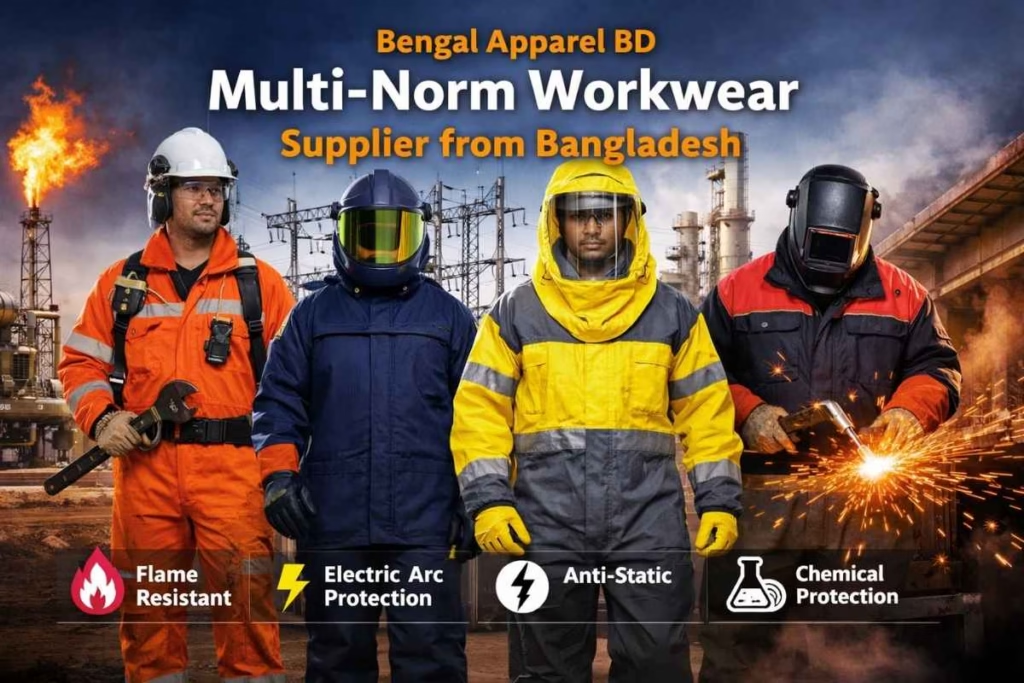
Workers in oil and gas, utilities, chemical plants, and heavy manufacturing face more than one hazard at a time. A garment certified for flame resistance alone is not enough when the same worker is also exposed to static discharge, electric arc, or chemical splash. Multi-norm workwear is built to address this. One certified garment covers several hazard categories simultaneously, reducing both risk exposure and the cost of managing multiple PPE items.
Bengal Apparel BD is a B2B multi-norm workwear supplier from Bangladesh. We work with importers, distributors, and private-label brands across the USA, Europe, Canada, the Middle East, and Australia. Rather than running production through a single factory, we route each order to the certified partner facility best suited for that garment type and compliance requirement.
What Makes a Multi-Norm Workwear Supplier Different
Not every factory in Bangladesh can produce certified multi-norm PPE. The garments are more complex, the fabric specifications are tighter, and the certification chain involves both the fabric mill and the production facility. As a dedicated multi-norm workwear supplier from Bangladesh, we manage that process end to end.
The certifications relevant to multi-norm programs are primarily held at the fabric mill level. The certified fabric carries the compliance, and full test documentation from accredited laboratories is provided with every order. Our partner factories additionally hold WRAP, BSCI, OEKO-TEX, RSC, and C-TPAT certifications.
Certifications We Supply as a Multi-Norm Workwear Supplier in Bangladesh
This set of certifications represents the full multi-norm protective clothing requirement for high-risk industrial environments, including oil and gas, electrical utilities, and metal smelting. Each standard covers a distinct hazard category, and a compliant garment must satisfy the specific performance codes within each.
EN ISO 13688:2013: General Requirements
The base standard that applies to all protective clothing. Covers ergonomics, sizing, labeling, and material innocuousness. Every multi-norm garment must meet this standard regardless of what additional certifications it carries.
EN ISO 11612:2015: Heat and Flame
Protects against convective heat, radiant heat, contact heat, and molten metal splash. Performance is expressed in codes: A1/A2 (flame spread), B1 (convective heat), C1 (radiant heat), E3 (molten iron splash), F1 (contact heat). Required across oil and gas, welding, metalwork, and petrochemical sectors.
IEC 61482-2:2018: Electric Arc Protection
Shields workers from the thermal effects of an arc flash event. APC=1 indicates Arc Protection Class 1, rated to 4kA. Required for electrical utilities, power generation, and any environment where arc flash is a live risk.
EN 1149-5:2018: Anti-Static Properties
Governs electrostatic dissipative clothing to prevent incendiary discharges. Essential in ATEX-classified zones where flammable gases or vapours are present. Typically combined with EN ISO 11612 in a single garment for oil and gas programs.
EN ISO 11611:2015: Welding and Allied Processes
Class 1 covers protection against less hazardous welding techniques, lower spatter levels, and moderate radiant heat. Required in fabrication and metalwork environments.
Besides, anti-static protection is one of the certifications most frequently combined into a multi-norm garment, particularly for oil and gas, petrochemical, and electrical utility programs where ignition risk and flame risk occur together. For a full breakdown of how EN 1149-5 anti-static certification works, how it differs from ESD protection used in electronics environments, and when each is required, see our anti-static and ESD protective clothing guide.
For procurement managers sourcing for environments where flash fire, arc flash, and static discharge occur as overlapping rather than separate hazards, our dedicated guide on multinorm FR coveralls combining arc flash, flash fire, and static protection in a single certified garment explains how EN ISO 11612, IEC 61482-2, and EN 1149-5 are engineered into one construction, and what to verify in the test documentation before approving bulk production.
How Multi-Norm Certification Works | Fabric Mill vs Production Factory
A common point of confusion when sourcing multi-norm workwear from Bangladesh is understanding who is responsible for which certifications. The answer is that responsibility is split between the fabric mill and the production factory. Both must perform distinct obligations for the final garment to be compliant.
Certifications are issued by notified bodies, independent third-party laboratories authorized to test and certify products against European and international safety standards. Recognized bodies include BTTG, SGS, SATRA, and Centexbel.
Fabric Mill Responsibilities
Because the protective properties of a multi-norm garment are built into the fabric itself, the mill carries the primary testing obligation. The mill must provide Test Reports and Technical Data Sheets covering:
- EN ISO 11612 performance levels (A, B, C, E, F codes)
- EN 1149-3/5 surface resistivity and charge decay tests
- IEC 61482-1-2 arc testing (Box Test or Open Arc Test on the fabric)
- EN ISO 11611 resistance to molten splash and heat transfer
- Shrinkage and colour fastness are critical for maintaining garment fit and hi-vis panel performance after washing
Production Factory Responsibilities
The factory is responsible for Module B (Type Examination) and Module D (Quality Assurance) of the finished garment. This includes:
- EN ISO 13688 compliance: correct sizing, labelling, and construction
- Garment design integrity: no exposed metal parts on anti-static or arc-rated garments, pocket and flap dimensions meeting safety width requirements
- Seam strength testing: thread and construction must withstand industrial use
- CE Certificate: the factory holds the Declaration of Conformity (DoC) and User Instructions for the finished garment
Using certified fabric is the necessary first step, but the garment itself must be certified as a finished product. When evaluating any multi-norm workwear supplier in Bangladesh, always request the fabric mill’s test reports before production begins. Without them, the production factory cannot successfully certify the final garment.
Bengal Apparel BD manages both sides of this process. We verify fabric mill documentation before committing to a production facility, and we provide the complete certification package- mill test reports and garment-level DoC for every order.
Fabric Options for Multi-Norm Workwear Bangladesh
Fabric specification is where the cost and compliance of a multi-norm program are decided. We work with buyers at both ends of the spectrum.
Inherent FR Fabrics
Flame resistance is built into the fiber, not applied as a finish. Protection is permanent across the garment’s service life and cannot wash out. Used in high-risk, continuous-exposure environments such as oil and gas, petrochemical, and electrical utilities. Nomex and Kevlar blends are the benchmark for inherent FR multi-norm programs.
Treated FR Fabrics
FR performance is applied to the base fabric as a chemical finish. More cost-effective than inherent FR and acceptable for lower-risk or intermittent-exposure applications. Protection can degrade over repeated wash cycles, which makes them unsuitable for prolonged high-risk environments.
Multi-Norm Fabrics
Some fabrics are engineered to meet several standards within a single textile, combining FR, anti-static, and arc flash properties in one construction. These are the most efficient option for programs requiring three or more certifications in one garment.
If you have a target FOB price in mind, share it and we will identify the fabric and construction combination that fits your certification requirement at that price point. In multi-norm workwear, the fabric is the primary cost driver, and reflective tape grade also has a material effect on final cost for hi-vis FR programs.
Markets We Serve as a Multi-Norm Workwear Supplier Bangladesh
We have supplied certified multi-norm and multi-risk PPE to buyers in Canada, Spain, Italy, the GCC, and other markets with strict EN ISO compliance requirements.
Industries Served
- Oil and gas upstream, midstream, and downstream operations
- Petrochemical and refinery
- Electric utilities and power generation
- Chemical and processing plants
- Welding and metal fabrication
- Construction, rail, and civil infrastructure
- Industrial maintenance and engineering services
Customisation Available from Our Multi-Norm Workwear Program
All garments are produced to your specification. Standard customisation includes:
- Company logo via embroidery or heat-seal badge
- Reflective tape placement and tape grade (standard, segmented, or FR-rated tape)
- Pocket configuration and placement
- Reinforced seams and stress points
- Sizing to your own size chart
All customisation is confirmed at pre-production sample stage before bulk cutting begins.
How We Work as Your Multi-Norm Workwear Supplier in Bangladesh
You deal with one contact at Bengal Apparel BD. We manage everything behind it; factory communication, fabric sourcing, quality checks, certification documentation, and shipping coordination.
- Enquiry- share your product specification, target volume, required certifications, and destination market. We respond within one business day.
- Sampling- we produce a physical sample to your specification. You confirm fit, fabric, and finish before any production commitment.
- Production- bulk manufacturing begins after sample approval. In-line quality checks run at every stage.
- Inspection- final AQL inspection before goods leave the factory. Third-party inspection is fully supported on request.
- Export- full shipping documentation provided for your destination market.
Order Information MOQ: 3,000 pieces per style Lead time: 75 days from sample approval Incoterms: FOB Chittagong
Order Information
MOQ: 1,000 to 3,000 pieces per style Lead time: 75 days from sample approval Incoterms: FOB Chittagong
Request a Quote from a Certified Multi-Norm Workwear Supplier in Bangladesh
Send us your garment specification, required certifications, and target volume. If you have a target FOB price, include it, and we will work from there. We respond within one business day with indicative pricing and a production timeline.