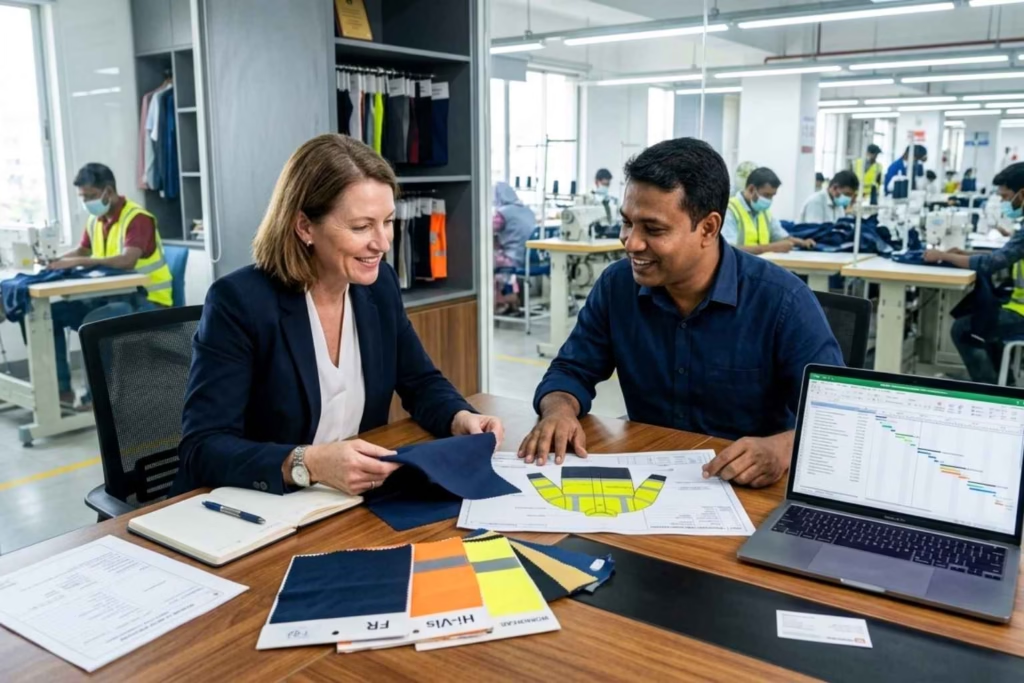
How to Source Workwear from Bangladesh: The Complete B2B Guide for International Buyers
Learning how to source workwear from Bangladesh is one of the most strategically important decisions a procurement manager, importer, or private-label brand can make. Bangladesh is the world’s second-largest garment exporter, and its manufacturing infrastructure for technical workwear, protective uniforms, and industrial apparel has matured significantly over the past decade. For buyers in the USA, Europe, Canada, the Middle East, and Australia, Bangladesh offers a combination of production capability, compliance infrastructure, and cost efficiency that no other sourcing market currently matches at scale.
This guide walks through the full sourcing process step by step, covering supplier verification, compliance requirements, sampling, quality control, logistics, and the practical advantages of working with a registered Buying House rather than approaching factories directly.
Why Bangladesh Is the Right Market for Workwear Sourcing
Before covering how to source workwear from Bangladesh, it is worth understanding why Bangladesh has become the preferred destination for serious B2B workwear buyers across every major import market.
Cost Efficiency Without Compromising Quality
Bangladesh offers production costs that are 25 to 40% lower than comparable manufacturing in China, Turkey, or Eastern Europe at equivalent quality levels. This cost advantage comes from a combination of a skilled and experienced garment workforce, a vertically integrated textile supply chain covering yarn, fabric, dyeing, and garment assembly, and strong economies of scale across a large certified factory base.
For workwear buyers managing programmes of 5,000 pieces or more per order, the unit cost saving across a two-year procurement cycle is substantial.
Technical Production Capability for Safety Apparel
The common assumption that Bangladesh only produces basic garments is outdated. A significant portion of the factory base is now fully equipped and certified for technical safety apparel production including flame-resistant FR workwear to EN ISO 11612, high-visibility clothing to EN ISO 20471 and ANSI/ISEA 107, multinorm protective garments combining multiple EN standards, industrial coveralls, healthcare uniforms, and hospitality uniforms.
These are not niche capabilities. They are mainstream production categories for a growing number of certified Dhaka-based factories.
Trade Advantages for Key Import Markets
Bangladesh benefits from GSP (Generalised Scheme of Preferences) trade status for EU and Canadian market buyers, reducing import duty on qualifying garment categories. For European procurement teams, this compounds the unit cost advantage significantly across large-volume programmes.
Industry Oversight and Regulatory Framework
The Bangladesh garment industry operates under oversight from the Bangladesh Garment Manufacturers and Exporters Association (BGMEA), the Bangladesh Knitwear Manufacturers and Exporters Association (BKMEA), the RMG Sustainability Council (RSC), and the Department of Textiles (DOT). This institutional framework means buyers have documented channels for supplier verification, factory audit access, and regulatory compliance checking that are not available in less structured sourcing markets.
The Biggest Risks for New Buyers Sourcing from Bangladesh
Understanding how to source workwear from Bangladesh also means understanding the risks that first-time buyers consistently encounter. The good news is that every risk listed below is preventable with the right process.
Supplier misrepresentation is the most common risk. Factories regularly claim certifications they do not hold, accept technical orders they are not equipped to produce correctly, and present samples produced in a different facility from the one that will manufacture the bulk order.
Quality inconsistency between the sample and the bulk production run is a persistent problem when buyers deal directly with factories without independent quality oversight during production.
Specification gaps occur when buyers provide incomplete technical packs. Without a detailed specification, the factory interprets ambiguous requirements in the way that is cheapest for them to produce, not the way that meets your customer’s expectations.
Customs and compliance documentation errors delay shipments, generate demurrage charges, and in some cases result in goods being held at port or returned.
Communication breakdown across time zones, language differences, and the gap between what a buyer requests and what a factory understands is a structural risk in any cross-border sourcing relationship.
All five of these risks are significantly reduced by working through a registered, accountable Buying House with a physical presence in Dhaka and a documented factory network.
How to Source Workwear from Bangladesh: The Step-by-Step Process
Step 1: Define Your Product Specification Before Contacting Any Supplier
The single most common mistake first-time buyers make when sourcing from Bangladesh is contacting factories or sourcing agents before they have a complete technical specification. Without a detailed spec, you will receive quotes that are not comparable, samples that do not match your requirements, and a production outcome that disappoints.
Your specification should cover fabric composition and weight in gsm, required safety certifications and the specific EN or NFPA standard codes, colour references using Pantone numbers rather than descriptions, construction details including stitching density, seam type, and pocket configuration, sizing and fit requirements with a graded measurement chart, branding placements for logos, labels, and hangtags, and packaging requirements.
The more complete your specification, the more accurate your quote, the more reliable your sample, and the fewer production errors you will encounter.
Step 2: Identify and Verify Qualified Suppliers
Once your specification is defined, the next step in learning how to source workwear from Bangladesh is identifying suppliers who are genuinely qualified to produce it. This is where most new buyers make their second common mistake: selecting based on price rather than capability.
A supplier qualified for your workwear programme should hold current third-party social compliance certifications such as WRAP, Amfori BSCI, or SEDEX, confirming ethical labour practices and safe working conditions. They should also hold technical certifications relevant to your product category, such as ISO 9001:2015 for quality management, or specific garment certifications for FR, hi-vis, or multinorm production. Factory audit reports from accredited bodies should be available on request before you place any order.
Our full compliance and certifications documentation is available to all prospective buyers before any commercial commitment is made. This is the verification standard you should expect from any serious Bangladesh-based workwear supplier.
Step 3: Request Samples Before Committing to Bulk Production
No workwear order should proceed to bulk production without a physical sample approval process. This applies regardless of how well-established your relationship with a supplier is.
The sampling process has two stages. A development or fit sample is produced first, allowing you to assess construction, fit, fabric quality, and compliance with your specification. Following your feedback and approval, a pre-production sample is produced from the actual bulk fabric and trims, providing a final reference point against which the bulk production will be checked.
Only after written pre-production sample approval should bulk production begin. This is a non-negotiable step in professional workwear sourcing and is built into our standard ordering process at Bengal Apparel BD as a contractual stage gate.
Step 4: Implement Quality Control at Each Production Stage
Quality control is where most sourcing relationships either build trust or break down. Inspecting only the finished goods before shipment is the weakest and most expensive form of quality management, because by that point any issues affect the entire production run.
A professional quality control protocol operates at three stages. Pre-production fabric inspection confirms that the fabric delivered to the cutting room matches the approved specification for weight, composition, colour, and performance. During Production Inspection (DUPRO) conducted at 20 to 50% completion detects construction defects before they scale across the full order. Final Random Inspection against AQL standards before packing confirms the finished garment quality across a statistically valid sample of the order.
Third-party inspections by SGS or Intertek are available on request and provide an independent verification layer that is increasingly required by corporate procurement frameworks and retail buyers.
Step 5: Understand Compliance and Certification Requirements for Your Market
How to source workwear from Bangladesh successfully depends on understanding which compliance standards apply to your destination market before production begins, not after goods arrive at the border.
For EU market buyers, garments classified as Personal Protective Equipment require CE marking and an EU Type Certificate under EU Regulation 2016/425. For UK market buyers, UKCA Type Examination Certificates are required for PPE post-Brexit. For North American buyers, ANSI/ISEA standards apply to hi-vis garments and NFPA 2112 or NFPA 70E apply to FR and arc flash protection garments.
Social compliance certifications including WRAP, BSCI, and SEDEX are required by major retail buyers and corporate procurement programmes globally. Environmental certifications including GOTS, GRS, and OEKO-TEX Standard 100 are increasingly specified by buyers with active ESG reporting requirements. The complete certification portfolio available through our factory network is documented on our compliance page.
Step 6: Manage Logistics and Export Documentation
All Bengal Apparel BD orders ship FOB Chittagong. We manage all pre-shipment logistics including factory-to-port transport, export customs clearance, and booking coordination with your nominated freight forwarder.
For sea freight to the USA and Canada, transit times typically run 25 to 35 days from Chittagong. For European ports including Felixstowe, Rotterdam, and Hamburg, transit times run 18 to 25 days. Air freight is available for urgent orders or samples at significantly higher cost.
Pre-shipment documentation includes a commercial invoice, packing list, certificate of origin, bill of lading draft, and all applicable certification and test report documents required by your import authority. Incomplete documentation is the most common cause of customs clearance delays for garment imports, and we manage this as a standard part of the export process rather than an afterthought.
Why Working with a Registered Buying House Changes the Risk Profile
Understanding how to source workwear from Bangladesh is one thing. Executing it reliably across an ongoing programme is another. The difference between a successful sourcing relationship and an expensive disappointment usually comes down to whether the buyer has accountable, on-the-ground representation in Dhaka.
A factory produces garments. A registered Buying House ensures your entire sourcing operation runs correctly. Bengal Apparel BD is registered under the Bangladesh Department of Textiles (Reg. No. DOT/BH/IMP-L-2277), VAT/BIN registered, and banked with BRAC Bank PLC. We are an accountable legal entity, not an informal intermediary, and that distinction matters when something needs to be resolved quickly during production.
Our manufacturing capabilities cover product development, fabric sourcing, factory allocation, sampling, production monitoring, quality inspection, and export management as a fully integrated service. You deal with one accountable partner from enquiry to delivery.
New Buyer Checklist: How to Source Workwear from Bangladesh
Use this checklist before placing your first order:
1. Specification complete — Does your technical pack cover fabric, construction, certification, colour, sizing, and branding in full?
2. Supplier certifications verified — Have you reviewed current WRAP, BSCI, or SEDEX audit reports from an independent third party?
3. Sample approval confirmed — Have you received and approved a physical pre-production sample before bulk production begins?
4. Quality control plan agreed — Are fabric inspection, DUPRO, and final inspection stages confirmed in writing before production starts?
5. Market compliance confirmed — Have you verified which EN, NFPA, ANSI, or CE standards apply to your destination market?
6. Export documentation reviewed — Have you confirmed the full pre-shipment document package required by your import authority and freight forwarder?
7. Buying House or direct factory — Have you assessed whether independent on-the-ground representation in Dhaka reduces your risk profile sufficiently to justify the cost?
Start Sourcing Workwear from Bangladesh with Bengal Apparel BD
Whether you are placing your first trial order or transitioning an existing programme from another market, Bengal Apparel BD provides the structure, documentation, and accountability that international buyers need to source from Bangladesh with confidence.
Review our frequently asked questions for detailed answers on MOQ, lead times, payment terms, and quality control. Check our minimum order quantities to confirm we can support your programme size. Then contact us with your specification and we will respond within one business day with factory suitability confirmation, indicative pricing, and a production timeline.
Request a Sourcing Consultation | View Our Full Product Range | Our Ordering Process