Arc Flash Protective Clothing Manufacturer: IEC 61482 and NFPA 70E Explained
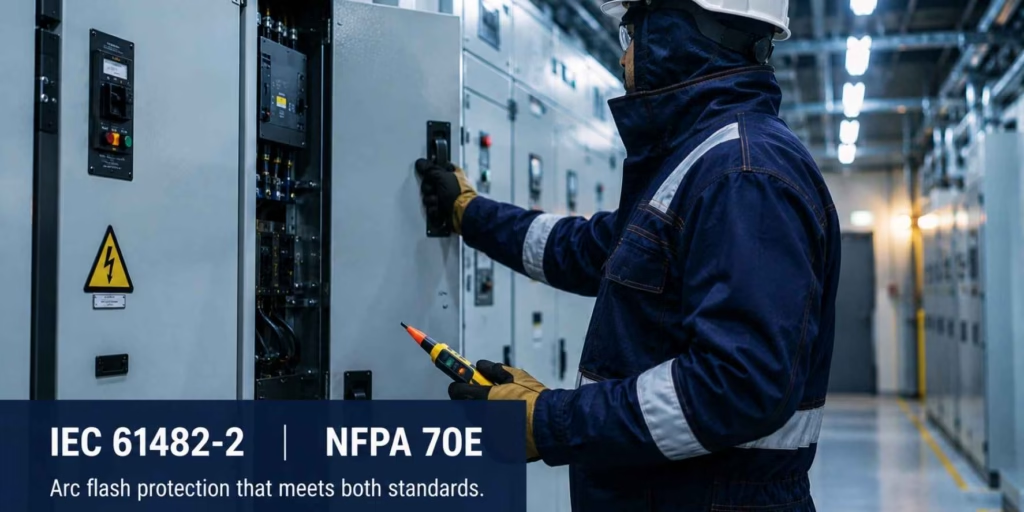
Arc flash is one of the most severe electrical hazards in industrial, utility, and commercial settings. When an arc flash event occurs, temperatures at the arc surface can exceed 35,000°F, releasing intense thermal radiation, a pressure wave, molten metal projections, and toxic gases within milliseconds. Workers in the proximity of an arc flash event without adequate protective clothing face potentially fatal burn injuries, even at distances of several metres from the fault point. As a certified arc flash protective clothing manufacturer, Bengal Apparel BD produces garments tested and certified to IEC 61482-2 for European and international markets and aligned to NFPA 70E requirements for North American buyers, with full third-party test documentation supplied on every production run.
This page explains what each standard requires, how they relate to each other, what the garment must physically deliver to carry a valid arc flash certification, and what to confirm with any manufacturer before approving bulk production.
What Arc Flash Protective Clothing Actually Has to Do
Arc flash protective clothing does not prevent the arc flash from occurring. It reduces the thermal energy that reaches the skin during the event so that second-degree burns are limited to a defined area under standardized test conditions, giving the worker enough time and skin integrity to survive and recover.
The common threshold that triggers the requirement for arc-rated clothing is 1.2 cal/cm², which is the approximate incident energy level at which an unprotected skin surface will sustain the onset of a second-degree burn. Any task where the calculated or estimated incident energy at the worker’s position equals or exceeds 1.2 cal/cm² requires arc-rated PPE. The garment’s arc rating must equal or exceed the incident energy at that work location, not just meet a generic minimum.
Three properties define whether a garment is genuinely protective against arc flash: it must resist ignition from the arc energy, it must limit heat transfer through the fabric to the skin, and it must maintain structural integrity throughout the event, meaning it cannot break open and expose the body underneath to direct energy transfer. A garment that burns through, melts, or breaks open at a lower energy level than its claimed rating provides less protection than its label indicates and may fail the wearer at exactly the moment it matters most.
Arc Flash Protective Clothing Manufacturer: IEC 61482-2 Certification Explained
IEC 61482-2 is the International Electrotechnical Commission’s product standard governing protective clothing against the thermal hazards of electric arc, and it is the certification required for arc flash PPE in European, Middle Eastern, and most international markets. The current edition is IEC 61482-2:2018, adopted as EN IEC 61482-2:2020 in Europe. It governs the performance requirements and test methods for both the fabric and the finished garment, and a manufacturer must certify the complete constructed garment, not the fabric alone, before the certification is valid for the specific style being produced.
IEC 61482-2 draws on two complementary test methods that produce different performance metrics:
IEC 61482-1-1 (Open Arc method) exposes fabric samples to an open electric arc using a method closely aligned with the North American ASTM F1959 approach. Results are expressed as ATPV (Arc Thermal Performance Value), the incident energy level at which there is a 50 percent probability of a second-degree burn, or EBT (Energy Breakopen Threshold), the energy level at which the material breaks open. A more conservative metric called ELIM (Incident Energy Limit) represents essentially zero probability of second-degree burn and is the metric most relevant for buyer-facing compliance documentation. All values are expressed in cal/cm².
IEC 61482-1-2 (Box test / Constrained Arc method) uses a directed arc inside a confined chamber at low voltage, more closely simulating the conditions of a switchgear or motor control centre fault. Garments are classified into two Arc Protection Classes: APC 1, tested at 4 kA (approximately 168 kJ of arc energy), and APC 2, tested at 7 kA (approximately 320 kJ). These are pass-or-fail classifications rather than a continuous cal/cm² scale.
Additional garment requirements under IEC 61482-2 include inherently FR sewing threads throughout all seams, no exposed external metal parts that could contact skin during an arc event, permanent labeling showing the arc rating and APC class, and minimum performance thresholds, with garments required to achieve at least ELIM 3.2 cal/cm² or ATPV/EBT of 4 cal/cm² under the open arc method, or APC 1 classification under the box test method, to carry the certification at all.
NFPA 70E: The North American PPE Selection Framework
NFPA 70E, Standard for Electrical Safety in the Workplace, is the primary reference used in the United States and many Canadian facilities for evaluating arc flash hazards and selecting appropriate protective clothing. The 2024 edition is the current version. Unlike IEC 61482-2, which is a product certification standard for the clothing itself, NFPA 70E is a risk assessment and PPE selection standard. It tells employers how to evaluate the hazard and choose the right garment, rather than specifying what the garment must do in a laboratory test.
NFPA 70E requires arc-rated clothing wherever the calculated incident energy exposure equals or exceeds 1.2 cal/cm². Employers select clothing using one of two methods. The incident energy analysis method, which is the more accurate approach, calculates expected incident energy at a specific work location using IEEE 1584 methods and requires the buyer to select clothing whose arc rating equals or exceeds that calculated value. The PPE Category method uses simplified tables for common tasks and equipment types, assigning four categories with minimum arc ratings:
- Category 1: Minimum arc rating 4 cal/cm², typically an arc-rated shirt and trousers or coverall with face shield
- Category 2: Minimum arc rating 8 cal/cm², arc-rated clothing with balaclava and face shield or arc flash hood
- Category 3: Minimum arc rating 25 cal/cm², multi-layer arc flash suit system with hood
- Category 4: Minimum arc rating 40 cal/cm², heavy multi-layer arc flash suit with hood
Underlying fabric and garment performance in the US context is governed by ASTM standards, specifically ASTM F1506 (performance specification for FR textiles used in arc-rated clothing) and ASTM F1959 (open arc test method for determining ATPV and EBT). Garments sold into the North American market must carry the arc rating determined by ASTM F1959 testing, with the ATPV or EBT value permanently marked on the label alongside the ASTM F1506 standard reference.
IEC 61482 vs NFPA 70E: How the Two Standards Relate
The two frameworks address the same hazard but from different angles, and understanding how they relate is essential for buyers whose programs span both European and North American sites or who source from a Bangladesh manufacturer for both markets simultaneously.
IEC 61482-2 is a product standard. It defines what the garment must achieve in testing before it can be sold as arc flash protective clothing in covered markets. NFPA 70E is a program standard. It defines how employers must assess the hazard and select appropriate PPE for their workforce. A buyer in the US uses NFPA 70E to determine which arc rating their program needs, then procures clothing that meets that rating through ASTM F1506-compliant fabric and ASTM F1959 testing.
The open arc test methods under IEC 61482-1-1 and ASTM F1959 are closely aligned, which means ATPV and ELIM values from one system are broadly comparable to arc rating values used in the other. A garment certified to IEC 61482-2 with a sufficient open arc rating can therefore often support NFPA 70E PPE Category selection for North American buyers, provided the garment also carries ASTM F1506 compliant labeling for the US market. The box test APC classes (APC 1 and APC 2) have no direct NFPA 70E equivalent since the PPE Category system uses cal/cm² rather than a pass-or-fail classification tied to a specific current level. For buyers needing compliance documentation for both markets, dual certification with separate test reports for each standard is the cleanest approach. Our multinorm FR coverall page covers how arc flash certification combines with EN ISO 11612 flash fire and EN 1149-5 antistatic certification in a single garment construction.
PPE Category and APC Class: Matching Protection Level to Hazard
The practical matching of garment rating to hazard level differs between the two frameworks and is worth understanding before specifying production.
Under NFPA 70E, a Category 1 task requires a minimum arc rating of 4 cal/cm². A single-layer arc-rated coverall at this rating level is a common and practical specification for general electrical maintenance. Category 2 at 8 cal/cm² covers higher-risk tasks such as panel work on energized equipment, where a heavier single-layer or light two-layer system is typically specified. Category 3 at 25 cal/cm² and Category 4 at 40 cal/cm² require dedicated arc flash suit systems with hoods and are specified for high-risk tasks involving close proximity to high-energy equipment.
Under IEC 61482-2, APC 1 (4 kA) covers the majority of standard switchgear and distribution panel maintenance scenarios and is the most commonly specified class for European utilities, petrochemical facilities, and industrial electrical maintenance programs. APC 2 (7 kA) is required for higher fault-current environments and is specified for work involving high-energy switchgear and main distribution equipment where the available fault current exceeds APC 1 thresholds.
Our arc flash vs flash fire protection guide explains how to identify which hazard type governs your program’s primary specification and how the two standards address fundamentally different aspects of electrical and thermal risk.
Fabric and Construction: What Certified Arc Flash Garments Require
The fabric specification for arc flash certified garments is more demanding than for standard FR workwear in several specific ways that affect production decisions at the factory level.
Inherent FR fiber blends are the standard for serious arc flash programs: meta-aramid (Nomex), para-aramid (Kevlar) as a blend component, and modacrylic blends each offer different arc performance profiles at different cost points. Our Nomex vs Kevlar vs modacrylic FR fabric comparison covers the performance and cost differences between the three fiber types for buyers who need to choose a fabric specification before finalizing the garment design.
Fabric weight is a primary driver of arc rating: heavier fabrics generally absorb more arc energy before reaching the ATPV or EBT threshold, which is why single-layer garments certified to higher arc ratings tend to be heavier and warmer than lower-rated alternatives. The practical challenge for any arc flash protective clothing manufacturer is engineering the right balance between arc performance and wearability, since a garment workers find too heavy or too hot is removed during breaks, and a garment that has been removed provides no protection when an arc event occurs.
Construction requirements beyond fabric include FR-rated sewing thread throughout all seams (a standard polyester thread will ignite and fail under arc flash energy even if the fabric itself survives), covered metal components including zippers and snap closures to prevent metal parts from contacting or branding skin during an event, high collars and tight cuff designs to minimize exposed skin at the wrist and neck where arc energy concentrates, and triple-stitched seams at the highest stress points to maintain structural integrity during the pressure wave component of an arc flash event.
Dual Certification: When One Garment Needs to Satisfy Both Standards
For buyers running programs across European and North American sites, or supplying distributors in both markets, dual certification to IEC 61482-2 and ASTM F1506 with NFPA 70E documentation is the practical solution. A dual-certified garment requires separate test reports and separate labeling for each standard, since one certificate does not cover both markets, but it allows a single production run to serve buyers in both regulatory environments without redesigning the garment or producing separate SKUs.
The open arc test alignment between IEC 61482-1-1 and ASTM F1959 means that a garment tested under one method can often provide supporting data for the other market with additional documentation rather than a full retest, though this depends on the accreditation status of the testing laboratory and the specific requirements of the buyer’s compliance framework. Confirm this with your manufacturer before assuming test reports from one standard will satisfy the documentation requirements of the other.
What a Credible Arc Flash Protective Clothing Manufacturer Delivers
A credible arc flash protective clothing manufacturer provides six things as standard rather than on request.
First, independent laboratory test reports from an accredited lab, referencing the specific standard edition and the exact garment style and size tested, not just the fabric. Second, complete garment test documentation rather than fabric swatch test data alone, since garment construction affects arc performance independently of fabric rating. Third, traceable fabric supply chain documentation confirming the specific inherent FR fiber blend and fabric weight used in the tested construction, since a change in fabric batch after certification is obtained affects compliance. Fourth, permanent garment labeling showing the arc rating in cal/cm², the APC class if applicable, the standard reference, manufacturer details, and care instructions. Fifth, wash durability data confirming the arc rating is maintained after the required number of industrial wash cycles, since both IEC 61482-2 and ASTM F1506 require performance retention after laundering. Sixth, a documentation package covering how the garment fits into the buyer’s NFPA 70E or IEC-based PPE program, including guidance on the PPE Category or APC class the garment supports and any layering or underlayer restrictions that apply.
How Bengal Apparel BD Produces Arc Flash Certified Garments
Bengal Apparel BD produces arc flash protective clothing through a network of nine certified partner factories, matching each arc flash order to the factory with documented experience in inherent FR fiber handling, IEC 61482-2 garment test documentation, and the FR thread and covered-closure construction standards that arc flash garments require across every seam and fastening point.
We produce to IEC 61482-2 APC 1 and APC 2 classes for European and international buyers, and to NFPA 70E Category 1 and Category 2 specifications for North American programs, with ASTM F1506 compliant fabric and labeling as standard for US-bound production. For buyers whose programs combine arc flash certification with flash fire, antistatic, or hi-vis requirements in a single garment, our full multi-norm workwear capability covers combined certification programs across all three hazard types. Our compliance and certifications page lists the full factory certification documentation available on every production run.
FOB Chittagong. MOQ from 1,000 pieces per style. Lead time 45 to 90 days from sample approval depending on fabric specification and construction complexity.
FAQs
What is IEC 61482-2 and why does it matter for arc flash clothing?
IEC 61482-2 is the International Electrotechnical Commission’s product standard governing protective clothing against the thermal hazards of electric arc. It specifies the performance requirements and test methods that a finished garment must satisfy before it can be sold as arc flash protective clothing in European and most international markets. It is the certification buyers in the EU, Middle East, and international markets require on their supplier’s documentation.
What is the difference between APC 1 and APC 2?
APC 1 and APC 2 are the two Arc Protection Classes under the IEC 61482-1-2 box test method. APC 1 indicates the garment has been tested and passed at a fault current of 4 kA, covering the majority of standard switchgear and distribution maintenance scenarios. APC 2 indicates testing at 7 kA, required for higher fault-current environments. Both are pass-or-fail classifications rather than a continuous cal/cm² performance scale.
Is NFPA 70E a garment certification standard?
No. NFPA 70E is a risk assessment and PPE selection standard used primarily in the United States. It tells employers how to assess arc flash hazards and select appropriate protective clothing. The garment certification standard for the North American market is ASTM F1506, with arc rating determined by ASTM F1959 testing. A buyer uses NFPA 70E to determine which arc rating their program needs, then procures clothing certified to the relevant ASTM standards.
Can a garment certified to IEC 61482-2 be used in a NFPA 70E program?
Often yes, with appropriate supporting documentation. The open arc test methods under IEC 61482-1-1 and ASTM F1959 are closely aligned, so ATPV and ELIM values from IEC testing are broadly comparable to arc ratings used in NFPA 70E PPE Category selection. However, the garment must also carry ASTM F1506 compliant labeling for the US market, which requires separate confirmation from your manufacturer.
What arc flash protection level do most electrical maintenance programs require?
Most standard electrical maintenance programs at switchgear and distribution panel level require IEC 61482-2 APC 1 certification or NFPA 70E Category 1 to Category 2 protection, covering arc ratings from 4 to 8 cal/cm². Higher-risk tasks involving close proximity to high-energy equipment require Category 3 or Category 4 systems at 25 to 40 cal/cm² or above, which typically involve multi-layer arc flash suit systems rather than single-layer coveralls.
What is the minimum order quantity for arc flash certified garments?
MOQ starts from 1,000 pieces per style and color, consistent with our standard FR and technical garment programs. For dual-certified programs or multi-style arc flash orders, contact us with your full technical brief including the required standard, APC class or PPE Category, fabric preference, and destination market, and we will confirm what is achievable including options for smaller initial test orders.