Procurement managers sourcing protective clothing for oil and gas, petrochemical, electrical utility, and industrial maintenance environments frequently encounter both terms on supplier documentation: arc flash protection and flash fire protection. The two are sometimes used interchangeably in casual conversation, occasionally appear on the same garment label, and both fall under the broader category of flame-resistant workwear. But arc flash vs flash fire protection is not a matter of degree or intensity. They are two fundamentally different physical hazards caused by different mechanisms, requiring different test methods, different certification standards, and in many cases different garment specifications to address correctly.
Getting this distinction wrong is not a paperwork problem. A garment certified only for flash fire protection worn by a worker exposed to arc flash risk may fail to provide adequate protection when it matters most, even if it carries legitimate EN ISO 11612 or NFPA 2112 certification. This guide explains exactly what separates the two hazards, which standards govern each, and how to determine which protection your program actually needs.
Arc Flash vs Flash Fire Protection: Two Hazards That Are Frequently Confused
The confusion between arc flash and flash fire is understandable for two reasons. First, both hazards produce extreme heat capable of causing severe burn injury in seconds. Second, both are addressed using flame-resistant clothing, which creates the impression that one type of FR garment covers both situations. Neither assumption is correct.
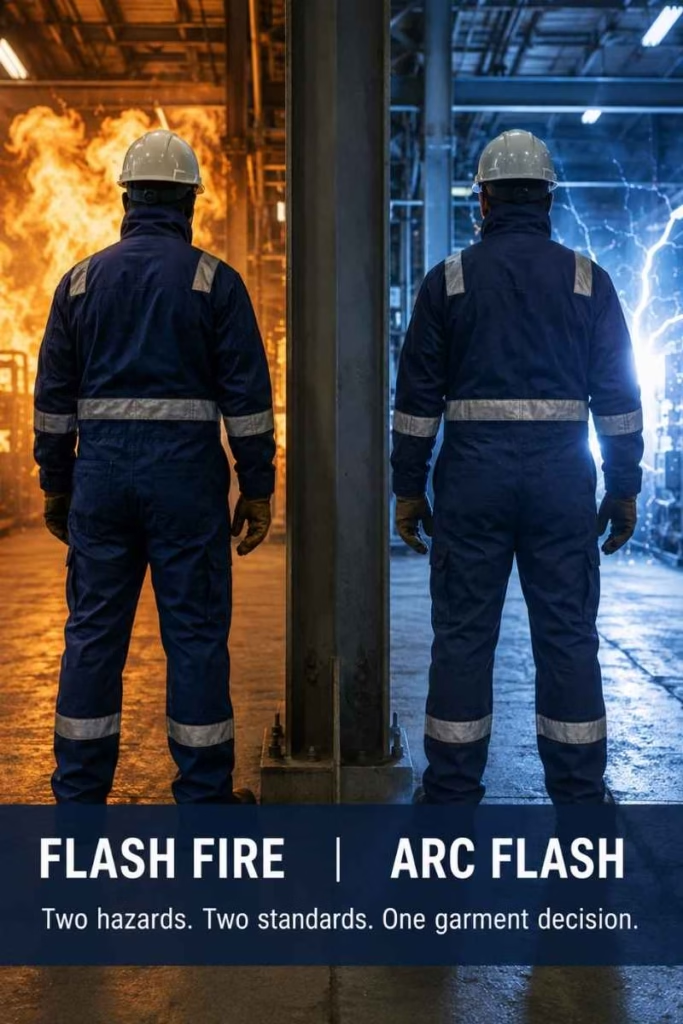
Flash fire is a fuel-based thermal hazard. Arc flash is an electrically-generated thermal hazard. The energy source, the duration, the temperature profile, and the physical mechanics of how each injures a worker are all different. The clothing that provides certified protection against one must be independently tested and certified to do the same for the other, and that testing uses completely different methods, metrics, and pass thresholds for each.
The single most important practical point for procurement managers: all arc-rated clothing is flame-resistant, but not all flame-resistant clothing is arc-rated. A garment carrying EN ISO 11612 or NFPA 2112 certification alone cannot be assumed to provide arc flash protection unless it has also been independently tested and certified to IEC 61482-2 or ASTM F1959.
For programs where arc flash is the primary hazard rather than one of several combined certifications, our arc flash protective clothing manufacturer guide covers IEC 61482-2 and NFPA 70E requirements in full, including APC class selection, PPE Category matching, and dual certification for programs spanning European and North American sites.
What Is a Flash Fire and How Does It Injures Workers
A flash fire is a sudden, short-duration fire caused by the ignition of a dispersed flammable substance, typically a flammable gas, vapor, or fine combustible dust mixed with air in concentrations sufficient for rapid combustion. It is characterised by a rapidly moving flame front, high temperature, and short duration, typically three seconds or less for the initial thermal exposure in an industrial incident. Flash fires do not produce significant overpressure damage. The primary injury mechanism is thermal radiation from the flame front and the heat absorbed by the body during the exposure window.
Flash fires are the primary thermal hazard in oil and gas production and processing, petrochemical refining, chemical manufacturing, and environments handling combustible dust or flammable liquids at scale. In these environments, a process upset, leak, or ignition event can produce a flash fire that engulfs a worker before they can move clear of the hazard zone. The garment’s job is to provide enough thermal insulation and self-extinguishing behavior to allow escape and minimize burn injury during the few seconds of exposure.
The key performance measure for flash fire protection is the predicted body burn percentage in a full-garment instrumented manikin test under ASTM F1930, which simulates a three-second flash fire exposure at approximately 84 kW/m² of heat flux. NFPA 2112 requires that the garment produce a predicted body burn of no more than 50 percent. High-performing FR garments for oil and gas environments typically achieve 10 to 30 percent in this test, providing a meaningful margin above the standard minimum.
What Is Arc Flash and Why It Is a Different Hazard Entirely
Arc flash is an electrical fault that results in an explosive discharge of energy between conductors. When sufficient electrical energy passes through an arc, temperatures at the arc surface can reach approximately 35,000 degrees Fahrenheit, far exceeding the temperature of the surface of the sun. The event produces extreme radiant and convective heat, a pressure wave capable of throwing a worker across a room, intense ultraviolet and infrared light, and molten metal projections from vaporised conductors.
Unlike flash fire, arc flash does not involve fuel combustion. It is an electrical energy release event, and its duration is typically measured in milliseconds rather than seconds, though the thermal energy delivered in that fraction of a second can be catastrophically high. The hazard is measured in incident energy, expressed in cal/cm², which quantifies the thermal energy delivered to a surface at a specific distance from the arc source. This is the value that drives PPE selection in an arc flash risk assessment.
Arc flash is the primary thermal hazard in electrical switchgear operations, transformer maintenance, panel work, and any task performed near energized electrical equipment. It is also present in environments that combine electrical infrastructure with other industrial hazards, such as power generation, utilities, and the electrical systems within oil and gas facilities, which is why workers in those environments may face both arc flash and flash fire risk on the same site.
Why FR Clothing Is Not Automatically Arc-Rated
This is the point most frequently misunderstood in workwear procurement, and it has direct compliance consequences.
A garment certified to EN ISO 11612 or NFPA 2112 has been tested for performance against heat and flame hazards including flash fire. These standards do not include arc flash energy testing. They do not measure ATPV, they do not classify garments by incident energy level, and a certification label for either standard does not indicate any verified level of arc flash protection.
Arc flash certification requires specific energy testing under IEC 61482-2 (the European and international standard) or ASTM F1959 (the North American method). These tests expose the fabric and finished garment to electric arc energy under controlled laboratory conditions and measure the energy level at which the garment fails to prevent a second-degree burn (ATPV) or breaks open (EBT). A garment that has not been submitted to this testing and certified by an accredited laboratory carries no arc flash rating regardless of how good its flash fire credentials are.
All arc-rated clothing is flame-resistant, but not all flame-resistant clothing is arc-rated. This distinction is explicitly stated in NFPA 70E and is one of the most practically important facts for any procurement manager specifying FR clothing for electrical environments.
The Standards That Govern Each Hazard
Understanding which standard applies to which hazard is the foundation of any compliant PPE specification.
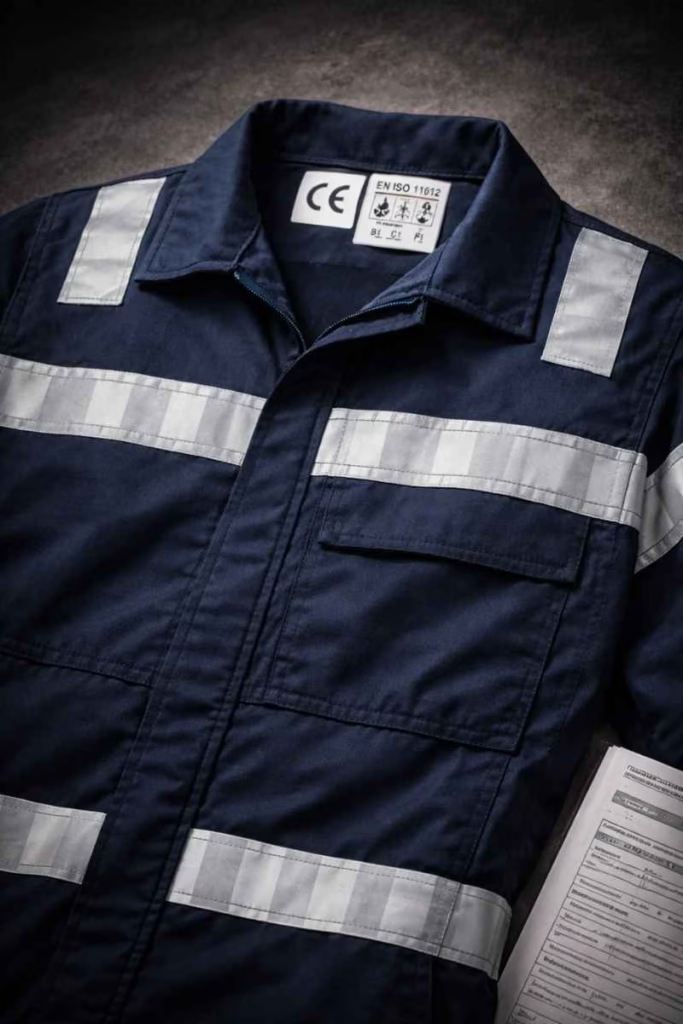
Flash fire protection is governed by EN ISO 11612 in European and international markets, which uses a modular performance code system (A1, A2, B1, C1, and so on) across different heat types. In North American markets, NFPA 2112 is the standard governing flame-resistant garments for industrial personnel against flash fire, and it is more pass-or-fail in structure, centred on the manikin test rather than modular performance grading.
Arc flash protection is governed by IEC 61482-2 in European and international markets, the standard published by the International Electrotechnical Commission covering protective clothing against the thermal hazards of electric arc, with two test methods producing either an ATPV or ELIM value in cal/cm² or an APC class rating. In North American markets, NFPA 70E governs the electrical safety program including PPE selection based on calculated incident energy, with ASTM F1959 providing the fabric and garment arc rating test method. NFPA 70E is the Standard for Electrical Safety in the Workplace, published by the National Fire Protection Association and revised on a three-year cycle, with the 2024 edition being the current version.
| Hazard | European/International Standard | North American Standard |
|---|---|---|
| Flash fire | EN ISO 11612 | NFPA 2112 |
| Arc flash | IEC 61482-2 | NFPA 70E / ASTM F1959 |
| Combined (multinorm) | EN ISO 11612 + IEC 61482-2 | NFPA 2112 + NFPA 70E |
Garment Protection: What Each Standard Actually Requires
For flash fire: EN ISO 11612 requires testing of limited flame spread, convective heat resistance, radiant heat resistance, and, for the highest performance levels, molten metal and contact heat resistance. NFPA 2112 centres on the manikin flash fire test under ASTM F1930, requiring predicted body burn below 50 percent after a three-second exposure, plus vertical flame char length below 4 inches and HTP (heat transfer performance) values meeting minimum thresholds for both spaced and contact configurations. Our detailed guide on reading an FR workwear test report, covering ATPV, HTP, and char length explains each of these metrics in plain terms.
For arc flash: IEC 61482-2 requires either an ATPV or ELIM value from the open arc test method, or an APC 1 or APC 2 classification from the box test method. A garment must achieve a minimum ELIM value of 3.2 cal/cm² or ATPV of at least 4 cal/cm² to qualify for the lowest arc protection level. NFPA 70E PPE categories run from CAT 1 (minimum arc rating 4 cal/cm²) through CAT 4 (minimum arc rating 40 cal/cm²), with the required category determined by an incident energy analysis at the specific work location.
When You Face Both Hazards on the Same Site
Many industrial environments present both arc flash and flash fire risk, sometimes in the same work area and sometimes in adjacent zones that workers move between during a single shift. Oil and gas processing facilities are the most common example: the process areas carry flash fire risk from flammable vapor, while the electrical infrastructure running throughout those same facilities carries arc flash risk from switchgear and distribution equipment.
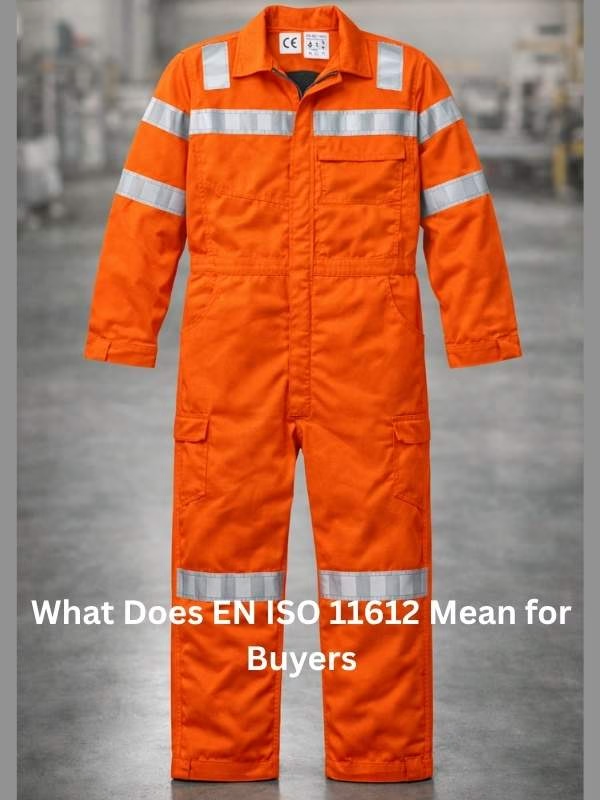
In these environments, the practical answer is a multinorm FR coverall combining EN ISO 11612 flash fire protection, IEC 61482-2 arc flash protection, and EN 1149-5 antistatic certification in a single certified garment. A properly certified multinorm coverall carries independent test reports for each standard, not a combined compliance statement, and the fabric and construction are engineered to satisfy all three certification requirements simultaneously rather than being optimised for one at the expense of the others.
The alternative, separate garments for each hazard, creates practical problems around layering, grounding system compatibility for antistatic performance, and the compliance complexity of managing multiple certification documents across one workforce. For environments with confirmed overlapping hazards, a single certified multinorm garment is generally the more practical and more compliant solution.
Matching the Garment to the Risk Assessment
The right garment specification always starts with a formal risk assessment, not with a product catalogue. Three questions drive the specification.
What is the primary hazard in the work environment? If flash fire from flammable process materials is the dominant risk, the primary certification driver is EN ISO 11612 performance codes or NFPA 2112 manikin test results. If arc flash from electrical equipment is the dominant risk, the primary driver is the calculated incident energy at the work location matched to the appropriate IEC 61482-2 APC class or NFPA 70E PPE category.
Are both hazards present? If a formal hazard assessment confirms both flash fire and arc flash exposure in the same work program, a multinorm certified garment covering both standards is required rather than a single-standard FR garment. Our oil and gas FR coverall page covers the specific certifications most commonly required for combined-hazard oil and gas programs.
What is the destination market? European and Middle Eastern programs specify EN ISO 11612 and IEC 61482-2. North American programs specify NFPA 2112 and NFPA 70E. Programs running across both markets require dual certification or separate production runs to the relevant standard for each market. Our broader flame-resistant workwear page covers how we handle multi-market FR programs across our nine certified partner factories.
FAQs
Is flash fire the same as arc flash?
No. Flash fire is caused by the ignition of a flammable gas, vapor, or dust mixture and involves a rapidly moving flame front. Arc flash is caused by an electrical fault and involves an explosive release of electrical energy producing extreme radiant and convective heat, a pressure wave, and molten metal projections. They are different hazards with different energy sources, different durations, and different injury mechanisms.
Can an EN ISO 11612 certified garment protect against arc flash?
No. EN ISO 11612 covers heat and flame protection including flash fire. It does not include arc flash energy testing. A garment requires separate IEC 61482-2 certification to carry a valid arc flash rating. All arc-rated garments are flame-resistant, but the reverse is not true.
What is the difference between ATPV and APC class?
Both are arc flash performance metrics from IEC 61482-2 but from different test methods. ATPV, or Arc Thermal Performance Value, is measured in cal/cm² from the open arc test method and represents the incident energy level at which there is a 50 percent probability of a second-degree burn. APC class is from the box test method, with APC 1 indicating protection at 4 kA and APC 2 at 7 kA. A garment may be certified to one or both methods.
What is the minimum arc rating for NFPA 70E CAT 1 work?
NFPA 70E PPE Category 1 requires a minimum arc rating of 4 cal/cm², covering tasks such as low-risk electrical panel inspections and infrared thermography on energized equipment. Higher-hazard tasks at CAT 2, CAT 3, or CAT 4 require minimum arc ratings of 8, 25, and 40 cal/cm² respectively.
Do I need a separate garment for arc flash and flash fire if both hazards are present?
Not necessarily. A certified multinorm FR coverall carrying independent certification to both EN ISO 11612 and IEC 61482-2 covers both hazards in a single garment, provided the specific performance levels of each certification are matched to the hazard assessment for your site.