Hi-Vis Workwear Supplier in Bangladesh
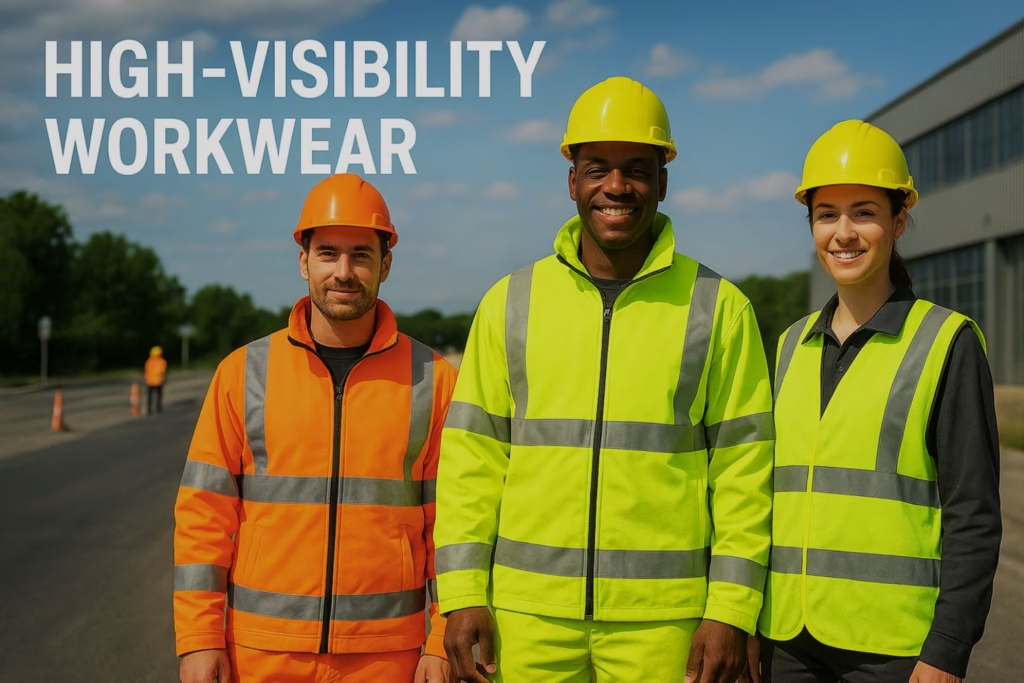
Bengal Apparel BD supplies certified high-visibility workwear for importers, distributors, and private-label brands worldwide. Our
Hi-vis garments are produced to EN ISO 20471 standards across a full range of styles: vests, jackets, coveralls, shirts, trousers, and fleece; all are available with custom branding and private labeling.
We supply buyers across the USA, Europe, Middle East, Canada, and Australia. All orders ship with full compliance documentation.
Looking for a full-range workwear manufacturer in Bangladesh? Bengal Apparel BD produces hi-vis, FR, and industrial garments for global buyers.


EN ISO 20471
Hi-vis certification standard
Class 1, 2 and 3
All performance levels available
MOQ from 1,000 pieces
Per style and colour
3M Scotchlite
Reflective tape standard
What EN ISO 20471 Means for Your Buyers
EN ISO 20471 is the international standard for high-visibility clothing. It defines three performance classes based on the amount of fluorescent
and reflective material on the garment. The higher the class, the more visible the wearer.
Most buyers sourcing hi-vis workwear for professional use need to specify the correct class for their end market. Getting this wrong means garments that fail compliance checks on site. We manufacture to all three classes and confirm the correct classification with every order.
Class Minimum coverage area Typical application
Class 1 Lowest visible area Parking attendants, shopping centre staff, low-risk environments
Class 2 Medium visible area Warehouse workers, airport ground crew, utility workers
Class 3 Highest visible area Road construction, highway workers, emergency services
If you are unsure which class your buyers require, share the end-use environment with us and we will confirm the correct specification before
Sampling begins.
For buyers supplying both the US and European markets, understanding how ANSI/ISEA 107 and EN ISO 20471 classify performance levels, specify tape placement, and handle dual certification is essential before committing to a production specification. Our ANSI/ISEA 107 vs EN ISO 20471 compliance guide for US and European buyers covers both standards side by side including classification, color testing, wash durability, and what to request from your supplier before bulk approval.
Our Hi-Vis Workwear Product Range
All styles below are available with custom colors, logos, reflective tape placement, and private labeling. Fabric weights and compositions
can be adjusted to suit your target market and climate requirements.
Hi-Vis Safety Vests
Mesh and solid fabric safety vests in standard yellow and orange. Available in security vest, professional vest, and ID-holder configurations. The fastest-moving hi-vis product for logistics, warehousing, and event management buyers.
Certification: EN ISO 20471 Class 1 and Class 2
Fabric options: Mesh polyester, solid polyester, recycled polyester
Tape: 3M Scotchlite or equivalent reflective tape
Colors: Yellow, orange, custom on request
MOQ: From 1,000 pieces per style and colour
Private label: Yes
Hi-Vis Jackets and Fleece
Polar fleece jackets in 280 gsm and 360 gsm weights, two-tone fleece jackets, and outer shell jackets. Designed for buyers supplying workers
in cold-weather outdoor environments—construction, utilities, road maintenance, and infrastructure.
Certification: EN ISO 20471 Class 2 and Class 3
Fabric options: Polar fleece 280 gsm, polar fleece 360 gsm, softshell
Tape: 3M Scotchlite certified reflective tape
Colours: Yellow, orange, custom on request
MOQ: From 500 pieces per style and colour
Private label: Yes
Hi-Vis Coveralls
One-piece hi-vis coveralls in TC twill fabric at 250 gsm. Full-body visibility with reflective tape across the chest, back, and legs.
Used by construction contractors, site supervisors, and infrastructure workers who need maximum coverage and compliance in a single garment.
Certification: EN ISO 20471 Class 2 and Class 3
Fabric: TC twill 250 gsm, polycotton options available
Tape: 3M Scotchlite or equivalent
Colours: Yellow, orange, custom
MOQ: From 500 pieces
Private label: Yes
Hi-Vis Shirts and T-Shirts
Cotton hi-vis shirts, polo shirts, and long-sleeve t-shirts with segmented reflective stripes. For buyers supplying workers who need visibility without the weight of a jacket—roadside crews in warm climates, site workers in summer, and mixed indoor and outdoor roles.
Certification: EN ISO 20471 Class 1 and Class 2
Fabric: 100% cotton, polycotton blends
Tape: Segmented reflective stripes
Colors: Yellow, orange, custom
MOQ: From 1,000 pieces per style and colour
Private Label: Yes
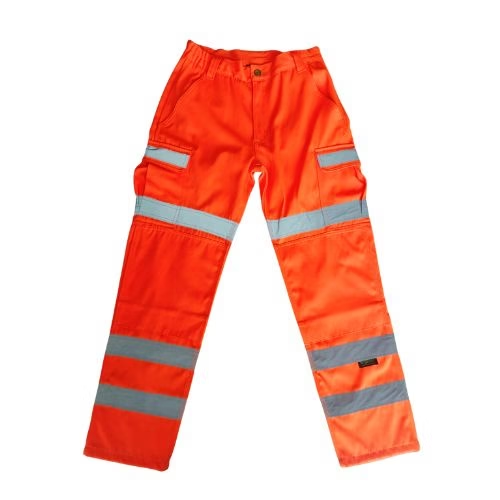
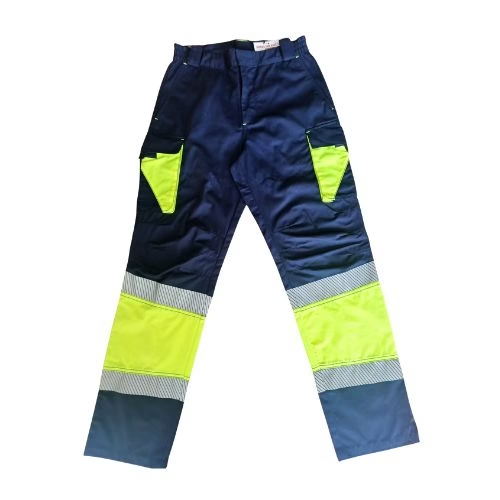
Hi-Vis Work Trousers
Cargo hi-vis work trousers and Class 1 hi-vis work trousers with reflective tape on the legs. For buyers building complete hi-visuniform programmes where tops and bottoms both need to meetEN ISO 20471 requirements.
Certification: EN ISO 20471 Class 1 and Class 2
Fabric: Polycotton, TC twill
Tape: Reflective tape on lower legs
Features: Multiple cargo pockets, reinforced knees on request
MOQ: From 1,000 pieces per style and colour
Private Label: Yes
Fabric and Construction Standards
– All fluorescent fabric is tested to EN ISO 20471 before cuttingbegins. Fabric that fails the luminance test does not go into production.
– Reflective tape is 3M Scotchlite or an approved equivalent. Standard reflective tape loses its effectiveness after repeated
washing. We use only tape certified to retain reflectivity after a minimum of 25 wash cycles.
– Seams on hi-vis garments are double-stitched for durability. Reflective tape is sewn rather than heat-applied wherever possible
for longer adhesion life.
– All garments are tested for colorfastness. Fluorescent fabric that fades loses EN ISO 20471 compliance. Our fabrics are tested
to confirm they retain the required luminance level after washing.
Industries We Supply
– Road construction and highway maintenance
– Utilities and power distribution
– Rail and public transport infrastructure
– Warehousing and logistics
– Airport ground operations
– Construction and civil engineering
– Emergency services and public safety
– Event management and security
Common Questions from Buyers
What is the difference between Class 1, Class 2, and Class 3 hi-vis?
The classes refer to the total area of fluorescent and reflective material on the garment. Class 1 has the least coverage and is
suitable for low-risk environments. Class 2 is the most common standard for general site and industrial use. Class 3 provides the
highest coverage and is required for workers on or near fast-moving traffic such as highways and motorways. If you are unsure which class
applies to your buyers, we can advise based on the working environment.
Can you produce hi-vis workwear in custom colors beyond yellow and orange?
Yellow and orange are the standard fluorescent colors certified under EN ISO 20471. Red-orange is also permitted under the standard. Other colors, such as green or pink, are not certified under EN ISO 20471 and cannot be used for compliant hi-vis garments. We can produce non-certified high-visibility items in other colors for non-safety applications on request.
How many wash cycles do your reflective tapes withstand?
Our standard reflective tape is certified to retain its reflective performance for a minimum of 25 industrial wash cycles, which is the EN ISO 20471 requirement. Some tape options are rated for 50 wash cycles for buyers with longer garment replacement cycles. We confirm the wash cycle rating with the tape specification at the quoting stage.
Do you supply hi-vis workwear with FR protection combined?
Yes. We produce hi-vis FR coveralls that meet both EN ISO 20471 and EN ISO 11612. These are used by workers who need visibility and flame protection in the same garment, such as utility workers near electrical infrastructure or construction workers on sites adjacent to fuel or gas lines. See our Flame-Resistant Workwear page for details.
What is the minimum order for hi-vis workwear?
MOQ starts from 500 pieces per style and color. For buyers running multi-style programs, we can combine styles to reach the minimum across the order rather than requiring 500 pieces of each individual style. Contact us with your full program requirements, and we will confirm what is achievable.
Request Hi-Vis Workwear Pricing
Tell us the styles, quantities, certification class, and destination market. We will respond within one business day with fabric options, unit pricing, and a production timeline.
Email: hello@bengalapparel-bd.com
Phone: +88 01706561468
ANSI 2024 High-Visibility Clothing Standards: Enhancing Safety and Comfort
High-visibility clothing is among the most critical pieces of personal protective equipment a worker in a hazardous environment can wear. For road construction crews, mining operations, emergency responders, railway maintenance teams, and dozens of other industries, being seen is not a preference. It is a condition of survival. The ANSI 2024 high-visibility clothing standards represent the most significant update to the US regulatory framework for this category of PPE in recent years, and procurement managers sourcing hi-vis workwear for US and international markets need to understand exactly what has changed and why it matters.
This guide covers the key updates in the ANSI 2024 high-visibility clothing standards, which sectors are legally required to comply, and how to source compliant garments at production scale from a certified manufacturer. For buyers sourcing for both US and European markets, our guide to high-visibility clothing manufacturing covers the full range of ANSI and EN ISO 20471 compliant styles we produce.
What Are the ANSI 2024 High-Visibility Clothing Standards?
The primary US standard governing high-visibility safety apparel is ANSI/ISEA 107, published by the American National Standards Institute in partnership with the International Safety Equipment Association. The 2024 revision updates the requirements that manufacturers, importers, and procurement teams must meet across five key areas: reflective material quality, chromaticity, retroreflective configurations, breathability, and labeling.
The standard defines three performance classes based on the amount of fluorescent background material and retroreflective tape on the finished garment. Class 1 is the minimum for lower-risk environments. Class 2 is the most commonly specified class for general construction, warehousing, and road maintenance. Class 3 provides the highest coverage for workers in direct proximity to fast-moving traffic or in complex visual environments.
Understanding which class applies to your buyers’ end-use environment is the starting point for any compliant hi-vis sourcing programme.
What Has Changed: The Five Key Updates in ANSI 2024 High-Visibility Clothing Standards
1. Reflective Materials: Higher Performance and Wash Durability
The 2024 update raises the performance threshold for retroreflective tape used on compliant garments. Two specific requirements have been tightened.
The retroreflection coefficient requirement has been increased, meaning the tape must return more light to the source from a greater distance than was required under previous versions of the standard. For workers operating in fast-moving traffic environments, this increase in retroreflective performance directly improves detection distance and reaction time for drivers.
Wash durability requirements have also been strengthened. Reflective tape must now pass abrasion and repeated wash cycle testing confirming that retroreflective performance is maintained after industrial laundering. This is a direct response to documented cases of tape delamination and performance degradation in garments that passed compliance tests on delivery but failed after a small number of wash cycles in commercial laundry programmes.
For procurement managers, this change means wash durability documentation is now a mandatory part of the compliance verification process, not an optional quality check. When evaluating any hi-vis workwear supplier, request third-party wash cycle test reports confirming retroreflective performance retention as a condition of sample approval.
2. Chromaticity: Brighter Colours with Batch Consistency Requirements
Chromaticity refers to the specific colour coordinates that fluorescent fabrics must fall within to qualify as compliant hi-vis material. The 2024 standards tighten the chromaticity boundaries for fluorescent yellow-green, orange-red, and red, requiring fabrics to be both brighter and more consistent across production batches.
The practical implication for B2B buyers is significant. A garment that passes chromaticity testing with one fabric lot but is produced in a subsequent batch using a slightly different dye formulation may no longer comply if that batch falls outside the tightened coordinates. This makes Pantone-referenced colour matching and documented batch records a critical requirement when specifying hi-vis garments for ongoing supply programmes.
Our high-visibility clothing manufacturing process uses certified fluorescent fabrics tested against both ANSI/ISEA 107 and EN ISO 20471 chromaticity requirements, with batch colour records maintained across repeat production runs to ensure compliance consistency.
3. Retroreflective Configurations: More Flexibility for Specific Work Environments
The 2024 ANSI standards introduce greater flexibility in retroreflective tape configurations, allowing manufacturers to design compliant garments with placement patterns optimised for specific work environments and job roles.
Under previous versions of the standard, tape placement options were more prescriptive. The 2024 update recognises that a roadside traffic flagger has different visibility requirements from a confined space worker, a warehouse operative, or an offshore platform crew member. Custom configurations that maintain the minimum tape area and retroreflective performance requirements while adapting placement for specific operational environments are now recognised as compliant.
For procurement managers building hi-vis programmes for specialised applications, this flexibility allows garments to be designed for the actual visibility requirements of the role rather than defaulting to a standard configuration that may not optimise visibility in the specific environment. Confirm with your manufacturer that any custom configuration has been independently verified against ANSI 2024 placement and area requirements before bulk production approval.
4. Breathability and Comfort: New Fabric Performance Requirements
Extended wear of heavy, non-breathable hi-vis garments in hot or physically demanding environments is a documented contributor to heat stress, which reduces worker performance and creates secondary safety risks. The 2024 standards address this by introducing new fabric breathability requirements that must be met alongside visibility performance.
Two specific tests are now incorporated into the standard. Moisture Vapour Transmission Rate (MVTR) testing measures how effectively the fabric allows sweat vapour to pass through, keeping the worker cooler and drier during physical activity in warm conditions. Air permeability testing confirms that the fabric structure allows adequate airflow to support heat loss during sustained physical work.
These requirements apply to the fluorescent background fabric, which has historically been the least breathable component of a hi-vis garment due to the density required to achieve the chromaticity performance. Fabric development to meet both visibility and breathability requirements simultaneously is now a manufacturing challenge that separates technically capable producers from those simply sewing certified tape onto standard fabric.
For buyers sourcing hi-vis workwear for warm-climate markets including the Middle East, Australia, and Southern US states, the breathability requirements in the 2024 update are directly relevant to worker adoption and comfort across extended shifts.
5. Labeling: Clearer Compliance Information on Every Garment
The 2024 standards tighten labeling requirements to give workers and employers immediate access to the compliance information they need to verify that a garment meets current standards and is being used correctly.
Every ANSI 2024 compliant garment must carry a label confirming compliance with the current ANSI/ISEA 107 standard by edition year, the performance class of the garment, the type of retroreflective material used, the manufacturer’s name and garment identifier, correct sizing information, care instructions that preserve compliance performance, and guidance on inspection and replacement criteria.
For procurement managers, the labeling requirement is a straightforward verification tool. If a garment’s label does not reference the 2024 edition of ANSI/ISEA 107, the garment was not manufactured to the current standard regardless of what the supplier claims verbally or in a sales presentation. Our compliance documentation covers all labeling requirements for both ANSI and EN ISO 20471 compliant production.
Sectors Where ANSI 2024 Compliant Hi-Vis Clothing Is Legally Required
The ANSI 2024 high-visibility clothing standards apply across a broad range of industries where worker visibility is a documented safety requirement. Procurement managers sourcing for any of the following sectors should confirm that all garments meet the 2024 edition requirements before placing bulk orders.
Construction and road maintenance workers near active traffic require Class 2 or Class 3 compliance. Traffic control and flagging personnel in direct proximity to moving vehicles require Class 3. Transportation and warehousing workers including airport ground crews and forklift-adjacent staff require Class 2 minimum. Emergency services personnel including police officers directing traffic and EMS crews attending roadside incidents require Class 2 or Class 3 depending on the proximity to moving traffic. Utilities and infrastructure workers including electricians, line workers, and water, gas, and telecom crews working near roadways require Class 2. Mining and quarrying surface operations where large vehicles operate require Class 2. Oil and gas onshore and offshore operations require hi-vis clothing meeting both ANSI and, for internationally deployed workers, EN ISO 20471 standards simultaneously. Railway and subway maintenance and inspection crews require Class 3 in most jurisdictions. Waste management and sanitation workers collecting alongside active traffic routes require Class 2. Maritime and dock workers in vehicle-heavy port environments require Class 2.
For buyers supplying across multiple sectors, specifying Class 3 as the baseline across the programme ensures compliance across all end-use environments without the administrative complexity of managing multiple class specifications within a single order.
Sourcing ANSI 2024 Compliant Hi-Vis Workwear from Bangladesh
Bangladesh is a fully capable manufacturing base for ANSI 2024 compliant high-visibility clothing at production scales that North American and European manufacturers cannot match on cost. Our partner factories produce Class 2 and Class 3 garments to ANSI/ISEA 107 and EN ISO 20471 using certified fluorescent fabrics and 3M Scotchlite or approved equivalent retroreflective tape, with third-party laboratory test reports provided as standard with every production batch.
For buyers supplying the North American market specifically, sourcing ANSI 2024 compliant garments from Bangladesh delivers a 25 to 40% unit cost advantage compared to equivalent production in North America or Western Europe, with the same documentation package required by US customs and procurement compliance frameworks.
Our multinorm workwear range covers combined hi-vis and FR programmes for buyers supplying oil and gas, utilities, and construction sectors where both ANSI visibility and flame-resistance standards must be met in a single garment. Our manufacturing capabilities page details our full technical production infrastructure for safety apparel programmes.
FAQ : High-Visibility Workwear Sourcing
What specific high-visibility certification standards do your garments comply with?
Our high-visibility protective clothing is fully certified to meet major international safety frameworks. We manufacture garments in strict compliance with the American standard ANSI/ISEA 107 (including the latest 2024 revision updates) as well as the European standard EN ISO 20471. Complete third-party laboratory test reports for background chromaticity and retroreflective tape performance are provided with every production batch.
Can you combine flame-resistant (FR) properties with high-visibility specifications in a single production run?
Yes. We specialize in engineering multi-norm safety garments. For heavy industries like Oil and Gas, petrochemical refining, and electrical utilities, we produce high-visibility workwear that simultaneously incorporates flame-resistant and anti-static properties. These specialty garments utilize certified technical fiber blends, such as Nomex, Kevlar, and treated modacrylics, alongside flame-retardant reflective striping to satisfy both EN ISO 11612 and EN ISO 20471 standards.
What materials do you use to ensure wash durability and long-term reflective performance?
We source high-performance background fabrics and premium retroreflective tapes, utilizing industry standards like 3M Scotchlite or verified equivalent technologies. Our materials undergo rigorous abrasion and industrial laundering tests to ensure they retain their bright fluorescent properties and high retroreflection coefficients even after 50 intensive commercial wash cycles.
What is your Minimum Order Quantity (MOQ) for custom high-visibility apparel?
Our standard minimum order quantity is 1,000 pieces per style for custom high-visibility workwear programs. This volume allows us to source certified, freshly dyed fluorescent fabrics directly from technical textile mills, guaranteeing absolute color batch consistency and full compliance with international visibility safety coordinates.
How do you manage quality control and compliance verification before shipping from Dhaka?
We implement a strict triple-stage quality assurance protocol across our certified factory network. Raw fabrics and reflective tapes are checked upon arrival at the cutting room, inline monitors inspect seam strength and tape placement during assembly, and a final statistical inspection is completed before packing. We fully support independent pre-shipment inspections from third-party agencies such as SGS or Bureau Veritas at our client’s request.
More Prodcut Links: