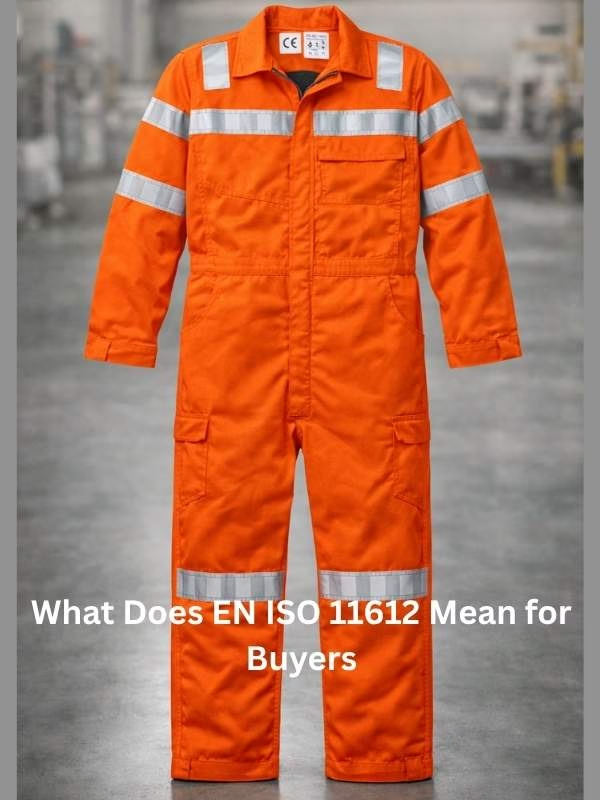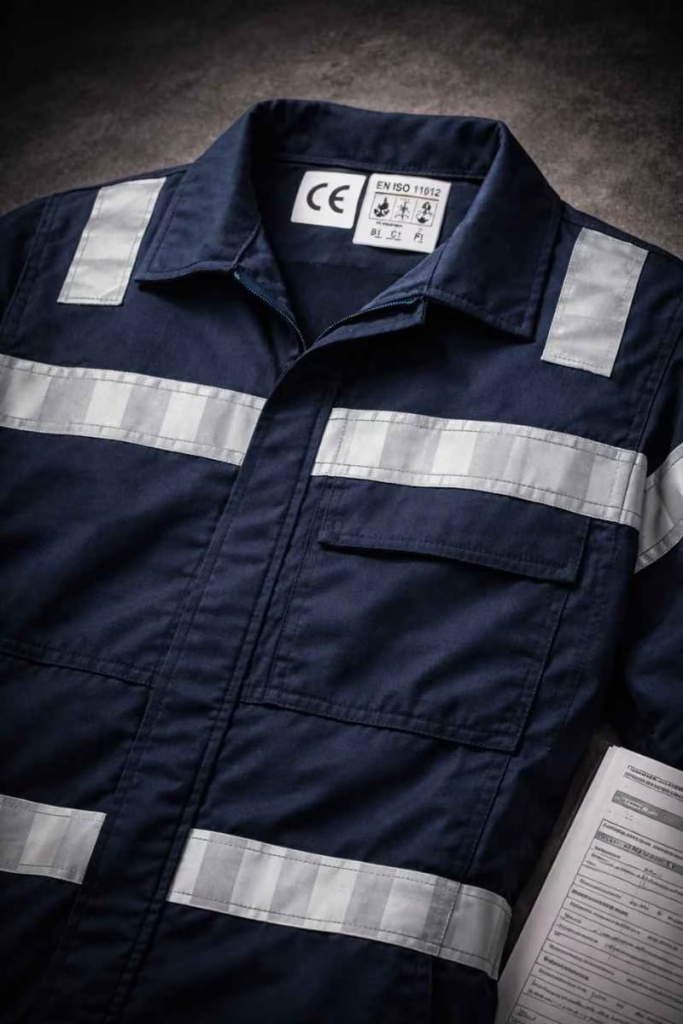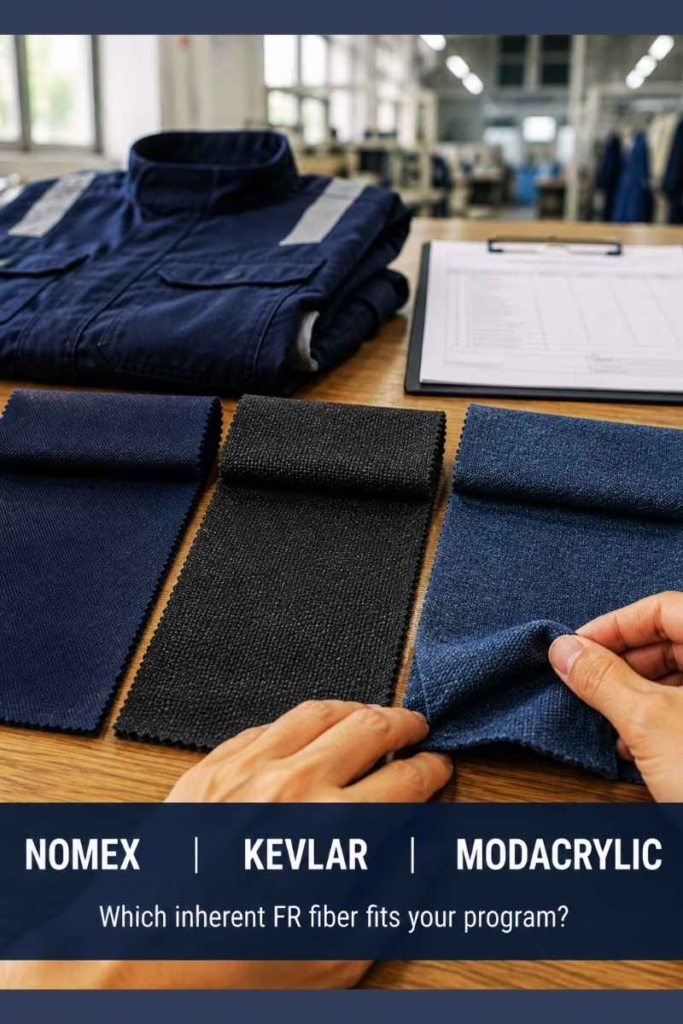
When procurement managers source flame-resistant workwear for oil and gas, petrochemical, electrical utility, or industrial maintenance programs, they eventually reach the same decision point: which inherent FR fiber is right for this program. Nomex, Kevlar, and modacrylic are the three most widely specified inherent FR fibers in certified industrial workwear, and the differences between them affect protection level, comfort across a full shift, program cost, and how well the garment performs after two years of regular industrial washing.
This Nomex vs Kevlar vs Modacrylic fabric comparison guide covers the technical properties, performance thresholds, cost ranges, and ideal applications for all three fibers, with a procurement decision framework that helps match the fiber to the specific hazard level and budget of your program. It is written for buyers who already know they need inherent FR fabric and need to understand which fiber, or which blend of fibers, is the right specification for their situation.
Nomex vs Kevlar Fabric Comparison: Why the Fiber Choice Matters Fabric Comparison:
All three fibers are inherently flame resistant, meaning the FR properties are built into the fiber chemistry itself rather than applied as a surface treatment. Unlike treated FR fabrics, where the flame-retardant finish degrades with washing and must be tested periodically to confirm continued compliance, inherent FR fibers maintain their protective properties for the full service life of the garment. This is the core reason that oil and gas, petrochemical, and electrical utility buyers specify inherent FR fabric as a baseline rather than treated FR for continuous high-hazard exposure.
But inherent does not mean identical. Nomex, Kevlar, and modacrylic differ significantly in their heat resistance thresholds, mechanical strength, comfort in extended wear, cost structure, and the hazard types they are best engineered to address. A garment built on the wrong fiber for the program’s primary hazard may be certified to the relevant standard and still underperform against what the buyer actually needed.
What Makes a Fabric Inherently Flame Resistant
Before comparing the three fibers, it helps to understand what inherent flame resistance actually means at the material level. An inherently FR fiber self-extinguishes when the ignition source is removed, does not melt or drip when exposed to flame, and forms a carbonised char barrier that insulates the underlying skin from continued heat transfer. These three properties, self-extinguishing behaviour, no melt or drip, and char formation, are the baseline requirements that appear in both EN ISO 11612 and NFPA 2112 for certified FR garments.
The Limiting Oxygen Index, or LOI, is one way to compare inherent FR performance across fiber types. LOI measures the minimum oxygen concentration in which a fiber will continue to burn. Ambient air contains approximately 21 percent oxygen, so any fiber with an LOI above 21 percent will self-extinguish in normal air when the ignition source is removed. Higher LOI values indicate greater resistance to sustained combustion. All three fibers covered in this guide exceed this threshold comfortably, but they differ in where exactly that threshold sits and how they perform at extreme temperatures beyond it.
Nomex (Meta-Aramid): The Thermal Protection Benchmark
Nomex is a meta-aramid fiber developed by DuPont, first introduced commercially in 1967 and now established as the benchmark inherent FR fiber for high-intensity thermal and electrical hazard environments. It withstands continuous temperatures up to approximately 370°C (700°F) and decomposes rather than melts at temperatures between 370°C and 425°C, forming an insulating char barrier that slows heat transfer to the body during the critical seconds of a flash fire or arc flash event.
Nomex has an LOI of approximately 28 to 32 percent, excellent dimensional stability under heat, and strong abrasion and tear resistance that holds up through extended service life and repeated industrial washing. It is the fiber of choice for structural firefighting turnout gear, racing suits, aircraft crew protection, electrical arc flash garments rated for higher incident energy levels, and petrochemical applications where the highest thermal protection and longest service life justify the premium cost.
The trade-offs are real. Pure Nomex fabric can feel stiffer and warmer than other FR fibers, particularly at heavier weights required for higher arc flash ratings. Color options are more limited since Nomex is often solution-dyed during fiber production rather than piece-dyed after weaving, which restricts the palette compared to modacrylic. And the cost is premium: finished Nomex garments typically range from around $80 to $150 or more per piece depending on weight, construction, and certification level.
The most common commercial form of Nomex in finished workwear is Nomex IIIA, a blend of approximately 93 percent Nomex, 5 percent Kevlar, and 2 percent antistatic fiber. The Kevlar component improves tear resistance and reduces flame breakopen risk. The antistatic fiber provides EN 1149-5 electrostatic compliance. This blend is the standard specification for our Nomex and Kevlar FR coverall program targeting oil and gas and petrochemical buyers who need the highest thermal protection level in a single inherent FR piece.
Kevlar (Para-Aramid): Strength First, Flame Resistance Second
Kevlar is a para-aramid fiber, also developed by DuPont, and chemically related to Nomex but with a fundamentally different molecular alignment that produces dramatically different mechanical properties. Kevlar’s tensile strength is approximately five times that of steel by weight, giving it exceptional cut, tear, and abrasion resistance that Nomex alone cannot match. Its heat resistance is also higher than Nomex, withstanding temperatures up to approximately 450°C (840°F) before decomposition, and it has an LOI of approximately 29 percent.
Despite these credentials, Kevlar is rarely used alone in finished FR workwear garments. Its initial stiffness makes single-fiber Kevlar fabric uncomfortable for extended wear, and it is more susceptible to UV degradation than Nomex over long-term outdoor exposure. Its primary role in FR workwear is as a blend component, added to Nomex or modacrylic base fabrics to contribute mechanical toughness without significantly reducing thermal performance or comfort. The Nomex IIIA blend is the most widely recognised example of this, but Kevlar is also blended into other inherent FR fabric constructions for applications where both thermal risk and physical wear hazards are present simultaneously.
Kevlar is the right specification driver when the program’s hazard profile includes both thermal risk and significant mechanical threat, such as environments combining flash fire risk with cutting, tearing, or high-abrasion exposure. For programs where thermal protection is the primary requirement and mechanical hazard is secondary, the Kevlar content in a Nomex blend typically handles the mechanical requirement adequately without needing a Kevlar-dominant construction.
Modacrylic: The Comfort and Cost Case for Daily Industrial Wear
Modacrylic is a modified acrylic copolymer fiber that incorporates halogenated monomers, typically chlorine or bromine-containing compounds, into the acrylonitrile polymer backbone during fiber production. These halogen elements release flame-inhibiting gases when heated, interrupting the combustion cycle and producing self-extinguishing behaviour without melting or dripping. Modacrylic is classified as an inherently FR fiber with an LOI range of approximately 27 to 33 percent, and its FR properties are permanent, remaining effective after repeated industrial wash cycles.
The defining advantage of modacrylic over the aramid fibers is comfort. Modacrylic has a soft, wool-like hand feel, excellent drape, and significantly better breathability in blended constructions than pure Nomex fabric. It dyes well across a wide colour range, which matters for programs requiring specific corporate colours or high-visibility combinations. And it costs substantially less: finished modacrylic blend garments typically range from approximately $50 to $100 per piece, making it the most cost-effective inherent FR option for programs where comfort and compliance matter more than maximum thermal performance.
The trade-offs are also real. Modacrylic’s heat resistance ceiling is lower than the aramids, softening at temperatures around 260°C (500°F) compared to Nomex’s 370°C. This makes it unsuitable for the most extreme continuous high-heat applications, particularly structural firefighting and very high arc flash energy environments. For oil and gas daily wear, general industrial maintenance, electrical utility work at arc flash Category 1 to 2 levels, and any environment where workers wear FR clothing for full shifts in physically demanding conditions, modacrylic blends offer the best balance of protection, wearability, and program cost.
Side-by-Side Comparison: Nomex vs Kevlar vs Modacrylic
| Property | Nomex (Meta-Aramid) | Kevlar (Para-Aramid) | Modacrylic |
|---|---|---|---|
| Heat resistance | Up to ~370°C continuous | Up to ~450°C | Up to ~260°C |
| LOI | ~28 to 32% | ~29% | ~27 to 33% |
| Melt or drip | No | No | No |
| Tensile strength | Excellent | Exceptional (~5x steel by weight) | Good in blends |
| Comfort and breathability | Moderate, can feel stiffer | Moderate, initially stiff | Best of the three |
| Color options | Limited (solution-dyed) | Limited | Wide range |
| Typical garment cost | $80 to $150+ | $100 to $200+ | $50 to $100 |
| Primary use in workwear | Flash fire, arc flash, firefighting, high-hazard industrial | Blend component for mechanical strength | Daily industrial FR, arc flash CAT 1 to 2, comfort-priority programs |
| Key standards | NFPA 2112, NFPA 70E, EN ISO 11612 | NFPA 2112, ASTM F1506 | NFPA 2112, NFPA 70E, EN ISO 11612 |
Blends: Why Pure Fibers Are Rarely Used in Finished Garments
Pure single-fiber constructions are the exception rather than the rule in certified FR workwear. Blends are the norm because they allow manufacturers to combine the thermal protection strength of one fiber with the mechanical durability, comfort, or cost advantage of another in a single fabric construction.
Nomex IIIA (93% Nomex, 5% Kevlar, 2% antistatic) is the most widely recognised example, but modacrylic blends are equally prevalent: modacrylic combined with cotton at ratios of around 60 to 70 percent modacrylic and 30 to 35 percent cotton, with one to two percent antistatic fiber, is a common construction for oil and gas daily wear and general industrial programs where the modacrylic provides the inherent FR performance and the cotton adds breathability, comfort, and absorbency that pure modacrylic alone does not deliver as well. Some constructions add small percentages of FR viscose or polyamide for additional strength or moisture management properties.
The practical implication for buyers is that specifying “Nomex” or “modacrylic” as a fabric type is a starting point, not a complete specification. The exact blend composition, fabric weight in g/m², and construction weave all affect the garment’s certified performance levels and its comfort in extended wear. Always request the full fabric composition by percentage, the fabric weight, and the specific certification test results for the exact construction you are being quoted rather than accepting a fiber name alone as a sufficient specification.
Matching the Fiber to the Hazard: A Procurement Decision Framework
Three questions drive the fiber selection decision in most B2B workwear programs.
What is the primary hazard and its intensity? For the highest thermal risk environments, including structural firefighting, severe industrial flash fire, and arc flash above Category 2 levels, Nomex-based or Nomex and Kevlar blend constructions are the right specification. For standard oil and gas daily wear, electrical utility maintenance at Category 1 to 2 levels, and general industrial environments with continuous FR exposure requirements, modacrylic blends deliver the required protection at a significantly better comfort and cost point. Our guide on arc flash vs flash fire protection covers how to identify which hazard type governs your program’s primary specification requirement.
Is mechanical durability alongside thermal protection a requirement? If workers in your program face both thermal risk and significant cut, tear, or abrasion exposure, a Nomex and Kevlar blend is the stronger specification. If thermal protection is the primary requirement and mechanical durability is standard industrial-level, either Nomex alone or a modacrylic blend with a small aramid component will satisfy the program without the cost premium of a Kevlar-heavy construction.
How long are workers wearing the garment per shift? Comfort drives compliance in FR programs. A garment that workers find uncomfortable to wear, too hot, too stiff, or too restrictive, gets removed during breaks or modified in ways that compromise protection. For programs requiring full-shift wear in physically demanding conditions, the comfort advantage of modacrylic blends is a real safety benefit, not just a preference.
Total Cost of Ownership: The Number That Changes the Decision
Unit price is not the same as program cost. A modacrylic blend garment at $70 per piece that lasts two years of regular industrial washing before its certified performance needs retesting is a different cost proposition from a Nomex IIIA garment at $130 per piece that maintains its inherent FR performance for five years or more under the same washing conditions.
For buyers running large-scale programs across multiple sites and hundreds of workers, the difference in total cost of ownership between a treated FR fabric that requires periodic retesting and replacement and an inherent FR fabric that maintains certification throughout its service life can be substantial over a three to five year program horizon. This is one of the core reasons large oil and gas operators and electrical utilities have moved toward inherent FR fabric as their program baseline even at the higher unit price, since the total cost including retesting, replacement, and compliance administration favors the inherent construction over time.
For buyers considering inherent vs treated FR as a prior question before choosing between the three inherent fibers covered here, our flame-resistant workwear manufacturing guide covers that comparison in detail alongside the certification requirements for both fabric types.
What to Request from Your FR Fabric Supplier
Before approving any inherent FR fabric for bulk production, request four documents directly from your supplier and verify them against the information in this guide.
First, the full fabric composition by fiber percentage and weight in g/m², since “Nomex blend” or “modacrylic blend” without the exact composition is not sufficient for compliance documentation. Second, the third-party test report for the specific fabric construction showing vertical flame char length under ASTM D6413, HTP values under ASTM F2700, and arc rating under ASTM F1959 if arc flash protection is claimed. Third, the wash durability data confirming performance retention after the required number of industrial wash cycles, since inherent FR certification requires this for both NFPA 2112 and EN ISO 11612. Fourth, the mill’s quality consistency data confirming that the fiber blend composition and weight are controlled within defined tolerances across production batches, since batch variation is the most common source of inconsistent FR performance in finished garments. Our detailed guide on reading an FR workwear test report covering ATPV, HTP, and char length explains how to verify each of these data points against the relevant standard thresholds.
Request a Fabric Specification and Sample for Your FR Program
FAQs
What is the difference between Nomex and Kevlar?
Nomex is a meta-aramid fiber optimised for thermal and flame protection, withstanding continuous temperatures up to approximately 370°C. Kevlar is a para-aramid fiber with approximately five times the tensile strength of steel by weight, optimised for mechanical strength and cut resistance alongside solid FR performance. In finished workwear, Kevlar is most commonly used as a blend component in Nomex-based fabrics to add toughness, rather than as a standalone fiber.
Is modacrylic as protective as Nomex for flash fire?
Modacrylic provides genuine inherent FR protection and can be certified to NFPA 2112 and EN ISO 11612 for flash fire environments. Its heat resistance ceiling is lower than Nomex at approximately 260°C versus 370°C, which makes it less suitable for the most extreme high-temperature applications. For standard industrial flash fire exposure in oil and gas daily wear, modacrylic blends deliver certified protection at a significantly better comfort and cost point than Nomex.
Why are FR garments almost always made from blended fibers rather than pure Nomex or modacrylic?
Blends allow manufacturers to combine the thermal protection strength of one fiber with the mechanical durability, comfort, or cost advantage of another. Pure Nomex can feel stiff and warm in extended wear. Pure modacrylic has lower mechanical strength than the aramids. Blending addresses both limitations while maintaining the inherent FR certification of the base fiber.
What is the LOI of Nomex compared to modacrylic?
Nomex has an LOI of approximately 28 to 32 percent. Modacrylic has an LOI range of approximately 27 to 33 percent. Both self-extinguish readily in ambient air, which contains approximately 21 percent oxygen. The LOI difference between the two is less significant for practical workwear performance than the difference in their heat resistance thresholds and mechanical properties.
How do I know which inherent FR fiber is right for my program?
Start with a formal hazard assessment identifying the primary hazard type (flash fire, arc flash, or both), its intensity level, and the expected wear duration per shift. Match the hazard intensity to the fiber’s heat resistance threshold, and factor comfort into the specification for programs requiring full-shift wear. For high-intensity flash fire and arc flash above Category 2, specify Nomex or Nomex and Kevlar blends. For daily industrial wear at standard hazard levels where comfort and cost matter, specify modacrylic blends.