Bengal Apparel BD is a specialist multi-risk protection workwear supplier in Bangladesh serving procurement managers, safety distributors, and private-label brands across the USA, Europe, the Middle East, Canada, and Australia. This guide covers the technical fabric specifications, certification standards, quality control protocols, and Total Cost of Ownership considerations that B2B buyers need to evaluate before committing to a Multinorm production programme.
Managing safety programmes for complex industrial environments where fire, static electricity, arc flash, chemical splash, and welding hazards coexist requires a consolidated PPE strategy. As a dedicated multi-risk protection workwear supplier Bangladesh, we help distributors replace multiple single-hazard garments with a single certified Multinorm solution. This consolidation streamlines inventory management, reduces warehousing footprint, and ensures full worker compliance on site.
Why Multinorm Workwear Is Now the Standard for Industrial Safety Programmes
The term Multinorm describes garments certified to multiple EN or NFPA safety standards simultaneously. A maintenance technician at a refinery may face flash fire risk, static discharge risk, and arc flash risk within a single shift. A Multinorm coverall addresses all three in one garment rather than requiring the worker to layer multiple items.
For procurement managers, the business case for Multinorm sourcing goes beyond worker safety. A single certified garment replaces three separate PPE items, reducing shipping weight, simplifying reorder management, and lowering the administrative cost of maintaining multiple supplier relationships. While the unit price of a Multinorm garment is higher than a basic flame-resistant workwear item, the Total Cost of Ownership across a two-year programme is consistently lower when the consolidated garment replaces two or more single-hazard items.
As a multi-risk protection workwear supplier in Bangladesh, our entire production model is built around this consolidation principle. We do not produce Multinorm garments as an add-on service. It is a core manufacturing specialisation.
Choosing a Multi-Risk Protection Workwear Supplier Bangladesh: What Separates Technical Manufacturers from Basic Producers
Not every factory in Bangladesh that sews an FR coverall qualifies as a genuine multi-risk protection workwear supplier. Bangladesh has hundreds of garment manufacturers and a much smaller number of technically qualified Multinorm producers. The distinction matters enormously for procurement managers whose buyers will audit garment compliance on site.
A genuine multi-risk protection workwear supplier in Bangladesh must demonstrate independent laboratory test reports from recognised Notified Bodies, documented fabric specification sheets for each fiber blend used in Multinorm production, batch-level traceability from fabric lot to finished garment, and factory-level certification covering both technical production capability and ethical compliance. We provide all four as standard before any commercial commitment is made.
Technical Fabric Deep-Dive: The Fiber Blends That Deliver Multi-Risk Protection
A Multinorm garment is only as reliable as its base fiber. Multi-risk protection cannot be achieved with a surface coating applied to a standard fabric. The protection must be inherent to the fiber structure or permanently integrated into the weave. This is the technical distinction that separates genuine Multinorm manufacturing from basic FR production with a label upgrade.
We work with two primary fabric categories for multi-risk applications, each selected for specific hazard profiles.
Modacrylic, Cotton, and Antistatic Blends
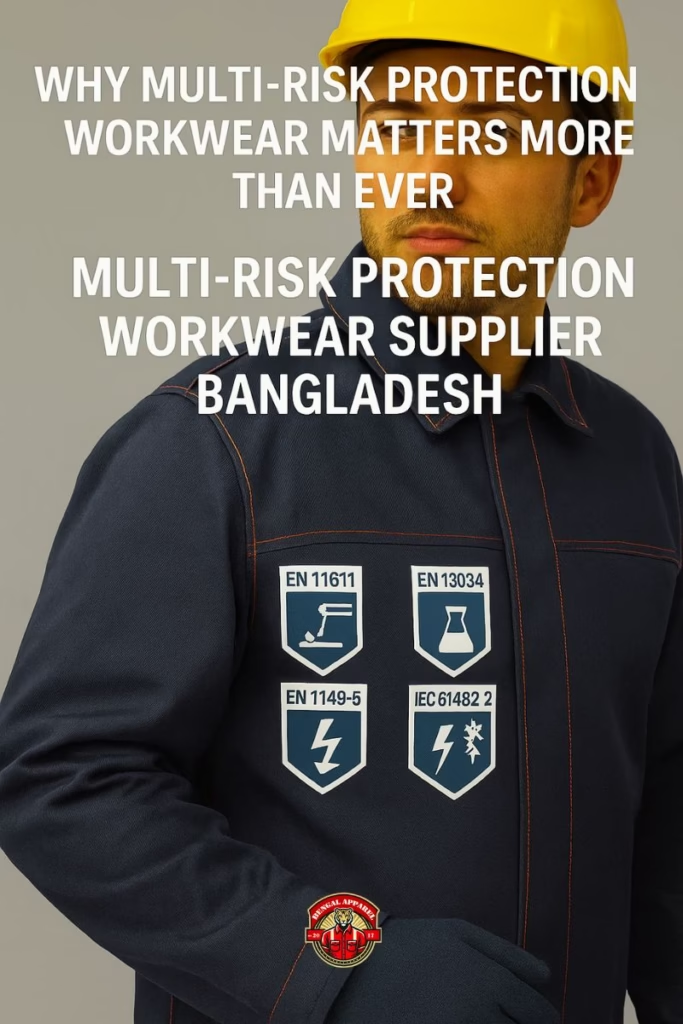
This is the most widely specified fabric for oil and gas, petrochemical, and utility applications. Modacrylic fibers are inherently flame-resistant, meaning the protection is a permanent property of the fiber and cannot wash out over the garment’s service life. When blended with high-quality cotton for comfort and a small percentage of antistatic carbon fiber, the result is a fabric that simultaneously meets EN ISO 11612 for heat and flame protection, EN 1149-5 for antistatic performance, and IEC 61482-2 for arc flash protection.
The inherent nature of the protection is critical for procurement managers specifying garments for high-wash-cycle programmes. A chemical treatment applied to the surface of a standard fabric will degrade with industrial laundering. An inherent modacrylic blend retains full certification compliance at wash cycle 50 as reliably as at wash cycle one. This is the wash durability standard that oil and gas sector safety programmes require and that our technical fabric specifications are built to deliver.
FR-Treated Polyamide and Cotton Blends
For environments requiring higher mechanical strength, such as heavy welding operations and metal fabrication facilities, we specify FR-treated polyamide and cotton blends. These fabrics offer superior abrasion resistance and tear strength compared to modacrylic blends, making them the correct specification for EN ISO 11611 welding protection and EN 13034 chemical splash resistance applications.
The trade-off is the wash durability of the FR treatment compared to inherent fiber protection. For programs with controlled laundry cycles and defined garment replacement schedules, FR-treated blends deliver the required performance at a lower unit cost than inherent fiber options.
Every fabric we use in Multinorm production comes with a comprehensive technical fabric specification sheet covering weight in gsm, tensile strength, tear resistance, color fastness rating, and wash durability data. This allows procurement officers to verify every performance parameter before production begins.
The Five Core Multinorm Certification Standards
When you source from a multi-risk protection workwear supplier in Bangladesh, certification documentation is the foundation of your compliance programme. We provide full test reports from accredited Notified Bodies including SATRA, BTTG, and SGS for every garment specification we manufacture. Here is what each standard covers and why it matters for your buyers.
EN ISO 11612 (Heat and Flame) is the baseline standard for all industrial safety garments in heat and flame environments. It covers radiant heat, convective heat, contact heat, and molten metal splash. Performance is rated across six separate test parameters, each with lettered performance levels. We specify the performance level combination relevant to your end-use environment rather than defaulting to minimum compliance across all parameters.
EN 1149-5 (Antistatic) prevents the buildup of electrostatic charges that could ignite explosive atmospheres in oil and gas, fuel handling, and chemical processing environments. Compliance requires that the fabric dissipates charge below the threshold that triggers ignition, tested under defined conditions including humidity variables.
IEC 61482-2 (Electric Arc) protects workers from arc flash events, which are among the most severe electrical hazards in utility and industrial maintenance environments. We provide both Open Arc test data confirming an Arc Thermal Performance Value in calories per square centimetre, and Constrained Arc Box Test data confirming the Arc Protection Class (APC 1 or APC 2) depending on your specification requirement.
EN ISO 11611 (Welding) covers protection against small splashes of molten metal and brief contact with flames during welding and allied processes. It defines two performance classes: Class 1 for less hazardous welding techniques and Class 2 for higher-risk welding processes including TIG and MIG welding at higher amperages.
EN 13034 (Chemical Splash) provides Type 6 protection against low-volume liquid chemical splashes and aerosols. It is a relevant specification for maintenance workers in petrochemical plants, cleaning operations, and laboratory environments where incidental chemical contact is a documented risk even if full chemical immersion is not.
Our SGS and Intertek certified garment production ensures that every combination of these standards is documented at the batch level, traceable to the specific fabric lot and production date, and formatted for the compliance documentation requirements of buyers in the UK, EU, USA, and GCC markets.
Quality Control for High-Risk Multinorm Garments
A missed stitch in a standard workwear garment is a quality issue. A missed stitch in an arc flash jacket is a life-safety risk. Our quality control protocol for multi-risk apparel operates across three distinct layers with zero tolerance for deviation.
Raw Material Verification tests every roll of fabric for FR performance and antistatic continuity before it reaches the cutting table. Fabric that fails either test does not enter production regardless of delivery schedule pressure.
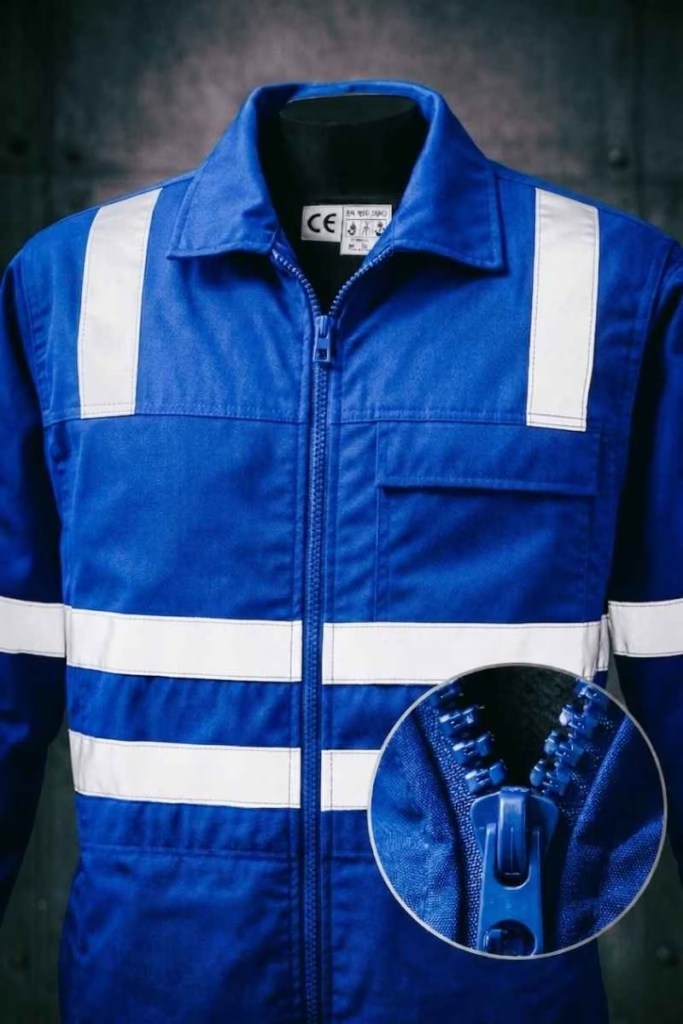
Construction Audits verify that FR-rated thread is used throughout the garment, that heat-resistant zippers meeting the relevant standard requirements are correctly installed, and that seam integrity at stress points meets the specific construction requirements for welding and arc flash protection. These are not visual checks. They are documented dimensional and performance verifications carried out by dedicated quality staff.
Batch Traceability means every Multinorm garment we produce carries a batch-coded label traceable to the specific fabric lot, cutting date, and production line. If a site manager or safety officer has a compliance question about a specific garment six months after delivery, we can pull the full production record within one working day.
Total Cost of Ownership: The B2B Commercial Case for Multinorm Sourcing
Sourcing from a multi-risk protection workwear supplier in Bangladesh allows procurement teams to achieve a measurably lower Total Cost of Ownership compared to managing multiple single-hazard garment programmes across different suppliers.
By consolidating five certifications into one Multinorm garment, buyers reduce shipping weight per worker kit by up to 30%, reduce warehousing footprint for safety garment stock, simplify the annual reorder process to a single specification and supplier relationship, and eliminate the compliance risk of workers combining incompatible single-hazard garments incorrectly on site.
For large-scale programmes supplying the GCC oil and gas sector, European utility companies, or North American industrial contractors, these operational savings compound significantly across the full programme cycle. The higher unit cost of a Multinorm garment, relative to a basic FR coverall, is recovered within the first reorder cycle when set against the consolidated logistics and administration costs it replaces.
Procurement Checklist for Multinorm Workwear Sourcing
Use this checklist when evaluating any multi-risk protection workwear supplier in Bangladesh for a Multinorm programme:
1. Fiber Specification Verification Is the FR protection inherent to the fiber or applied as a surface treatment? For high-wash-cycle programmes, inherent modacrylic or Nomex blends are the correct specification.
2. Notified Body Test Reports Are garment test reports provided from recognised Notified Bodies such as SATRA, BTTG, SGS, or Intertek? Supplier-issued test summaries are not a substitute for independent laboratory reports.
3. Arc Flash Classification For IEC 61482-2 compliance, does the supplier provide both Open Arc ATPV data and Box Test APC classification? Confirm which test method is accepted by your end buyer before specifying.
4. Wash Durability Documentation Does the supplier confirm the number of industrial wash cycles the garment retains full certification compliance? Request this in writing as part of the production specification.
5. Batch Traceability Does every garment carry a batch code traceable to the fabric lot and production date? This is the minimum traceability standard for safety-critical PPE programmes.
6. Factory Certification Status Does the manufacturer hold current WRAP and BSCI certifications confirming ethical production standards, available before order placement?
Request a Multinorm Production Quote
Tell us your required certification combination, fabric specification, garment styles, annual volume, and destination market. We will respond within one business day with fabric options, unit pricing, certification documentation, and a production timeline.
Request a Production Quote | View Our Multi-Norm Workwear Range | Our Ordering Process