Procurement managers sourcing workwear for European, GCC, North American, and Australian markets are under real commercial and regulatory pressure from two directions at once. Their clients want sustainability credentials. Their regulators are beginning to require them by law.
Bangladesh has the certified fabric supply chain, the LEED-certified factory infrastructure, and the documentation processes to meet both demands. What it lacks, in many sourcing relationships, is a supplier who can prove it.
This guide covers what certified sustainable workwear from Bangladesh actually means at the procurement level, which certifications carry weight in which markets, how to verify claims before you place an order, and how to build a program that holds up under buyer audit, client scrutiny, and regulatory review.
Why "Sustainable Workwear Bangladesh" Is Now a Compliance Requirement
The EU CSDDD: What It Means for Workwear Importers
The EU Corporate Sustainability Due Diligence Directive (CSDDD) requires companies importing into European markets to demonstrate that their entire supply chain meets defined human rights and environmental standards. Non-compliance penalties reach up to 5% of global net turnover for the largest companies, with lower-tier thresholds applying to mid-market importers from 2027.
For workwear distributors and private-label brands, this has a direct and specific implication: the sustainability credentials of your Bangladesh supplier are now part of your legal liability exposure, not just your marketing narrative. If your supplier cannot provide independently verifiable documentation, you cannot comply.
The CSDDD documentation a compliant Bangladesh workwear supplier should provide includes:
- RSC (RMG Sustainability Council) factory monitoring reports confirming remediated safety compliance
- Fabric mill scope certificates and transaction certificates for GRS or GOTS materials
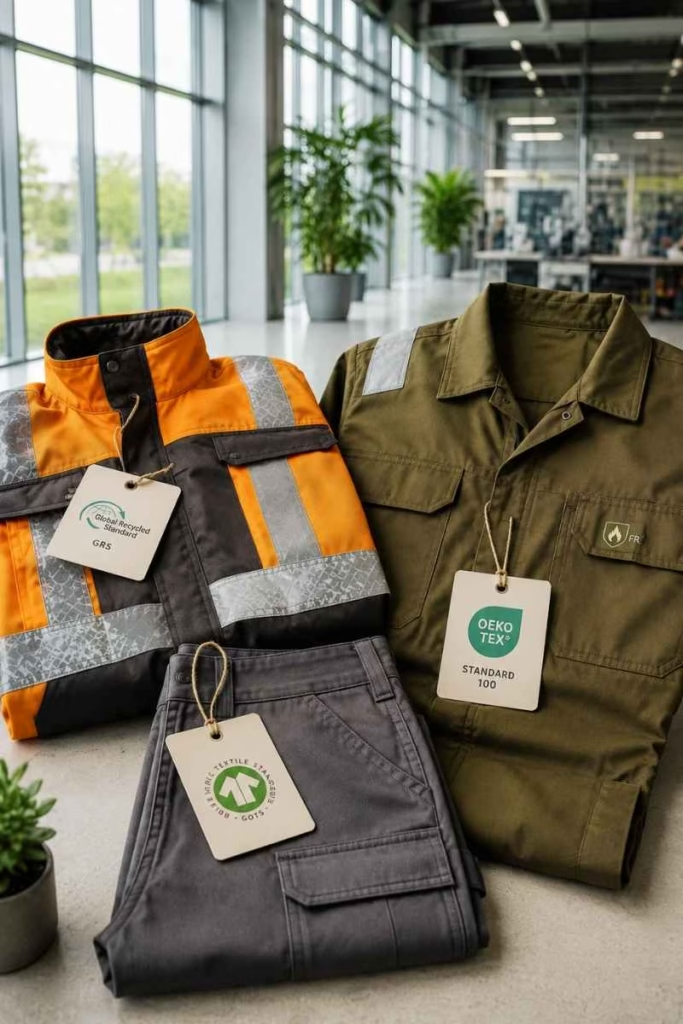
- OEKO-TEX Standard 100 test certificates covering all garment components
- A supplier declaration of compliance that maps to CSDDD Article 7 and Article 8 obligations
- Greenhouse gas and water consumption data from the production facility
Bengal Apparel BD prepares this documentation as a standard part of every export package for European buyers. You do not chase documents from multiple parties.
GCC Markets: Sustainability in Tender Qualification
In the GCC, sustainability requirements in workwear procurement are embedding themselves in project tender specifications for oil and gas, construction, and large infrastructure programs. Requirements from major operators in Saudi Arabia, the UAE, and Qatar now sit alongside the technical and safety certifications that have always been mandatory.
For technical protective workwear programs in the GCC, a garment combining EN ISO 11612 FR certification, EN 1149-5 anti-static compliance, and GRS or OEKO-TEX material certification in a single product is where the market is heading. Buyers who can demonstrate this combination in their current offering are positioned more competitively in the next tender cycle.
The Four Certification Layers That Matter for B2B Programs
The term “sustainable workwear” is used loosely enough in sourcing conversations to be commercially meaningless without specifics. For procurement purposes, a garment is genuinely sustainable when its materials, production process, and supply chain documentation can be independently verified against recognised standards.
These are the four certification layers with direct relevance to B2B workwear programs sourced from Bangladesh.
GRS: Global Recycled Standard
The Global Recycled Standard ([Outbound Link: Textile Exchange GRS page]) certifies that a product contains a verified proportion of recycled material, with chain-of-custody documentation covering every stage from the recycling facility to the finished garment.
What buyers must require: Both a scope certificate (covering the facility) and a transaction certificate (covering the specific batch in your order). A supplier who references GRS without providing both documents is not providing compliant certification.
Recycled polyester certified under GRS typically carries a 5-12% per-metre price premium over standard polyester at sourcing volumes above 5,000 metres. At MOQ 3,000 pieces per style, this premium is workable for most European and GCC procurement budgets.
GOTS: Global Organic Textile Standard
GOTS certifies organic fibre content (minimum 70% for the “made with organic” label, 95% for “organic”) and requires environmental and social compliance throughout every processing stage, including dyeing and finishing. It is the relevant standard for programs using organic cotton.
Verification step: Ask for the certified entity’s GOTS certificate number and verify it directly on the public GOTS database at global-standard.org. Certificates are publicly searchable. A supplier whose name does not appear on that database is not GOTS certified, regardless of what their brochure states.
OEKO-TEX Standard 100
OEKO-TEX Standard 100 tests finished garments for harmful substances including heavy metals, formaldehyde, pH levels, and pesticide residues. Every component of the garment must be tested, including threads, buttons, zips, and labels.
This is a baseline requirement for workwear entering most European distribution channels and is increasingly required for GCC corporate programs. [Internal Link: OEKO-TEX Certified Workwear Fabrics guide] contains a full explanation of product classes and testing scope for B2B buyers.
RSC: RMG Sustainability Council
The RSC is the successor to the Bangladesh Accord. It conducts independent factory safety inspections across Bangladesh’s garment sector and publishes inspection histories publicly via the RSC portal. An RSC-monitored factory provides buyers with a verifiable record of workplace safety compliance, remediation history, and outstanding action items.
For CSDDD Article 7 (identifying adverse human rights and environmental impacts), RSC monitoring documentation is primary evidence. Buyers can verify factory inspection status directly through the RSC portal before placing an order.
CSDDD Compliance Checklist: What to Request from Your Bangladesh Supplier
This is the document demand list for a CSDDD-compliant sourcing program. Request all of these before confirming bulk production.
From the fabric mill:
- GRS scope certificate (valid, current, issued by an accredited certifier)
- GRS transaction certificate for the specific batch in your order
- GOTS certificate if organic cotton is included (verify on global-standard.org)
From the production factory:
- RSC monitoring report (current inspection cycle)
- OEKO-TEX Standard 100 test certificate covering all garment components
- ISO 9001:2015 QMS certificate
- WRAP or BSCI social compliance audit report
From the supplier/exporter:
- Supplier declaration of compliance referencing CSDDD Articles 7 and 8
- Scope 3 emissions data or Environmental Impact Statement for the facility
- Water use reduction documentation if required by your sustainability reporting framework
At shipment:
- Bill of Lading and packing list cross-referenced to transaction certificates
- Written confirmation that the certified fabric batch in the transaction certificate corresponds to the shipped goods
Bengal Apparel BD provides all of the above as a standard export documentation package for European buyers.
Sustainable Fabric Options: Technical Specifications for Industrial Workwear
Sustainable workwear programs from Bangladesh are not limited to lightweight corporate or fashion garments. Certified performance materials are now available for industrial, technical, and protective workwear categories.
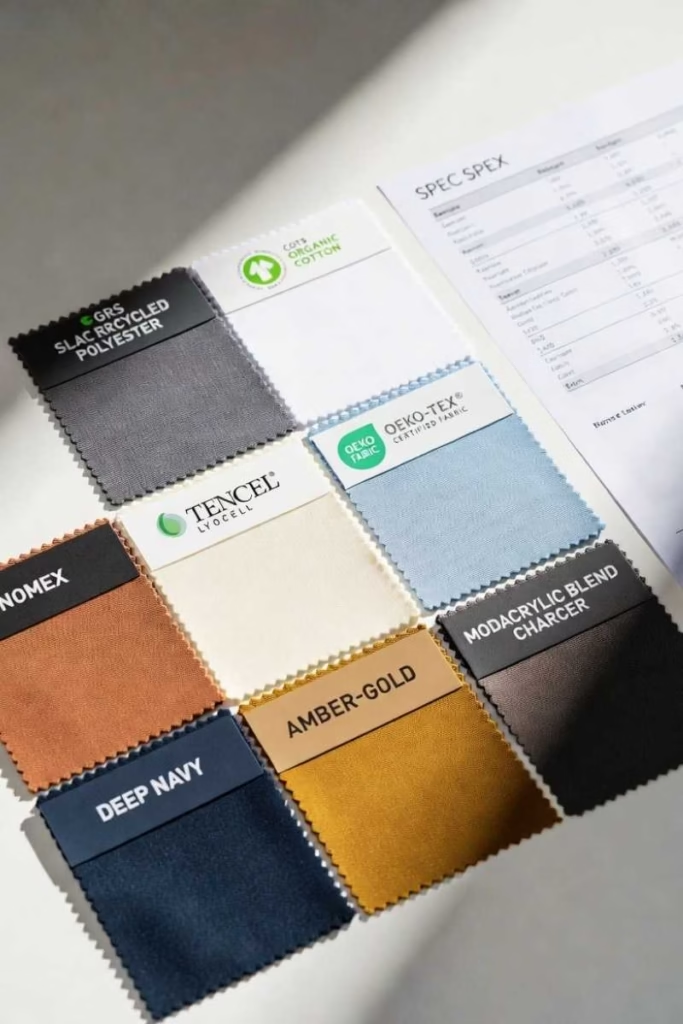
Recycled Polyester (GRS-Certified)
Source: Post-consumer PET waste (plastic bottles, textile offcuts)
Certification: GRS chain-of-custody
Performance: Equal to virgin polyester on tensile strength, colourfastness (ISO 105-C06), and wash durability
Applications: Hi-vis outer shells, 5-in-1 jackets, corporate workwear programs, softshell jackets, cargo trousers
Price premium at volume: 5-12% over standard polyester per metre at 5,000m+
Recycled polyester is the most commercially accessible sustainable fabric option for B2B workwear programs at standard MOQ levels. It allows buyers to provide verified recycled content claims without a significant cost impact on the total program.
Organic Cotton (GOTS-Certified)
Source: Non-GMO cotton grown without synthetic pesticides or fertilisers
Certification: GOTS, minimum 70% organic content
Performance: Equivalent breathability and comfort to conventional cotton; slightly lower colour yield in some dyeing processes
Applications: Polo shirts, t-shirts, summer-weight coveralls, hospitality and healthcare uniforms
Price premium at volume: 15-25% over conventional cotton per metre
Organic cotton is the appropriate sustainable material choice for programs where the end client’s sustainability policy specifically requires organic fibre certification.
Recycled Nylon (ECONYL)
Source: Recovered fishing nets, industrial nylon waste
Certification: GRS, ECONYL brand certification
Performance: Equivalent to virgin nylon on abrasion resistance, tensile strength, and UV stability
Applications: Heavy-duty workwear, protective gear, outdoor performance garments
Price premium at volume: 20-35% over standard nylon per metre
ECONYL is a premium option suited to programs targeting high-value sustainable positioning in sectors with strong sustainability mandates.
Blended Performance Fabrics (Recycled Polyester + Stretch)
Construction examples: 88% GRS recycled polyester / 12% elastane; 75% recycled polyester / 21% nylon / 4% T400
Applications: Active industrial workwear, stretch coveralls, ergonomic-fit uniforms for sectors requiring freedom of movement
Certifications: GRS for the polyester content; OEKO-TEX Standard 100 on the finished fabric
These blended constructions maintain certified recycled content claims while delivering the stretch and recovery performance industrial workwear programs require. [Internal Link: Manufacturing Capabilities page]
Total Cost of Ownership: The Procurement Calculation That Changes the Conversation
The objection procurement teams raise most consistently when evaluating sustainable workwear programs is per-unit cost. The comparison that matters commercially is not cost per garment but total program cost across a 3-year supply cycle.
Recycled Polyester vs. Standard Polyester: Program Cost Comparison
| Factor | Standard Polyester | GRS Recycled Polyester |
|---|---|---|
| Per-metre price (5,000m+) | Baseline | +5-12% |
| Average garment lifespan (heavy industrial use) | 18 months | 22-26 months |
| Replacement cycles over 3 years | 2 orders | 1-2 orders |
| CSDDD documentation included | No | Yes |
| Client sustainability reporting support | No | Yes |
| Tender qualification (GCC/EU) | Limited | Full |
When replacement frequency, re-sourcing logistics, and the value of compliance documentation are included in the calculation, the total 3-year program cost difference between standard and GRS-certified recycled polyester narrows materially, and frequently reverses.
Inherent FR vs. Treated FR: The Oil and Gas Calculation
For FR workwear programs in the oil and gas sector, the same logic applies with sharper numbers. A Nomex/Kevlar blend coverall (93/5/2) certified to EN ISO 11612 and EN 1149-5 carries a higher unit cost than a treated FR cotton alternative. Over a 3-year supply program in a continuous high-use environment:
- Treated FR cotton: typically loses certification-level flame protection after 50 industrial wash cycles, requiring replacement at 12-18 month intervals
- Inherent FR (Nomex/Kevlar): maintains protection permanently regardless of wash cycles; no re-testing or replacement required for protection compliance
For buyers supplying into the GCC oil and gas sector, where site specifications frequently require inherent FR as a minimum, the calculation is settled at the specification stage.
How to Identify Greenwashing from a Bangladesh Workwear Supplier
Greenwashing is a genuine sourcing risk. A supplier can reference GRS or GOTS without holding a current, valid certificate that covers the specific garment in your order. Here is a four-step verification process.
Step 1: GRS
Request the transaction certificate, not only the scope certificate. The scope certificate covers the facility. The transaction certificate covers the specific material batch in your order. Both must be valid and current at the time of bulk production, not at the time of sampling.
Step 2: GOTS
Request the certificate number and verify it at global-standard.org. Search by company name or certificate number. If the name does not appear, the facility is not currently GOTS certified.
Step 3: OEKO-TEX
Request the certificate number and test report reference. Verify at oeko-tex.com using the certificate number. Confirm the product class is appropriate for the garment category (Product Class II for clothing with direct skin contact for adults).
Step 4: RSC
Request the factory’s RSC portal reference. Factory inspection status, outstanding remediation items, and compliance history are publicly accessible. Cross-check what the supplier tells you against the public record.
Bengal Apparel BD provides all certification documentation with full verification references as a standard pre-order deliverable. Buyers can check every certificate we provide against the issuing body’s public database before committing to bulk production.
Bangladesh's Certified Manufacturing Infrastructure
Bangladesh is the world’s second-largest garment exporter and holds more LEED-certified green factories than any other country, providing the physical infrastructure behind sustainability claims in this supply chain.
Key documented metrics:
- The RSC has conducted over 56,000 factory inspections and remediated more than 140,000 safety hazards across the Bangladesh garment sector, building a publicly verifiable compliance record.
- BGMEA’s Sustainability Vision 2030 targets 30% greenhouse gas reduction, 50% sustainable material sourcing, and 20% renewable energy share across the sector.
- Leading facilities have achieved measurable resource reduction: 40% water use reduction through zero-discharge dyeing processes, and 25 million litres annual water conservation through biological treatment systems at documented facilities.
For buyers whose sustainability reporting requires Scope 3 emissions data and water consumption figures from their supply chain, this level of facility-level documentation is available through Bengal Apparel BD’s partner manufacturing facilities.
Our production range for sustainable workwear programs includes industrial workwear, FR and multinorm protective garments, hi-visibility workwear, healthcare and hospitality uniforms, and outdoor performance clothing, all available with GRS, GOTS, or OEKO-TEX certified materials as required.
How to Start a Sustainable Workwear Program with Bengal Apparel BD
The process for starting a certified sustainable workwear program follows the same structure as any production inquiry, with additional documentation steps built in at each stage.
What to send us to begin:
- Your garment specification or tech pack
- Target certifications required (GRS, GOTS, OEKO-TEX, or a combination)
- Destination market (EU, GCC, North America, Australia)
- Required volume and target FOB price range
What we provide in response:
- Certified fabric options available within your specification and price range
- Partner facility recommendation based on garment type and certification combination
- Indicative FOB Chittagong quote with itemised sustainability certification costs
- Full documentation list covering every certificate included in the program
Commercial terms:
| Parameter | Detail |
|---|---|
| MOQ | 3,000 pieces per style |
| Lead time | 75 days from sample approval |
| Incoterms | FOB Chittagong |
| Sample availability | GRS recycled polyester and organic cotton swatches available on request |
| Documentation package | Fabric mill cert, transaction cert, OEKO-TEX test cert, RSC monitoring report, supplier compliance declaration |
Frequently Asked Questions
Do you provide GRS transaction certificates with every shipment?
Yes. For any order using GRS-certified fabric, we provide both the fabric mill’s scope certificate and the transaction certificate covering the specific batch used in your order. Transaction certificates are issued per shipment.
Can you combine sustainable material certifications with EN ISO 11612, EN ISO 20471, or other safety standards in a single garment?
Yes. We supply multi-norm protective garments combining EN ISO 11612 FR, EN 1149-5 anti-static, and EN ISO 20471 hi-vis certifications with GRS or OEKO-TEX material certification. This combination is required on an increasing number of GCC and European industrial tenders.
How do you support CSDDD compliance documentation for European buyers?
Our standard export documentation package for European buyers includes RSC factory monitoring reports, fabric mill scope and transaction certificates, OEKO-TEX test certificates, and a supplier declaration of compliance referencing CSDDD Articles 7 and 8. We can adapt the package to your organisation’s specific reporting format.
Is there a significant cost difference between GRS recycled polyester and standard polyester at your MOQ?
At 3,000 pieces per style, the GRS recycled polyester premium is typically in the 5-12% range per metre. At 5,000 metres of fabric and above, the premium compresses. We provide itemised costing so you can assess the per-garment impact before committing.
Bengal Apparel BD | Dhaka, Bangladesh | Phone: +88 01706561468| Email: hello@bengalapparel-bd.com