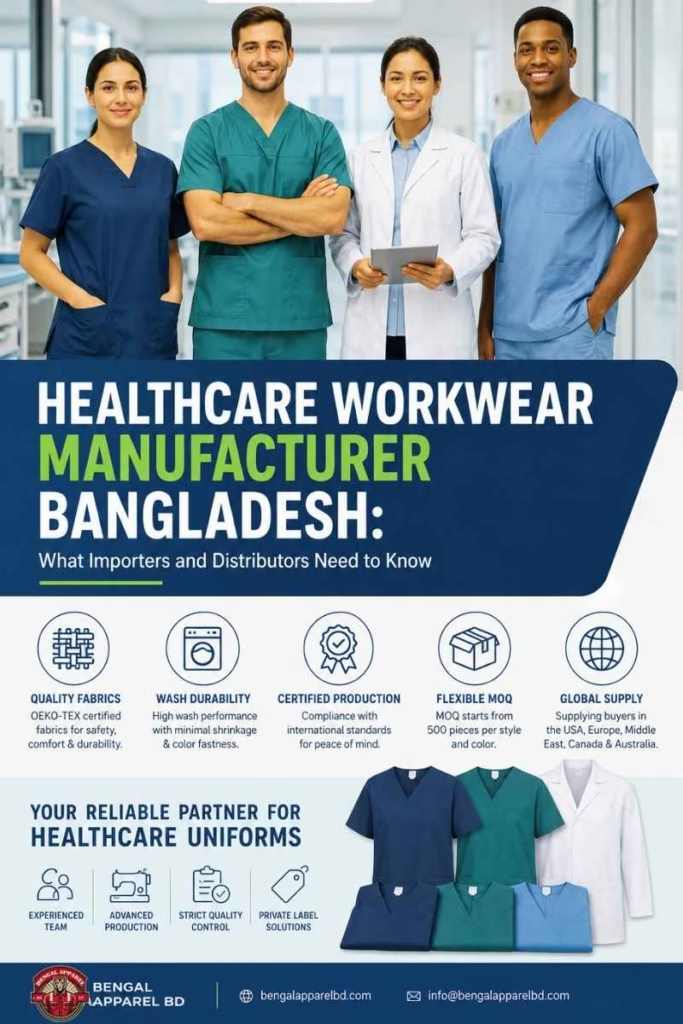
Sourcing healthcare workwear from Bangladesh is not a new idea. Hospitals, private clinic networks, pharmacy chains, and medical uniform distributors across Europe, North America, the Middle East, and Australia have been doing it for years. What has changed is the level of sophistication buyers expect from their manufacturing partner.
This post covers what healthcare workwear buyers at the importer and distributor level need to evaluate before placing production: fabric requirements, wash performance standards, certification, MOQ, and what a Bangladesh-based healthcare uniform manufacturer can realistically deliver. If you are an end consumer looking for a brand to buy from, this is not the right article. If you are sourcing or private-labeling healthcare uniforms at volume, read on.
Why Bangladesh Works for Healthcare Workwear Sourcing
Bangladesh’s dominance in garment production is well established for fashion and basic workwear. What is less often discussed is how well the country’s manufacturing infrastructure suits healthcare uniform production specifically.
Healthcare workwear is not technically complex in the way that certified FR or hi-vis workwear is. There are no mandatory EN or ANSI certifications for scrubs and lab coats in most markets. What buyers require instead is consistent fabric quality, reliable color matching, wash durability, and the ability to produce private-label programs at competitive unit cost across repeatable order cycles. These are exactly the capabilities Bangladesh’s established garment factories have built over decades.
For importers sourcing healthcare workwear for hospitals, care home networks, or pharmacy chains, Bangladesh delivers volume, consistency, and margin that other origins cannot match at equivalent quality. For distributors building private-label medical uniform programs, Bangladesh provides the full infrastructure: custom grading, woven label production, branded packaging, and documentation for target market compliance.
Bengal Apparel BD manufactures healthcare workwear for buyers supplying the USA, Europe, the Middle East, Canada, and Australia. MOQ starts from 500 pieces per style and color.
What Healthcare Workwear Covers
Healthcare workwear is a broad category. For B2B buyers, it typically breaks down into four product types, each with distinct fabric and construction requirements.
Scrub Tops and Scrub Trousers
Scrubs are the most ordered category in healthcare workwear. They are worn by nurses, surgical teams, dental staff, veterinary practitioners, and care home workers across all markets. The standard construction is a short-sleeve top with chest or side pockets paired with pull-on trousers with an elastic or drawstring waistband.
For buyers, the key sourcing decisions on scrubs are fabric weight, fabric content, and fit configuration. A 180 to 200 gsm polycotton blend is the most common specification for buyers supplying general clinical environments. Buyers supplying environments with higher laundry demands, such as NHS trusts or large private hospital networks, often specify 100% cotton at 190 to 220 gsm for better wash durability. Stretch polyester and microfibre fabrics are popular with buyers supplying markets where staff preference leans toward lightweight, quick-drying performance.
Fit configuration matters more in healthcare than in many other uniform categories because garments are worn for 10 to 12 hour shifts. Gender-specific cuts and stretch options reduce physical fatigue and improve acceptance with end users. Our healthcare uniforms product page shows the full range of scrub styles available, including unisex, women’s, and men’s cuts across multiple fabric options.
Lab Coats
Lab coats are used by pharmacists, laboratory technicians, dental professionals, and clinical staff in settings where a visible outer layer is required. The standard specification is a knee-length or short white coat in 100% cotton or polycotton, with button or snap closure and functional pockets for instruments.
For buyers sourcing at volume, the critical requirements on lab coats are colorfastness (white and light colors show any wash degradation quickly), shrinkage control across repeated high-temperature cycles, and consistent construction quality so that logos and embroidery sit correctly across the full size range.
Medical Tunics and Specialist Tops
Medical tunics, dentist tops, and ambulance uniform tops serve professional healthcare roles where standard scrubs are not appropriate. These garments often carry specific design requirements around pocket placement, closure type, and collar construction. For buyers supplying specialist healthcare sectors, this category typically requires custom pattern development against buyer specifications rather than stock styles.
Isolation and Surgical Gowns
Isolation gowns and surgical gowns are a separate production category to reusable healthcare workwear. They typically require fluid-barrier performance testing and, in the case of surgical gowns for EU markets, compliance with EN 13795. Buyers sourcing certified surgical gowns should discuss fabric certification requirements before sampling. Our compliance and certifications page covers the certification standards applicable to protective healthcare garments.
Fabric Requirements for Healthcare Workwear
The fabric specification in healthcare workwear is where most sourcing decisions are made or lost. Buyers who specify the wrong fabric for their target market’s laundry conditions end up with garments that fail prematurely, generate complaints, and erode the buyer-supplier relationship.
OEKO-TEX Certification
For healthcare workwear, fabric safety is non-negotiable. Garments are worn against skin for extended periods. All fabrics used in Bengal Apparel BD’s healthcare production are sourced from OEKO-TEX Standard 100 certified mills. OEKO-TEX Standard 100 tests for over 100 harmful substances including formaldehyde, pesticides, and heavy metals. For buyers supplying healthcare facilities with procurement policies covering chemical safety, OEKO-TEX certification from the fabric mill is the standard documentation required.
Wash Performance
Healthcare uniforms are laundered at temperatures between 60 and 90 degrees Celsius, often in commercial laundry programs. Fabric that has not been tested for performance at these temperatures will shrink, fade, or lose dimensional stability quickly. Buyers should request wash test data from their manufacturer showing colorfastness, shrinkage percentage, and appearance after a defined number of wash cycles at the target temperature.
Fabric Options by Application
The right fabric depends on the end-use environment and the buyer’s priorities.
100% cotton suits buyers who prioritize breathability and high-temperature wash durability. It is the preferred specification for NHS supply and similar public healthcare procurement. It wrinkles more easily than synthetic options but maintains wash performance well.
Polycotton blend (65/35 or 50/50) is the most widely specified fabric across general healthcare uniform programs. It combines cotton’s comfort with polyester’s reduced shrinkage and easier care. It performs well at 60-degree wash cycles and holds color reliably across volume production.
Stretch polyester is specified by buyers supplying markets where staff preference favors lightweight, flexible, quick-drying garments. It performs well for dental and veterinary uniform programs where ease of movement matters and laundry temperatures are typically lower.
Microfibre polycotton gives a smooth, fluid-resistant surface finish and is popular in markets where a more professional aesthetic is required alongside easy care.
Recycled polyester is increasingly specified by buyers with sustainability reporting requirements. The fabric performs comparably to virgin polyester and is available with GRS (Global Recycled Standard) certification from our mills.
What B2B Buyers Should Require from Their Healthcare Workwear Manufacturer
For importers and distributors building or managing a healthcare workwear program, the manufacturer relationship involves more than product quality. The following requirements define a capable manufacturing partner.
Consistent Color Matching Across Runs
Healthcare facilities often specify exact colors, and repeat orders must match previous deliveries precisely. A manufacturer without a documented color management process will produce variation between runs that creates visible differences across a facility’s uniform program. We use Pantone color matching for all custom colors and maintain production records to ensure consistency across repeat orders.
Private Label Capability
Most buyers supplying healthcare uniforms to institutions or building their own brand require private label production: woven labels, printed labels, custom branded packaging, and accurate label content including washing instructions, fiber content, and country of origin. This is standard in our production program.
Grading and Size Range
Healthcare workwear buyers supplying large facility programs often need a full size range from XS to 4XL or beyond. Consistent grading across the range is essential for institutional procurement. Inconsistent sizing across runs generates returns and complaints. We maintain graded pattern sets for all standard styles and match sizing to buyer specifications on custom styles.
Documentation and Compliance Support
For buyers in the EU or other regulated markets, OEKO-TEX fabric certification, factory audit reports (BSCI, SEDEX, WRAP), and accurate product labeling documentation are often required for procurement approval. We prepare documentation packages as part of the standard supply process. Our manufacturing capabilities page outlines what is available.
Healthcare Workwear and Sustainable Sourcing
Sustainability requirements are becoming part of healthcare procurement criteria, particularly for buyers supplying public healthcare systems in Europe and the UK. The areas that most commonly come up are fabric chemical safety, factory labor standards, and the availability of recycled or lower-impact fabric options.
On fabric chemical safety, OEKO-TEX Standard 100 covers this fully for garments worn against skin. On factory labor standards, our partner factories maintain BSCI and SEDEX audit status, which covers the labor and social compliance criteria most European procurement frameworks require. For recycled fabric options, we offer GRS-certified recycled polyester across our scrub range for buyers who need it.
For a broader look at sustainable sourcing considerations in workwear procurement, the B2B Guide to OEKO-TEX Certified Workwear Fabrics and Sustainable Sourcing covers the key standards and what they mean in practice for B2B buyers.
The Sourcing Process for Healthcare Workwear from Bangladesh
For buyers placing their first order with a Bangladesh-based healthcare workwear manufacturer, the process follows a defined sequence.
Inquiry and specification review. Share your product specification, target styles, color requirements, and volume. We respond within one business day with a pricing indication and confirmation of whether your specification is within our standard production scope or requires custom development.
Sample development. A pre-production sample is produced to your specification. This covers fabric approval, construction, fit, and branding. For buyers moving from an existing supplier, we match your current garment as the reference sample where required. Our workwear sample approval checklist gives buyers a structured framework for reviewing samples before approving bulk production.
Bulk production and quality control. Production follows a three-stage quality process: pre-production fabric and trim inspection, in-line production checks, and final inspection against the approved sample. Third-party inspection can be arranged at this stage.
Documentation and shipment. The full documentation package including fabric certification records, factory audit certificates, and labeling documentation is prepared alongside the shipment. Our ordering process page describes the complete sequence from order confirmation to delivery.
Lead times for healthcare workwear from Bangladesh are typically eight to twelve weeks from order confirmation, depending on fabric sourcing requirements and order volume.
MOQ for Healthcare Uniforms
MOQ at Bengal Apparel BD starts from 1,000 sets per style and color. For buyers ordering multiple styles across a program, for example a scrub top and matching trousers in three colors, we can discuss combining styles to reach the minimum across the order rather than applying it strictly per SKU. Contact us with your program details and we will confirm what is workable within your volume.
For context on how MOQ works across our product range, see our MOQ page.
Summary
Healthcare workwear sourcing from Bangladesh is a well-established route for importers, distributors, and private-label brands. The capability is there for fabric quality, wash performance, color consistency, private label, and the documentation that institutional buyers require. What separates a capable healthcare workwear manufacturer Bangladesh from a general garment factory is the understanding of what healthcare buyers actually need: OEKO-TEX certified fabric, wash-tested performance, consistent grading, and a production process designed for repeat program management rather than one-off orders.
If you are sourcing healthcare workwear and want to confirm that your specification is within our production scope, contact our team directly. We will review your requirement and respond with pricing and production details within one business day.
Related reading:
- Healthcare Uniforms: Product Range and Specifications
- Key Factors in Choosing Healthcare Uniforms
- How to Source Workwear from Bangladesh
- OEKO-TEX Certified Workwear Fabrics: B2B Guide
- Workwear Sample Approval Checklist
- Manufacturing Capabilities
- MOQ Information
- Compliance and Certifications
Lorem ipsum dolor sit amet, consectetur adipiscing elit. Ut elit tellus, luctus nec ullamcorper mattis, pulvinar dapibus leo.