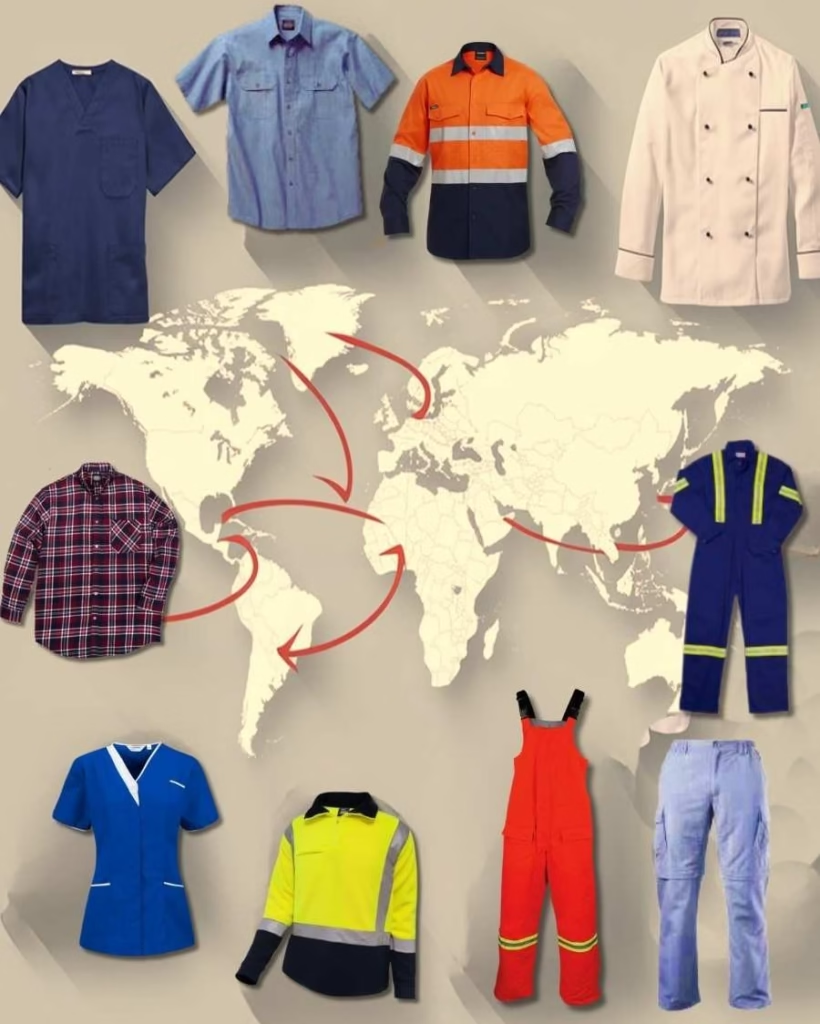
Workwear durability and affordability are not competing priorities. For importers, distributors, and procurement managers placing volume orders, the two are directly linked. A garment that fails early costs more over time than one that costs more upfront and lasts three times as long. The challenge is knowing where to spend, where to save, and how to verify that your supplier is actually delivering what they quoted.
This guide breaks down the key decisions that determine durability and cost in workwear production, and what each decision means for your total cost of ownership.
Why Workwear Durability and Affordability Must Be Evaluated Together
Most buyers approach workwear procurement by comparing unit prices. That is a reasonable starting point, but unit price alone does not tell you what the garment will cost over its working life.
A coverall priced at USD 18 that needs replacing every four months costs more annually than one priced at USD 26 that holds up for twelve months. When you multiply that difference across 500 workers, the procurement decision becomes a significant budget item.
Workwear durability and affordability, evaluated together, requires looking at three things: fabric specification, construction quality, and the compliance requirements of the end market. Getting any one of these wrong shifts the cost equation in the wrong direction.
If you are new to sourcing from Bangladesh, our guide on how to source workwear from Bangladesh covers supplier selection, compliance verification, and the full ordering process from inquiry to shipment.
Fabric Specification: Where Most of the Cost Decision Happens
The fabric accounts for the largest share of a garment’s unit cost and its durability. Choosing the right fabric for the end use is the single most impactful decision in the procurement process.
Cotton and cotton blends remain the most common choice for general industrial workwear. Pure cotton is comfortable and breathable but wears faster in high-abrasion environments and loses shape more quickly through repeated washing. A 65/35 polyester-cotton blend costs marginally more but holds its structure significantly longer, retains color better, and resists pilling. For most standard industrial workwear applications, a polyester-cotton blend at 240 to 280 GSM is the practical sweet spot between durability and cost.
For protective workwear, fabric selection is a compliance issue before it is a cost issue. FR garments certified to EN ISO 11612 require inherently flame-resistant fibres or treated fabric that maintains its FR properties through the garment’s full wash cycle. Treated FR fabric is cheaper upfront but degrades with washing. Inherent FR fabric costs more but retains its protective properties throughout the garment’s life, which matters for both end-user safety and your certification liability.
Our flame-resistant workwear and multi-norm workwear pages cover the fabric and certification requirements for protective applications in detail.
For hi-vis garments, the retroreflective tape specification is as important as the background fabric. Tape that meets EN ISO 20471 Class 2 or Class 3 requirements has a defined minimum retroreflectivity and wash durability. Cheaper tape fails the wash test faster, which means the garment goes out of compliance before the fabric wears out. Specifying the tape grade in your purchase order, not just the garment standard, protects you from this outcome.
Construction Quality: The Difference Between a Sample and a Bulk Order
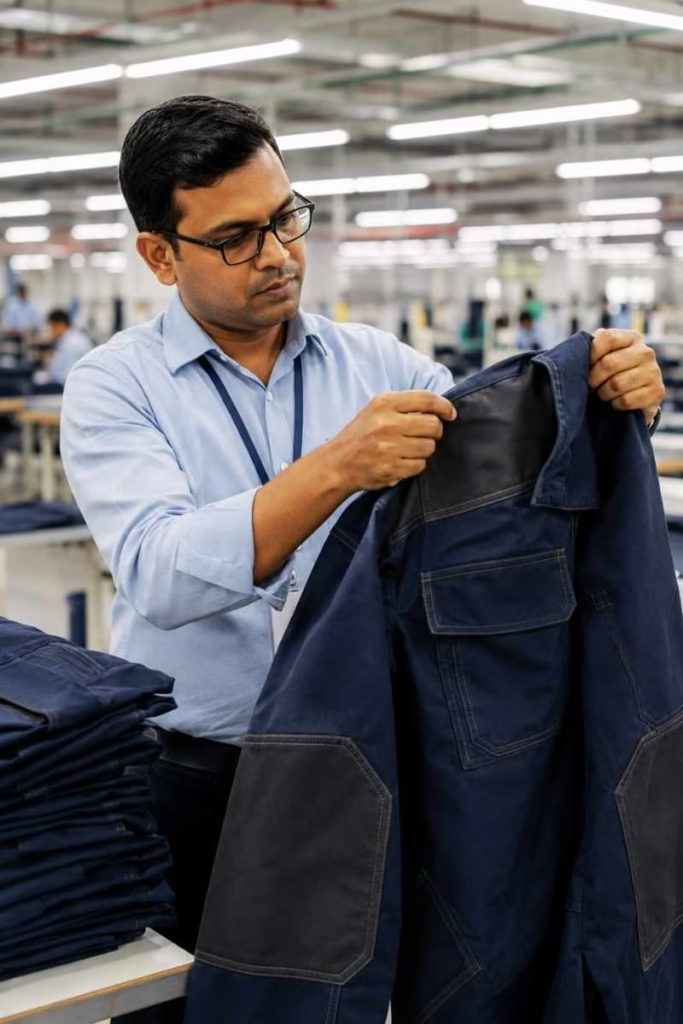
A garment can be made from the right fabric and still fail quickly if the construction is poor. The areas to check are seam type, thread quality, stress point reinforcement, and hardware.
Seam type determines how well the garment holds together under repeated stress and washing. Flatlock seams are more durable than plain seams for areas under frequent movement. For coveralls and garments worn in physically demanding environments, double-needle stitching at stress points such as crotch seams, pocket corners, and back yokes significantly extends garment life.
Thread quality is rarely specified in purchase orders but has a direct impact on seam integrity. Spun polyester thread degrades faster than core-spun thread, particularly in garments that are washed frequently at high temperatures. For FR garments, the thread must also be FR-rated. A garment certified to EN ISO 11612 sewn with standard polyester thread is not compliant.
Hardware including zippers, press studs, and hook-and-bar fastenings is another area where cost-cutting creates problems. YKK and equivalent branded zippers cost more than generic alternatives but fail far less often. For garments with high zipper use such as oil and gas FR coveralls, specifying zipper brand in the tech pack is a practical step that avoids replacement costs later.
Before approving bulk production, a thorough pre-production sample inspection that covers all of the above is essential. Our workwear sample approval checklist gives you a structured framework for what to examine before committing to a bulk run.
The Lifecycle Cost Approach: How to Calculate the Real Price
The lifecycle cost of a workwear garment is the total cost of ownership divided by the number of months it remains fit for purpose. This calculation is more useful than unit price for procurement decisions involving volume orders.
A simple way to apply it:
Total lifecycle cost = (unit price + annual maintenance cost) divided by garment lifespan in months
If Garment A costs USD 20, requires no repairs, and lasts 10 months, the monthly cost is USD 2.00. If Garment B costs USD 28, requires no repairs, and lasts 18 months, the monthly cost is USD 1.56.
Garment B is 28% more expensive to buy but 22% cheaper to own. Across a fleet of 300 workers, that difference compounds significantly over a two-year procurement cycle.
This framework changes the conversation with internal stakeholders who focus on purchase price. It also changes the conversation with suppliers, because you are now specifying durability outcomes, not just product specifications.
Where Bangladesh Sourcing Fits the Durability-Affordability Equation
Bangladesh is the second-largest garment exporter globally, and its certified workwear sector produces to the same European and North American standards as suppliers in higher-cost countries. The cost advantage comes from labor and infrastructure, not from lower material or compliance standards.
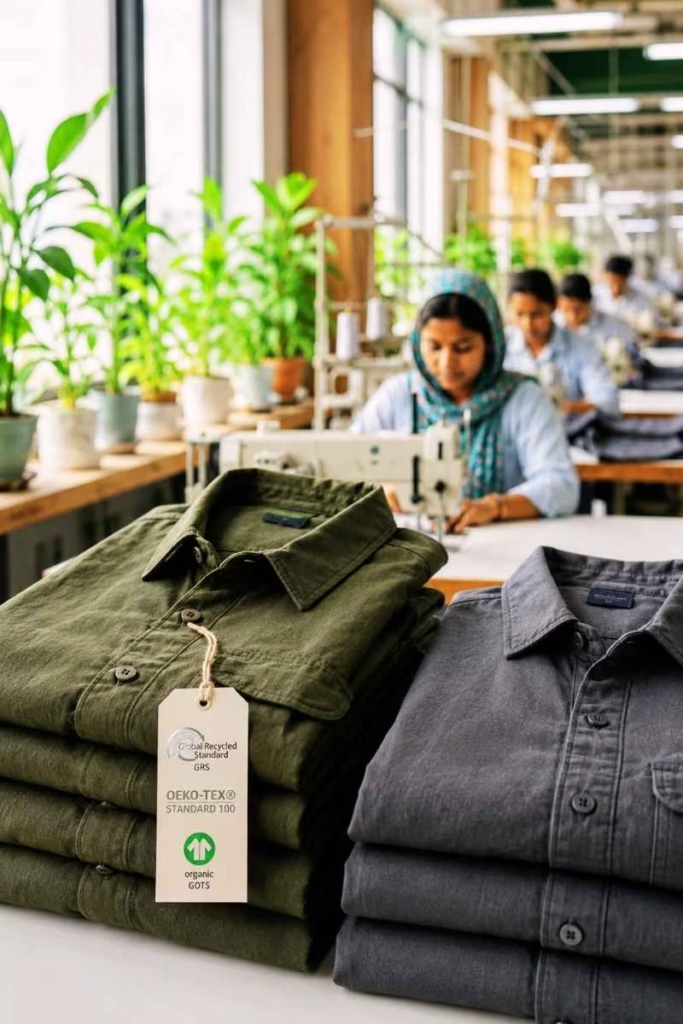
For buyers sourcing OEKO-TEX certified workwear fabrics, certified partner factories in Bangladesh use the same approved fabric mills as factories in Europe. The OEKO-TEX Standard 100, maintained by the OEKO-TEX Association, certifies at the fabric level regardless of where the garment is assembled.
The savings available through Bangladesh sourcing are most meaningful when you are ordering at volume and specifying correctly. A poorly specified order produced cheaply creates the replacement costs that eliminate the sourcing advantage. A well-specified order produced by a certified factory at Bangladesh pricing delivers both workwear durability and affordability across the full procurement cycle.
Our manufacturing capabilities page outlines the production standards and certifications held by our partner factories, including the compliance documentation available for EU and US market entry.
Practical Questions to Ask Your Supplier
When evaluating a supplier on workwear durability and affordability, these questions move the conversation beyond price comparison:
On fabric: What is the GSM and fiber composition of the fabric you are quoting? Can you provide the fabric mill’s test reports for tensile strength, tear resistance, and wash durability?
On FR garments: Is the FR protection inherent or treated? What is the rated wash cycle count before the fabric falls below standard?
On construction: What seam type do you use at stress points? What thread specification do you use for FR and hi-vis garments?
On compliance: Can you provide the EN test reports for the specific garment standard I am sourcing to, not just the factory certification?
On re-orders: Can you guarantee the same fabric batch specification on repeat orders placed six or twelve months later?
A supplier who answers these questions with specifics is a supplier who controls their production process. One who deflects to general capability statements is a risk.
Summary
Workwear durability and affordability is a procurement outcome, not a product category. It is achieved through the right fabric specification for the end use, construction quality that holds up through the garment’s working life, and a supplier relationship that maintains those standards from the first sample to the tenth re-order.
The buyers who get this right evaluate total cost of ownership rather than unit price, specify construction details in the tech pack rather than leaving them to the factory’s discretion, and verify compliance at the garment level rather than relying on factory certificates alone.
If you want to discuss your current workwear specification and whether it is optimized for durability and cost, contact our team directly. We will review your requirement and provide a clear assessment of what is achievable within your target price range.