Police uniforms in Europe carry more weight than most garments. They signal authority to the public, protect officers across unpredictable operational conditions, and must hold up through long shifts, rapid movement, and industrial laundering cycles. Getting the specification wrong is not simply a quality issue. It can affect officer safety, departmental compliance, and the outcome of a public procurement tender.
Demand for modern, performance-driven European police uniforms is growing. Fleet renewals across forces in Germany, France, the Netherlands, and Scandinavia are driving volume, and procurement teams are under pressure to source garments that meet increasingly detailed technical requirements at competitive prices. This has opened the door to specialist manufacturers outside Europe, particularly in Bangladesh, where technical workwear production capabilities have advanced significantly.
This guide covers what makes EU police uniforms technically distinct, the fabric and standards requirements buyers must meet, and what to look for when selecting an EU police uniform manufacturer as a sourcing partner.
What Makes EU Police Uniforms Different from Standard Workwear
EU police uniforms are not general industrial garments with a logo applied. They are performance garments with specific safety, visibility, durability, and appearance requirements that are defined partly by regulation, partly by departmental specification, and partly by the operational environments officers work in.
Officer Safety Requirements
The safety layer of a European police uniform specification covers three main areas.
Flame resistance is required for officers who may be exposed to vehicle fires, Molotov cocktail attacks, or other urban fire hazards. In these programs, fabrics meeting EN ISO 11612 are specified for outer layers. For a full breakdown of EN ISO 11612 performance codes and what each one tests, see our FR coverall supplier page. The level of protection required depends on the specific threat assessment, with A1 and A2 limited flame spread being the baseline for most patrol applications.
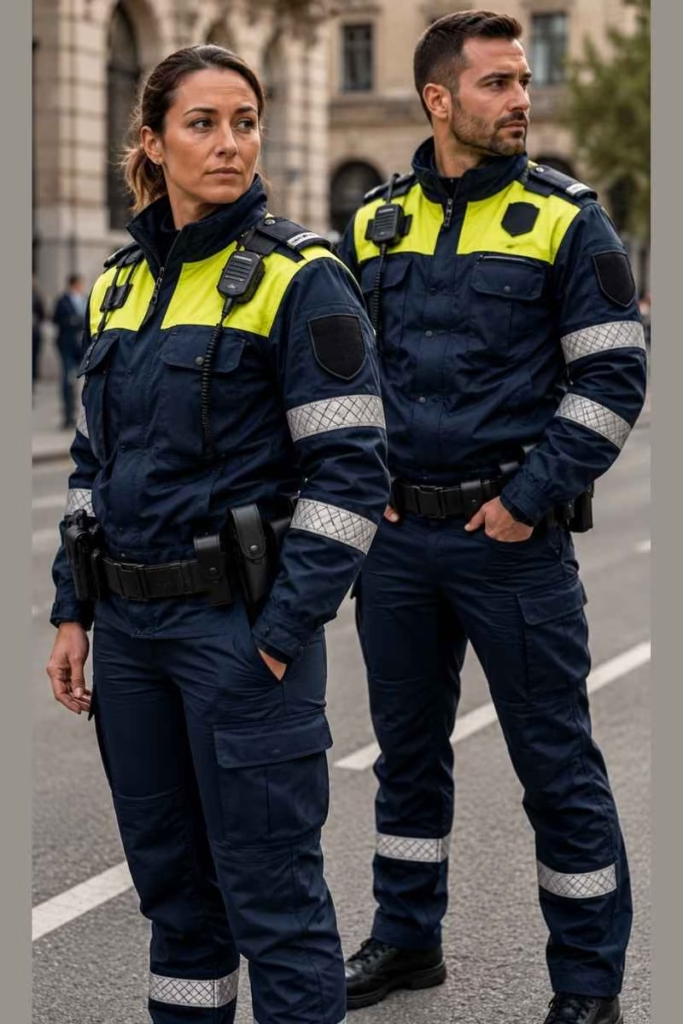
High visibility ensures officers are seen in low-light conditions and during road operations. EN ISO 20471 Class 2 is the standard minimum for most road-adjacent duties. Some forces specify Class 3 for motorway and high-speed road operations. Hi-vis integration must not compromise the professional appearance of the uniform, which is why segmented reflective tape and carefully placed fluorescent panels are specified rather than the full hi-vis vest approach used in construction.
Weather protection is a practical requirement across Northern and Central European climates. Water-repellent coatings, windproof outer shells, and insulated lining options are part of most complete EU police uniform programs. The garment must keep officers functional and comfortable through a full shift in rain, cold, or wind without restricting movement or communication equipment access.
Professional Appearance Standards
European police forces maintain strict appearance standards because uniform consistency directly affects public perception of authority and institutional trust. This means precise colour matching across large orders, consistent embroidery quality for insignia and rank markings, and construction that holds its shape and appearance across repeated washing cycles.
Departmental branding includes force patches, shoulder insignia, rank indicators, and national flag markings. Each of these is either embroidered or applied via heat-sealed badge, and placement is specified to the centimetre in many procurement tenders. An EU police uniform manufacturer must be capable of executing these consistently across runs of thousands of garments.
Comfort for Operational Shift Lengths
Officers on patrol, response, or duty shifts commonly work eight to twelve hours at a stretch. Fabric breathability, ergonomic fit, and moisture management are not secondary features. They directly affect officer performance and fatigue levels over a full shift.
Moisture-wicking polyester blends are widely used in base layers and patrol shirts. Articulated knee and elbow construction allows full range of movement without binding during physical tasks. Fabric weight is balanced against breathability requirements, with lighter constructions used in summer patrol programs and heavier insulated or softshell constructions used in winter programs.
Common Types of European Police Uniforms
Patrol Uniforms
Patrol uniforms are the daily operational wear for most officers. They typically consist of a duty shirt, reinforced trousers, and an outer jacket or gilet. Fabrics are durable twill constructions, most commonly 65/35 poly-cotton or poly-cotton ripstop, in force-specific colours. Construction includes reinforced stress points at the knees, seat, and elbows, along with multiple functional pockets for equipment access.
Tactical Police Uniforms
Tactical police uniforms are built for intervention units, counter-terrorism response teams, and specialist operations. Reinforced fabrics, modular pocket systems, and stretch panels for full mobility are standard. Ripstop nylon or poly-cotton-spandex blends are common fabric choices. These garments are specified with heavier reinforcement, higher abrasion resistance, and compatibility with load-bearing equipment and ballistic vests. For programs requiring both tactical protection and certified coverall construction, see our coverall manufacturer Bangladesh page. Tactical police uniforms are a distinct product category from standard patrol wear and require a manufacturer with genuine experience in technical garment construction.
High-Visibility Police Apparel
Traffic officers, road policing units, and scene management teams require EN ISO 20471 certified hi-vis outer garments. These integrate fluorescent background panels and retro-reflective tape while maintaining the professional appearance standards of the force. For a detailed breakdown of EN ISO 20471 class requirements and fabric specifications for hi-vis programs, see our high-visibility workwear guide.
Cold Weather and Rain Protection
Softshell jackets, waterproof hardshell outer layers, and insulated body warmers form the cold-weather layer of most EU police uniform programs. Waterproof and breathable membrane constructions, equivalent to Gore-Tex performance standards, are specified for forces in Nordic, Alpine, and Atlantic climates. These outer layers must carry all insignia and branding requirements while maintaining full waterproof integrity through industrial laundering.
Fabric Requirements for EU Police Uniforms
Durability and Abrasion Resistance
Police uniforms face demanding physical use. Officers climb fences, restrain individuals, enter vehicles repeatedly, and operate in environments ranging from rough ground to urban concrete. Fabric must resist abrasion, tearing, and pilling across a service life of two to three years and 50 or more industrial wash cycles.
Heavy-duty woven fabrics in 65/35 poly-cotton at 240 to 300 GSM are the standard construction for patrol trousers and duty jackets. Ripstop construction, where a reinforcing grid of thicker yarn is woven into the base fabric at regular intervals, prevents small tears from propagating into full failures. Cordura nylon reinforcement panels at high-wear points including knees, elbows, and seat provide additional protection in tactical and patrol applications.
Stretch and Mobility
Modern EU police uniform specifications increasingly include mechanical stretch or stretch blend fabrics to support officer mobility during physical tasks. A 5 to 10% spandex or elastane component in patrol trousers allows full range of motion during pursuit, restraint, or access to elevated positions. Stretch panels at articulated joints in tactical jackets provide the same benefit in upper-body garments. Stretch fabrics must maintain their performance and dimensional stability across repeated industrial washing without loss of elasticity.
Moisture-Wicking and Breathability
Officers wearing patrol or tactical uniforms for extended shifts generate significant body heat. Moisture-wicking performance finishes draw sweat away from the skin and allow evaporation through the fabric surface, reducing the risk of chilling during rest periods and overheating during physical activity. Mesh ventilation panels under the arms or at the back yoke are included in many patrol jacket specifications for summer programs. Breathability is measured by moisture vapour transmission rate (MVTR), with a minimum of 5,000 g/m²/24h typically specified for functional patrol outerwear.
Sustainable Textile Options
EU public procurement increasingly includes sustainability criteria. Recycled polyester certified under the Global Recycled Standard is now available in many of the technical fabric constructions used for police uniforms, including ripstop and twill weaves. OEKO-TEX Standard 100 certification for chemical safety is a common procurement requirement across EU member states. For a full guide to sustainable sourcing options, see our sustainable workwear Bangladesh page. Manufacturers who can provide GRS and OEKO-TEX documentation alongside EN ISO performance certifications are better positioned for EU tender qualification.
Important European Standards for Police Uniforms
Compliance is a non-negotiable starting point for any EU police uniform manufacturer. Procurement tenders across EU member states reference specific standards, and garments that cannot provide test documentation from accredited Notified Bodies will not pass technical evaluation.
EN ISO 20471: High-Visibility Requirements
EN ISO 20471 classifies hi-vis garments by the area of fluorescent background material and retro-reflective tape. Class 2 is the standard minimum for most road-adjacent police duties, requiring at least 0.50 square metres of background material and 0.13 square metres of reflective tape. Class 3 is required for motorway and high-speed road operations. Tape width must be a minimum of 50mm, and 360-degree visibility from all angles is required through torso and limb encirclement.
EN ISO 13688: General Protective Clothing Requirements
EN ISO 13688 is the base standard that all protective clothing must meet before any hazard-specific certification applies. It covers ergonomics, material safety, sizing designation, and the labeling and care instructions that must accompany every certified garment. Compliance with EN ISO 13688 must be demonstrated alongside any hazard-specific certification in the garment’s technical file.
Flame Resistant and Antistatic Standards
For police programs where flame resistance is specified, EN ISO 11612 governs heat and flame protection. A1 and A2 limited flame spread are the most commonly required performance codes for patrol outer garments. EN 1149-5 anti-static properties are specified for programs where officers operate in environments with explosive atmosphere risk, including fuel depot security and hazmat response roles. For programs requiring simultaneous FR, anti-static, and hi-vis certification in a single garment, see our multi-norm workwear page.
OEKO-TEX and REACH Compliance
OEKO-TEX Standard 100 certifies that every component of the finished garment has been tested for harmful substances. REACH compliance confirms that no restricted chemical substances, including azo dyes and heavy metals, are present in the fabric or trims. Both are standard requirements for EU public procurement tenders and demonstrate the chemical safety of the garment for officer welfare.
Key Features Modern EU Police Uniforms Must Include
A technically complete EU police uniform specification in 2026 includes the following construction and functional features:
Reinforced knees and elbows using double-layer Cordura nylon or equivalent abrasion-resistant fabric at high-wear contact points. This directly extends garment service life in operational use.
Functional storage including cargo pockets with internal dividers, concealed security pockets, and dedicated slots for operational tools including cuffs, notebooks, and first aid items.
Body camera compatibility with reinforced mounting tabs or integrated clip anchors positioned at the chest. Body camera use is now standard across most EU forces and must be accommodated in the uniform design.
Radio loops and communication equipment access including dedicated loops for handset cables, antenna routing channels, and earpiece cord management. These features must be integrated into the garment construction without creating snag points or restricting movement.
Badge holders and rank insignia mounting at specified positions, constructed to hold epaulette loops, Velcro badge panels, or embroidered insignia depending on force specification.
Easy-care construction capable of surviving 50 or more industrial wash cycles at 60 degrees Celsius without significant colour fade, dimensional change, or loss of reflective tape adhesion.
Fabric weight under 300 GSM for patrol outer layers to minimise bulk while maintaining required durability and weather resistance.
Why European Buyers Source EU Police Uniforms from Bangladesh
Bangladesh has grown into one of the most capable sourcing destinations for technical and certified uniform programs. The combination of competitive manufacturing costs, advanced fabric development, third-party certified quality systems, and flexible OEM capability makes it a practical choice for EU police uniform procurement, particularly for large-volume programs where cost efficiency is a tender requirement.
Competitive Manufacturing Cost
Labor and overhead costs in Bangladesh are significantly lower than in EU production countries. For large police force fleet renewals involving tens of thousands of garments, sourcing from a Bangladesh-based EU police uniform manufacturer can reduce unit costs by 20 to 35% compared to European production without compromising technical specification or certification compliance. For government procurement teams operating within budget constraints, this difference is material.
Advanced Fabric Development
Local mills in Bangladesh now produce technical fabrics including FR ripstop, moisture-wicking poly-cotton blends, stretch twill, and softshell constructions suitable for police uniform programs. Specialist trims including IR-suppressing threads for tactical applications, EN ISO 20471 certified reflective tape, and FR hook-and-loop are available through established supply chains. This reduces reliance on imported European fabrics and shortens lead times.
Compliance and Quality Control
Partner factories working with certified EU police uniform manufacturers in Bangladesh operate under third-party quality assurance systems. AQL 2.5 final inspection is standard. SGS, Intertek, and Bureau Veritas are used for independent test and certification verification. Factory social compliance certifications including WRAP, BSCI, SEDEX, and RSC provide the supply chain due diligence documentation required for EU public procurement under CSDDD.
Flexible OEM and ODM Capability
Bangladesh manufacturers support full OEM production from buyer-provided technical packs, as well as ODM development where the manufacturer produces a technical specification based on the buyer’s brief. Custom force colours, embroidery, printed patches, woven labels, and packaging are all available. Sampling turnaround of two to four weeks from technical pack receipt allows EU procurement teams to evaluate garments before committing to bulk production. Scale ranges from pilot programs of 500 pieces per style to full fleet renewals of 50,000 units and above.
For a full overview of Bengal Apparel BD’s manufacturing capabilities and certified factory network, visit our industrial workwear page.
How to Choose the Right EU Police Uniform Manufacturer
For procurement teams evaluating EU police uniform manufacturers, this checklist covers the factors that separate capable specialist suppliers from general garment manufacturers with no technical workwear experience.
Experience with technical and protective workwear is the first filter. A manufacturer producing fashion garments or basic corporate uniforms does not have the construction expertise, fabric sourcing relationships, or quality systems required for police uniform programs. Ask for specific examples of police, security, or technical workwear programs supplied to EU buyers.
Knowledge of EU compliance requirements including EN ISO 20471, EN ISO 13688, EN ISO 11612, OEKO-TEX, and REACH. The manufacturer should be able to discuss these standards fluently and provide current certificates from accredited Notified Bodies, not just reference them by name.
Certified fabric sourcing capability covering both standard patrol fabrics and specialist constructions. Ask specifically which mills supply their FR, hi-vis, and stretch fabrics, and request mill-level certification documentation before committing to a sample program.
Rapid sampling support with a two to four week turnaround from technical pack receipt to first sample delivery. Police uniform tenders have evaluation timelines. A manufacturer who cannot deliver fit samples within this window will not support your procurement schedule.
Stringent QA systems including pre-production fabric inspection, in-line stitch and construction checks, and final AQL inspection with report documentation before shipment. For a full overview of how we manage this process, see our manufacturing capabilities page.
Export experience to EU markets including knowledge of EU customs documentation, CE marking requirements for protective clothing, and typical lead times of 45 to 60 days from sample approval to FOB shipment.
Conclusion
Performance-driven police uniforms are essential operational equipment for EU law enforcement agencies. Durability, weather resistance, high-visibility compliance, officer comfort across long shifts, and consistent professional appearance are not optional features. They are the baseline specification that any credible EU police uniform manufacturer must be able to deliver.
Bangladesh has established itself as a capable and cost-competitive source for certified European police uniforms, combining technical fabric development, EN ISO compliant production, and flexible OEM capability in a single manufacturing base. For procurement teams managing large-volume fleet renewals or seeking to qualify new suppliers for framework agreements, the case for Bangladesh as a sourcing destination is both technical and financial.
As a trusted workwear supplier from Bangladesh, Bengal Apparel BD supports global buyers with custom police uniforms, tactical apparel, and technical workwear manufacturing solutions from our certified factory network in Dhaka.
Frequently Asked Questions on EU Police Uniform Manufacturing
What standards must an EU police uniform meet?
The core standards for EU police uniforms are EN ISO 13688 for general protective clothing requirements, EN ISO 20471 for high-visibility garments, EN ISO 11612 for flame-resistant applications, and OEKO-TEX Standard 100 and REACH compliance for chemical safety. Specific requirements vary by force and by garment type.
What fabric is used for EU police patrol uniforms?
The most common fabric construction for EU police patrol trousers and duty jackets is 65/35 poly-cotton twill or ripstop at 240 to 300 GSM. Stretch variants incorporating 5 to 10% spandex or elastane are increasingly specified for mobility. Cordura nylon reinforcement panels are used at high-wear points including knees and elbows.
Can police uniforms be sourced from Bangladesh to EU standards?
Yes. Bangladesh-based manufacturers can produce EN ISO compliant police uniforms with full test documentation from accredited Notified Bodies. Partner factories hold WRAP, BSCI, SEDEX, and RSC certifications, providing the supply chain compliance documentation required for EU public procurement under CSDDD.
What is the typical lead time for a police uniform order from Bangladesh?
Standard lead time is 45 to 60 days from sample approval to FOB shipment. Sampling from technical pack receipt typically takes two to four weeks. Total timeline from initial inquiry to first shipment is approximately 90 to 100 days for a new program.
What is the MOQ for an EU police uniform program from Bangladesh?
MOQ from 500 pieces per style for pilot or evaluation programs. Large fleet renewal programs are handled from 5,000 pieces per style and above. Contact us with your volume and technical specification for a specific recommendation.
What customisation is available for EU police uniform programs?
Force-specific colours, embroidered insignia and rank markings, heat-sealed badge panels, woven labels, epaulette loops, radio loops, body camera mounting tabs, and custom packaging are all available. Full OEM production from buyer-provided technical packs is supported.